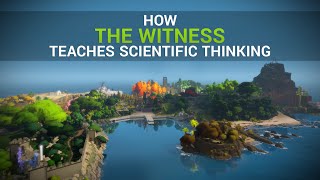
A short YouTube monologue (creator: LARRUZ) arguing that the puzzle game The Witness trains scientific thinking by forcing players to impose and revise constraints, learn concepts implicitly, and systematically eliminate solutions. The speaker walks through tutorial-level puzzles (noting mechanics like separate white/black regions, exits, and empty blocks), praises the game’s ‘teaches without teaching’ design, and compares its approach to Josh Waitzkin’s The Art of Learning (dogma insertion and exploitation). The piece is personal and evaluative, emphasizing how small changes to puzzles encourage rethinking and model scientific problem-solving.
Chapters
Dear fellow scholars, I'd like to draw your attention to the Witness, which is a computer game that helps you improve your scientific thinking and reasoning skills. It is a first person game and if you like solving puzzles, well, it has them in abundance. Before we start, I'd like to note for transparency that if you are worried about spoilers, everything shown in this video is taken from the first five to ten minutes of the game. Also, this is not a sponsored video. I am not paid for any of this. I'm just absolutely spellbound by this game. After completing it, I felt that I learned so much and felt so much smarter, which is something that I did not feel playing through any other game. I remember that I felt sorry after beating every single puzzle as there was less and less left from the game. I just absolutely love how this game approaches the concept of teaching. It never says a word. It guides you by creating appropriate puzzles for you to overcome. It teaches without teaching. First, we're shown that we have to reach the exit from a starting point. However, there is many different ways of doing that. So to keep it challenging, we have to put constraints on the problem. It seems that these white and black blocks have to be in separate regions. We now have seemingly the same puzzle, but we realize that by changing something as simple as the position of the exit, our previous plans fall apart and we often have to think outside of the box to overcome these new challenges. I see an empty block over there. Who knows how it will react if I lock it together with a white block. There's an opportunity to try it for educational purposes. I'll ignore it for now. Another slightly changed puzzle. Another time when we need a complete redesign. This series of puzzles beautifully displays how the slightest change to a problem can require us to completely rethink our approach. In this last puzzle, we need to use these empty blocks to create one big region with all the white markers. We had the opportunity to learn about the empty blocks before, but even if we missed it, the game makes sure we understand this concept by the end of this challenge. Beautiful design. These were of course tutorial level educational puzzles from the very start of the game. Later, the search space will be too large to just guess randomly. So we have to systematically put constraints on the problem and eliminate a large number of solutions. If we do this, more and more we inevitably end up with the right solution. This is exactly the kind of thinking that is required for scientific breakthroughs. Some of the teachings really remind me of the book by the name the Art of Learning by Josh Waitzkin. He discussed that improvement in almost any field comes by challenging and overcoming dogma. Dogma means a set of principles that are so deeply entrenched in our minds that that we take them for granted and are unable to challenge them. For example, in karate, fighting on the ground is deemed to be not honorable, therefore they don't practice it. A wrestler would exploit this weakness and use it to his advantage and smash them into the ground. The author of the book defeated his opponents in chess and martial arts by not only finding out their dogma, but inserting dogma into their heads and using it against them. One great example of that in martial arts is when you are facing a weaker opponent who pushes you. If you didn't want to, you could remain unwavering. But what is even better is pretending to move when he pushes you. After a few times, your opponent will be undoubtedly sure that when he pushes you, you will move. And in the decisive moment when he pushes you will remain still and in balance and counter attack. Your opponent will be swiftly defeated and won't have any any idea what really happened. This book is such a great read. Check it out. The witness often tries to do the same. It inserts dogma in your head without you noticing it and will ask you to break through it to overcome new challenges. And it does it in the most beautiful way I have seen. Thanks for watching and for your generous support, and I'll see you next time.