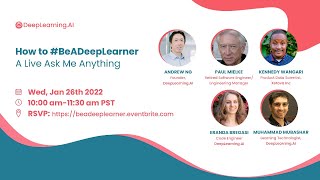
Andrew Ng and Deep Learning Specialization mentors answer questions about learning deep learning, building projects, and choosing between industry and academia. They discuss data-centric AI, TensorFlow versus PyTorch, and how to manage time while learning.
Chapters
Sam.
Hi, everyone. Welcome to how to be a Deep Learner, an AMA about the Deep Learning specialization and how to grow your career in AI. It's great to see viewers from all over the world joining us today. Why don't we share a little bit about ourselves? I'll start. My name is Ishita Chaudhary and I'm a Product marketing manager at DeepLearning AI. I live in San Francisco. What about you guys? What do you do? Where are you all from? Hi, Gerald from Holland. Hi, Ananya from India. Nice to have you guys here. Hey, angel from Mexico. Nice to have you here. Okay, please keep sending these wonderful messages. Oh, Happy Republic Day. Thanks for. Thanks for noticing that, guys. Okay. Over a million people have taken the Deep Learning specialization over the last couple of weeks. Thank you to everyone who's reached out to us about how DLS has changed their lives. We've dedicated this entire month to celebrate these learner stories and their successes. And I hope that you get a chance to read them and are inspired by them. Today we have a panel of some fantastic mentors who will answer any questions you might have about the Deep Learning specialization or about building a career in AI. You can post questions for our speakers in our online Discourse community. I know a lot of you are already on Discourse, but for those of you who are joining us for the first time, let me show you how to quickly participate in today's AMA on this YouTube page. Just scroll down to the description under the video. If you are new to Discourse, click on this invite link to make an account. If you already have an account, click on this link instead and you will be redirected to the Q and A page for this event. To ask a question, simply click on new topic and start writing your question here. You can add more details about your question right here. If you would like to upvote any other question, simply click into the topic and click on Vote. If you'd like to see what questions are the most upvoted, sort by votes and you'll see the questions that have the most votes so far. For example, this one. I hope that was helpful. If you have any more questions, please post it on the YouTube live chat and our moderators will help you out. Now, I know many of you are excited about our keynote speaker today, so without further ado, I'd like to welcome our founder, Andrew Ang.
Thank you, Ishita. And hey everyone. It's nice to see you here. So DeepLearning AI is celebrating the community of deep learners. One of the thrills I get is whenever I hear from one of you about learning machine learning or deep learning and using those skills to grow your career, get a new job, often build things that I could never have imagined building myself or maybe even more inspiring sometimes using your skills to go lift someone else up and maybe help someone else's goals or help someone else's career. As Ishita mentioned, over a million learners have enrolled in the Deep Learning specialization. You hear from some of the deep Learning specialization mentors later today and so I'm often inspired, excited, grateful to hear about the many individuals that that have taken the deep learning specialization and gone on to do really cool things with it. I just want to highlight mention a few of the learner stories that had caught my eye out of a very large number. But on the Deep Learning AI blog there's a post about Matt Strubel who talked about moving past an imposter syndrome, feeling like an outsider to complete some of his courses. And since then he's now working on machine learning at a leading sports brand and that's his main job. But cool Proji is working on using analytics to decide which picture looks nicest, which is actually important for a lot of e commerce retail applications, something I worked on in other contexts. So someone can do that, enter deep learning, build a career and I think that's really cool. Or Khalsun Abdullah who had jumped into this field based on initially curiosity about theoretical machine learning concepts and after learning the foundation started doing more hands on deep learning projects and most recently was working on chest X ray classification and again because of my interest in chest X rays, I think it's really cool that today someone can learn online and do really cutting edge work. I'll mention just one more. Wonjin Kim had a job as a software engineer and after finishing the deep learning specialization he was able to dive into research and now is doing research in biomedical imaging where he's using deep learning to do very cutting edge things. So I myself get thrilled whenever I learn about any of your successes. And if you feel the same, I hope you also check out the DeepLearning AI blog which has some of these stories and you find any of these stories helpful or inspiring. I find many of these stories in addition to inspiring have know kind of useful career tips about what different people did to get to where they are. I hope you share these stories with others as well. And then before moving on I I also want to extend my gratitude to the entire deep learning community AI community, the entire community of deep learners for spreading the word Freely sharing your advice of others, collaborating on projects, mentoring others, and there's an idea of struggle to articulate. I've mentioned this in the batch a few times over the years, but this is idea that I feel strongly about that frankly, I've struggled to find the right words for. But I'll just try to say it one more time, which is that I feel that AI is much bigger than each one of us individuals in it. I think the community of deep learners, it is about the individuals and, and is also about the community of all of us working together. All those little acts of kindness will extend help to someone else. Sometimes that little act of kindness will be acknowledged, sometimes not. But I think it's that our community has those millions of little acts of kindness that collectively causes everyone to then be lifted up and I hope can, even as we build cool things, support people's careers. I think this community, I hope can be a core part of how we go about building AI systems as well. And of course, I feel privileged to be one of you, to be part of this really amazing community of deep learners. And I hope that things like the deep learning specialization can also keep on helping more and more people join us in this, I think, wonderful community. I know we have some fantastic course mentors joining us today and when, you know, chatting with different learners in different cities and different places, I found that there are lots of people with questions about the deep learning specialization or about growing a career in AI. So what we wanted to do was organize this event to celebrate the community of deep learners and also to try to get some of these questions answered. I find that, you know, that I enjoy teaching online. One of the things I really enjoy doing. I hope it helps others. I think taking online courses gives a good foundational knowledge and I think sadly, taking an online course is not the only thing that's needed in order to build a great career in AI. And so once I have this event today to both talk about the online coursework and also to answer some of the questions people have about the other things that you might want to do beyond or after finishing courses to grow your career into exciting projects. And so I think a little bit later, I'm excited to have several of the wonderful deep learning specialization course mentors that, that, that have been a tremendous force helping learners and helping everyone move forward to join us to talk to some of these things. But I am, you know, really happy to have you here with us today and look forward to chatting about various people's career experiences and career tips with all of you. So thank you for being with me here today. And let me hand it back over to Ishita.
Thank you so much. Andrew. Before we let you go, we do have some questions for you from our learners, so I'd love to have a couple of your minutes and go over those questions.
Okay.
Our first question is from John Davis. He asks what skills do people from academia require to switch to working in the AI industry?
Yeah, thanks. Thanks, John Davis, for the question. I find that when I'm wearing an academic hat, a lot of the systems and processes needed to do academic research has focused on doing modeling work. And I find that academia allows for success in often relatively siloed roles where the only thing you need to do is invent a new neural network architecture or something. You can publish papers and be very successful in academia. I find that in the industry often we end up worrying about much more than modeling, you know, the full cycle of a machine learning project. How do you actually deploy systems? How do you apply data centric AI development techniques to get the whole thing to work rather than beat s? And I find that depending on your role in industry, having cross functional business skills where you can not just improve benchmark performance, which is great, you can do that, do that, purchase paper, but also select the right business use case to build something that's really valuable, selecting the right project and selecting how to build the thing, take the deployment work cross functionally to make sure the rest of the organization, including teams outside engineering are aligned. Those skills often become critical to succeed in industry as well. I've seen a few friends make the academia to industry transition and I think both are great. But I hope that people making that transition can efficiently acquire those other skills needed as well to do on the industry.
Thank you, that's great. Moving on, our next question is from Yaroslavimenko. A number of 2022 AI forecasts say that data engineering skills will be more important than data science ones. Is it better to skip DLS and go directly to the machine learning engineering for production MLOPS specialization?
Yeah, I would probably not. I think there are multiple career paths to be successful in AI machine learning and so on. And I think that it is true that, you know, data engineering is really important and in fact about a year ago we had an event at Deep Learned AI where I talk about some of the work that Land AI also is doing on data centric AI and systematically engineering the data. I think data centric AI and more systematic data engineering processes is an emergent set of technologies. Having said that, for you to really know how to engineer the data effectively. I think that understanding the state of the art and deep learning is also important. So it turns out that your ability to kind of pick and tune just a little bit, the right neural network, it is really critical. So it's not that the neural network architecture or something is not important. That decision, how you tune the hyperparameters, how you optimize it, how you evaluate it, that needs to be done. Well, I do think as long as you do that well for a lot of applications, most of the effort should be spent injuring the data. Hence the rise of data centric AI. Having said that, it is really important to get the neural network right. That's still the goal of the deep learning specialization. I still recommend, you know, build that foundation in the deep learning specialization and then maybe after that do ML help. So that would be my recommendation for most people wanting to grow, do more in machine learning.
Fair enough, Sounds good. Okay, sorry. Okay. Our third question is from Corey Merchant who asks, where do you see deep learning being used in manufacturing or the assembly industries today?
Hey, thanks Corey for that question. I think I actually know Corey Merchant. Hey, Corey. So I think, as you know, Corey Land, AI is doing a lot of work on applying deep learning to machine vision in manufacturing. I think it's a very early phase. There's a AI industry wide problem that I, many others are working on, which is that there's been a recipe for getting machine learning to work. And consumer software Internet companies, which often have, you know, tens or hundreds of millions of users or billions of users, and can build a single monolithic AI system to serve a massive user base and thus create massive amounts of value in manufacturing, industrial automation, machine vision. There are tens of thousands of factories and each one of them needs a custom deep learning model because every factory makes something different. So they just need a different neural network, maybe the same neural network architecture, pick a good one, but train on a unique set of data. So the industry wide problem I think that still faces manufacturing is how can we help 10,000, say factories train 10,000 custom machine learning models rather than hope one company train one monolithic machine learning model. So because of this challenge, I think that we still need better data centric AI platforms that makes it possible for the customer to do the customization. And while I've been focused on this in manufacturing, to those of you in other industries, I think this design pattern will need to be repeated in many other industries as well.
So.
So in healthcare, I don't think it's possible to Train one neural network that can read electronic health records for every healthcare system in the world because different healthcare systems code electronic health records a little bit differently. So the challenge that our whole industry faces is if they are using a round number, if there are 10,000 healthcare systems and each one of them needs their own neural network trained up to read their electronic health records and make accurate predictions, how can we get 10,000 models built without someone like me trying to grow a team of 10,000 machine learning engineers? I think the data centric AI movement and platforms that enable the end customer to engineer the data to build their own things is a key recipe to making this happen. Land AI is doing this in manufacturing, but I think someone else, not me, should take this recipe and replicate it to tons of other indigenous. So I think we're in very early phases. I'm excited about the work that hopefully all of us collectively will do to take machine learning to all of these other industries in consumer software Internet.
Yeah, absolutely. Thanks for that. Great question, Corey. Hope you got the answer you were looking for. Moving on, our next question is from Ty. What's the biggest skills gap in the field now and will be in the next few years?
Yeah, you know, I think there are a lot of skill gaps. So with the rise of deep learning there's increased specialization. So I think just, just like, you know, many decades ago software engineering, there was one title like software engineer, but then as software engineer matured they became, you know, front end, back end, full stack, mobile and so on. And I think deep learning is starting to mature and have different subspecialties. And so I can tell you what I think is the single hardest road to hire for in, in the whole AI world right now is the AI architect. There are many gaps where we don't have enough people that understand deep learning, don't enough people don't understand that people understand NLP or computer vision or lots of other things. So there are many, many gaps. All of this, you know, ample opportunities. But I'll tell you the single role that I personally find hardest to find is the AI architect, which is that person that has a technical judgment, really understands what neural networks can do, how much data is needed, what's technically feasible project, but then also can look at a business context and walk into a company, be it a manufacturing company or healthcare company, a retail company or something else, and look through or create or help create the many, many ideas for projects one could do and actually figure out what is going to be feasible and valuable. So the AI architect role of deciding what to do that is technically feasible and also is valuable for the mission or the business or the for profit nonprofit or whatever. That's really difficult. I do think the foundation of getting there is because machine learning is still evolving. You know, you do need that deep technical foundation in order to make accurate judgments about what is feasible and worth doing. But then, so start from there and then beyond that through hopefully pattern matching, you know, gain enough experience to work on different projects to hone one's intuitions about what other projects worth working on. I think machine learning is still rapidly evolving. Every month or two there are new things. This is why we keep on updating the deep learning specialization as well to reflect the latest. We updated deep learning specialization last year to make sure that you can learn about the latest. And that's another challenge of this role because this AI architect person needs to be aware of close to the state of the outer state of the art and all these judgments. Sorry, there's a long winded answer, but I find a lot of senior people in corporations, in research, in government, still struggle to decide what to work on. But having said that, beyond that, I think lots of the specific technical skills, there's still huge gaps in terms of how many people actually know how to do it compared to the number of opportunities to do exciting projects. So thank you, Ty, for that question.
All right, our next question is from Ali Saeed for data centric deep learning. What's the best strategy to start the data in any domain, especially the healthcare sector?
Yeah, thanks Ali. For data centric AI, the design pattern I often use is, I think of there as being two types of problems. One is a type of problem where the community has worked on it a bunch of times, like speech recognition. I've worked on it, many people worked on it. Because of that, we already know from the literature or various people's prior work how much data, what type of data is needed there? You know, I need at least this many tens of thousands of dollars of data. So let's go do that and get started. Having said that, what I see today is that the majority of machine learning applications are the opportunities. Many, many of them are things that kind of no one has really worked on and there's no existing literature, there's no track record, no one really knows what's going to work is needed, and so on. And for that second category of problems where I think there are just massive number of opportunities and projects that no one's working on, I find that it's often better to jump in quickly, start of a small data set, train an end to end system and then use error analysis to drive further development. So for a lot of problems in the health sector, ranging from the various diagnostic problems to using learning algorithms to help with healthcare operations or read electronic health records, which is something I've worked on for many of these problems, no one really knows. The literature may not kind of exist on how much data, what's the quality that is needed. And for those, the design pattern I often use is start a little bit of data, whatever you can get your hands on quickly in help. Obviously being mindful of privacy and ethical issues, but subject to those things. Try to get access to initial set of data and then train a model and use that to do error analysis to figure out where the gaps are in performance and when you know where the gaps are, then to then apply, you know, data centric or model centric, but often data centric approaches to target often the slices of data, the slices of the problem or subsets of the data where the performance isn't working that well yet to then have an efficient path to improving the overall systems performance performance. Hope that makes sense. But I think that pattern could apply to a lot of industries.
Sorry. Our last question for Andrew is from Ahmed Nehmood. And this is a question that, I mean, I think a lot of us have the same question. How is Dr. Andrew so productive?
Thanks. Thanks Ahmed. I'm probably less, to be honest, I'm pretty less productive than most people think actually. That's very true. Sorry. So this is random, but this is annoying. You know, I stayed up until 4am last night. I couldn't figure out why I couldn't go to sleep. And I was kind of lying in bed last night until 4am and then I finally figured out this this morning, which is that I decided to switch from coffee to tea last November. I thought, oh, too much caffeine. So I actually switched from coffee to tea. Oh, this is, this is actually my morning tea right here. And I was out with two different friends yesterday and I happened to drink coffee with both of my friends. So I was really over caffeinated yesterday and stayed up until 4am and I couldn't figure out why I couldn't go to sleep until this morning. So maybe I tell that story just to, just to reassure you that some days of the week I don't feel terribly productive and I kind of make dumb mistakes like that. But, but having said that, I find that there are two things I feel lucky to have. One is working with great teammates, deep learning Team Ishter. Many others are deep learning that I feel privileged to work with. And I feel that a lot of what I feel able to do is because I'm fortunate to have many friends that I will totally go to bat for and that I also trust to have my back. And it's that, you know, microcosm of that community that makes all of us better. And then one, one, one other thing I spent a lot of time on is cultivating habits. So maybe, maybe another personal story. I have many, many work habits, but as, as one other example, I'm pretty religious about working out every Monday, Wednesday, Friday, Saturday, Sunday. And because it's a habit, I, I kind of don't think about it. I wake up and I go do it whether I feel like it or not. But that's just one example. So I find that, oh, and you know, I wear a blue shirt every day. This isn't a habit. So there's lots of stuff, easy things and hard things that because it's a habit, I don't even need to think about it. And then, and, and, and so where I often reflect is, you know, how can I cultivate new habits that allows me to be more productive in the future without really needing to think about it? And, and I think you, you probably guess right. Lifelong learning, you know, reading a bit, watching a bit videos every day that I just get up on a weekend and every Sunday I know, yep, I'm gonna spend time learning something and sometimes and because it's a habit, it doesn't feel effortful and just wake up and of course I'm gonna brush my teeth and of course I'm gonna, you know, go learn something today. And I find that those habits often lets me get stuff done without. And it doesn't feel that difficult anymore once it's a habit. So hope that was helpful, but I'm probably less productive than most people think. But thank you for the question.
Thank you so much for that, Andrew. That's a great answer. Curate, find the right people to surround yourself with, have lifelong learning habits and stick to your habits. And also I'm really ashamed that I haven't worked out in a month. So I'm gonna probably get to that tomorrow. But thank you so much, Andrew for joining us today. It was really great to have you kick off the AMA and yeah, thanks. We'll let you go and so you can like be more productive now while we, while we let our course mentors take over.
Thanks. Thanks Isiah. Thanks everyone. It's good to see all here all.
Right, well, that was great. Before I actually introduce our amazing speakers for today, I'd like to take a couple of minutes and overview the deep learning specialization for you all so that we can get at least so you have a basic idea and then if you have any more questions, feel free to add them to Discourse. So what is the Deep Learning specialization? It's a foundational online program on Coursera which has the leading edge machine learning and deep learning concepts. This entire program has five courses which have been divided into really clear, concise modules for self paced learning. Since its launch, more than 1.1 million learners have enrolled in the specialization. And this has been rated 4.8 out of 5 by more than 130,000 learners all over the world.
World.
Now, who is the specialization for? Honestly, anyone who's looking to master AI concepts and to acquire the practical skills they need to build an AI career or deep dive into AI research. But if you're a STEM student or technical professional or software engineer, this is great for you. Like you should absolutely check this out. What do you need before you enroll in the specialization? You do need some intermediate Python experience. You also need some knowledge of linear algebra. Nothing too complicated and it'll be great if you have a basic understanding of like common ML concepts. This entire. As I mentioned, this specialization is divided into five courses. As you go through each course, you will end up learning about neural networks, about how to improve deep neural networks, how to structure your machine learning projects. You learn about convolutional neural networks and sequence models. Now, obviously there's a lot more under each of these courses, but instead of talking about all of that right now, we urge you to go to the Deep Learning specialization page on our website or on Coursera and look at the Week Wise syllabus. That'll give you a really great idea of what this entire specialization is about. All right, now that we are done with that, I hope you have a slightly better understanding of dls. And if you're not sure, as I said, don't worry. This is exactly what today's event is about. It's about you. So we encourage you to go to Discourse and ask any questions you might have about the deep learning specialization. And now, without taking any or more of your time, let me welcome our speakers for today. All right, let's start off. Hi, Paul.
Hi everybody. Well, I can just give a quick, quick intro here. Well, you can see the data there. So I'm a software. I spent my whole career in Silicon Valley as a software engineer working on various things and when I retired a few, and I should say my academic background is in math back when I was I'm old enough that that when I was an undergraduate there really wasn't such a thing as a computer science major, if you can believe it. And when I retired I was curious to just learn some new stuff. So I went on the Coursera and I just happened to get lucky and ran across Andrew Ang's original Stanford machine learning course and I was just totally hooked. So I've been spending most of my free time taking more courses from Andrew and then I got interested enough to spend a lot of time on the forums helping people out with questions about the DLS specialization. So that's where I spend most of my time. So it's great to see everybody and I look forward to hearing some of your questions.
All right, thank you. Thank you, Paul. We're going to move on to Kennedy. Hi Kennedy. Hi everyone.
Thank you so much for having me for this session. Kennedy Wangari is my name. I'm a Data Scientist at Zetova, a developer, advocate, technical AI community lead, currently a Deep Learning Ambassador to Kenya, supporting a community of 200 members and also a deep learning.AI mentor for the Deep Learning specialization. I took the deep learning AI specialization in 2018 and I've been able to walk the journey as a deep learner and I've been certified as a Google Cloud Professional Architect with my background is in Business Intelligence, Data Science and Software Engineering. I recently graduated from my Bachelor's degree in Business Information Technology. My main motive and it's in my main work is being a stand up voice and an advocate promoting data science education for all in Kenya and Sub Saharan Africa. And through that we've been able to tailor programs, initiatives and activities with Nvidia AI, with pact, with Data Camp and recently with Facebook AI Research all trying to ensure that we provide we promote the deep learning AI mission of ensuring that world class AI education is accessible to everyone. And that's part of what we're doing and much actively involved with activities that go towards empowering our deep learning ti our developer communities and great to be here. Thank you.
Thank you so much. That was great. Hi Eranda.
Hi everyone. My name is Deronda Bregasi. I'm a curriculum engineer here at Deep Learning AI. Thank you so much for the invite. I'm really looking forward to today's session and to hopefully answer some of your questions. My background is in Electrical Engineering, Computer Science from UC Berkeley. Go Bears again. I work in developing course materials and assessment for machine learning and deep learning specializations. I'm very passionate about advancing the learners experience in our platform and also like breaking down like these complex AI research topics and making them accessible for everyone in order to apply and deploy there every day tasks. I'm also really passionate about representation in AI and I, I hope I can empower at least other people to get involved in any sort of interest they have both in AI. And so let us know what questions you have today. Thank you.
All right, and last, not least, we have Mubashar, or as we call him, Mopsy. Hey, Mopsy.
Thanks, Ista. Hi everyone. My name is Mohammed Basher. I'm pursuing my computer science degree of Bachelor's. I took the deep learning specialization myself back in 2018. Back then my only exposure was that people build websites and mobile apps. But when I read the description of the deep learning specialization, I was blown away that I had no idea we could actually make a computer do all of these things. And that really got my interest and I got hooked to it and I took the whole specialization. I literally took notes and everything. I was completely loving it. And ever since then I took all of the deep learnings, the specializations, and it helped me make a career in the industry side of things by working in the industry for about a year, after which I joined the deep learning itself. And now I work as a learning technologist where I basically help build the course material and help maintain its integrity after the courses are launched. And yeah, like myself, when I, my life changed after taking this course. Now I am devoted to like, hoping that someone else out there will also feel the same way and they could also see the potential AI has in this world and making things better.
All right, that was great. Thanks for the introduction, guys. Let's dive right into the questions I'm going to share. I'm going to actually share the event Q A page so all of us can look at the questions. Now let me zoom in a little. Can you all read? Can you all read what's on my screen or should I zoom in further? You're okay. Okay. All right, let me refresh this page now. So the way we're gonna go about this is I'm gonna sort everything by the number of upvotes and we can just start taking questions like as, as we go. Feel free to jump in and answer whatever question we're talking about. And yeah, let's get this started. We're starting with the big questions. How do I get hired after taking the deep learning specialization, I've completed the Specialization before it was updated. Do I need to take the new updated version? And how can I get hired after completion? That's the big question, right? What do you guys think?
I think a few years ago, since this was new, there was not a lot of competition. Like you could take specialization and you could like apply anywhere. But now I think there's a lot of competition out there. So just taking the specialization itself is not sufficient. You. You actually need to show that what you have learned. So I would recommend take on projects. They don't necessarily have to be something massive. It's something that you're interested in your own personal interest, like your own personal side project. So you need to be able to show that what you have learned, you know how to actually apply it.
I can. One, one thing to add to what Mubzi said is that the question about the update to the deep learning specialization, the critical thing that happened in April was that they switched from using TensorFlow 1.0 to TensorFlow 2.0, which is actually quite a bit different. I mean, if you already know TensorFlow, maybe it doesn't. If you know both 1.0 and 2.0, it doesn't really matter to you that much. But. And there's also some brand new material that's really about things like UNET and transfer learning and stuff that wasn't in the original course. So I would say it's worth taking a look at the, at the updated version of the course as well. And then what Mubsy said about you really need to do some projects and you, you really learn something when you try to actually apply. And it's one thing to take the course, but trying to apply it to an actual problem. So one good way to get a handle or to get find examples of things like that are like that. The Kaggle website is really great. They have a ton of different. They just pose these challenges and then people, people try to solve them and you can look at some past examples of what people have done. That's one good way to get practical experience.
If I also add to that perhaps something else that could be very interesting for a learner could be also the deep learning specialization is a great first step. So I want to personally congratulate you for finishing and that could be a very good opportunity for you to also explore some interest that you may have in the field and that gives some direction into what specifically you'd want to do in your future. And to me, I think there's a special pride in showing off the projects that you've worked on your work that you've. The hours that you've put into the specialization and perhaps also looking to some other specialization such as nlp, ML Ops, depending on what your specific interests are. And I'd say that's a very good transitioning step into what specifically you'd want to do and what positions you'll be applying for. So definitely something to keep in mind.
Thank you. That was a lot of information, but thank you so much, guys. That's great. Let's move on. Oh, this is a good one. What are your time management tricks? How do you decide what to learn next? Kennedy, do you want to. Do you want to start. Start off with this one. Sorry, Kennedy, I think you're on mute.
Yes, it's okay now. Great. When it comes to. For me on time management, when Jahur has worked for me in more so when learning the deep learning specialization and also looking at this so much in terms of the amount of the volume and the kind of, there's a lot of content that you get to learn. And for me, what has worked is first, by the time I'm getting to take up any course or enroll or any program, we first set my objectives, what do I want to learn from, what do I expect from this particular course and also set timelines within each and every week so that I'm able to basically setting a routine of activities in terms of every day, I'm able to dedicate a number of hours so that I'm able to tackle the projects, the assignments. And also that discipline to sticking to your routine has really worked well for me. And also always keeping in check with my roadmap in terms of what comes next after learn I've learned this course or after I've taken up the assignment and the projects and I can say, yeah, having a strong and routine in terms of being fully objective in terms of this is what I want to learn, this is what I'll be learning this week and setting up that schedule and sticking to it. But day after day, I think it pushes you to be able to learn and be able to grasp and understand the concepts better.
Great. That's. Yeah. A lot of what like, like as you said, like something that Andrew mentioned as well. Like have, have a routine and if you can try to stick to it, even if you don't do it like 100% of the time, you're gonna like still be successful because you're gonna like try to get yourself out there, get yourself doing the things you need to do to learn what's Next, Next. Would anybody else like to add to.
This, perhaps something very very briefly? I think the time management could also be very, very helpful for structuring your own machine learning projects. And I'd wanted to tie this back to the specializations because it might come very handy actually in your career to have some sort of conceptual planning how you approach projects and how you, especially in the industry and how you deploy them. So I also wanted to definitely emphasize to not get discouraged if you end up spending too much time on something or if you like fall into that rabbit hole of like actually diving into some other research topics that might not be necessarily directly related to your own project. But I think it's very, very helpful. And those sort of like zoom in, zoom out balance, it's much more balanced actually in how you approach your work. So definitely something to keep in mind for also in other specializations.
No, absolutely. That's a, that's a, that's a great, that's a great tactic. I mean if I am bored with like the main TV show I'm watching, I like kind of cheat on that by watching smaller TV shows. I think that's a great zoom in, zoom out technique. Okay, moving on. Okay, let's take this one. Is so the deep learning specialization versus the original machine learning course. Is the ML course required to start the deep learning specialization? I really want to hop directly on dls. Does anyone want to take that? Oh, Paul, I think you're on mute.
Sorry.
Yeah.
Yeah, no, I started, you know, as I mentioned in my intro, I started by taking the Stanford machine learning course. It's really great. And the thing that's different about it than the DLS courses, it's really a survey. It covers many things besides just neural networks. So it's useful to take. But the DLS course is standalone. You can take, you can start with that. And it's also the DLS courses also a bit more modern. It was published in 2017. The original one was from 2011. And there's quite a lot of water under the bridge. I mean it's still, the material is all still valid and great, but the techniques used and the sort of assumption of the amount of power, compute power you've got at your disposal and that kind of stuff is more modern in the DLS course, but you can find a start with dls and then you might want to go back and look at Stanford ML to get to learn about some other areas.
Yeah, plus the deep learning specialization was also updated last year. So like there are some absolutely like brand New cutting edge concepts. So it's absolutely state of the art. Great. Let's take the new one, the next one. Sorry, let me sort by boots again to see if there's any more new questions.
Okay.
Sorry.
Let me increase the size of my screen. I feel like some of the questions are getting. Oh no, I think we can see the thing. As an Egyptian, I find it hard to attend offline meetups and grow my connections. How can I fulfill this gap? Should we answer this question before we move on to part two? So who's, who would like. So I mean apart from just Covid, I know a lot of us are in places where we might not have as many events, we might not have as many things happening in the local community, but we might find, we might find it relevant to find online communities. Do you guys like Kennedy, I know you're really social both offline and online and like others as well. How do you, do you think it's worthy to like completely kind of like replace offline meetups with like trying to build your community online or like do you think we should still try? Like, is there a way that people who don't have access to offline communities can maybe start their own, like be the first person who takes, who takes a step in their local, like in their region to kind of kickstart something that they're interested in. What are your thoughts?
Great. That's one of the best ways because that's a few. Three years ago I was in similar shoes having taken up the deep learning specialization. There was no really active or per se active communities within Nairobi. And being that desire to have a community of like minded people who are sharing similar interests and being able to learn together forced me to move out the way and build the first data science community for my university and also walk through that journey and saw the benefits of learning and working together with others in a, in a community. And that also propelled me to also be the first deep learning AI ambassador to Kenya. So in response to Mohammed question, I would say take up that initiative that in your setting, if there's no really active online or physical community, we have the deep learning AI community, join the community and be able to build, establish that community for you people and you'll get to learn along, you'll be able to build the community and other people will also greatly benefit from the same. And again, like you did mention, you can also leverage on online discussion forums and communities. We're talking of the DeepLearning AI discourse community online. There are LinkedIn groups, there are also forums online that you can also follow the Kaggle community online forum to basically be able to be with the team and be able to learn from them and also be able to share your questions and get the support.
Great. That makes total sense. I'd also like to mention that the DeepLearning AI team does have pioneer ambassadors in Egypt. If you want to check out upcoming online meetups, do check out the event page on our website. But everything Kennedy says makes absolute sense. Like if there's something, like, if there's something that you think is missing, like take the first step and like start it. Like, there's a lot of advantages to being the first person or the first, the first person who is active enough to build a community in your local area. Okay, let's move on to the second part of the question. This person has taken the deep learning specialization, worked on projects, was hired as an ML software engineer. They're planning on migrating to the US one day and get their PhD from Stanford. Well, all the best for that. What can they do to land a job in the us? This is, this might be a little too specific. So if anyone has like, even like, if you have a sense of like a broader answer. Happy to hear your thoughts.
Well, I can, I can start on that one and then other people can chime in. I think you're on a great path there. I mean, if you've already got a job in the industry, then that's perfect. Basically that's what people are looking for. I mean, it's, it's, you know, it's. Some of the stuff that people asked Andrew about is, hey, you know, how do I make the jump just from taking classes to actually getting a job? And the key thing is to have experience. And one way is to, is to do your own projects on Kaggle. But if you're actually in the industry, then that should, you know, that that will catch people's attention. So you just have to start looking at people's websites and trying applying for jobs. And in terms of, you know, I was a hiring manager in Silicon Valley for 30 years or so. It's an absolutely common thing. I mean, it's sort of, maybe the, the best understood path for getting to the US is to go to grad school. So you might want to just apply to school first. I mean, that, that, that's, everybody understands how that works and it's, it's a way to get feet on the ground here and then you can kind of get a better sense for how everything works. And so we Frequently in Silicon Valley hire people that got their bachelor's degrees from their local universities and then went to mit, Cornell, Stanford, Berkeley, whatever to get their advanced degrees. And the immigration side of that's all well understood by companies and they can help you with all the paperwork and that stuff. Just a thought.
Thank you. Yeah, that makes absolute sense. Would anyone like to chime in? If not, we can move on to the next question. Okay. All right, That's the age old question, right? TensorFlow or PyTorch? I've heard research, I've heard research in ML has transitioned to using the PyTorch library from the TensorFlow library. Is learning TensorFlow today still recommended?
I think I just start by saying they both are good, they both can be used, but everyone has their own preference. Like you said, like it's an age old question. You'll see a lot of pros and cons about both things. But over the years what I've seen is people use them for particular tasks. For example, like if you go towards the advanced side of things, the generative adversarian networks or the nlp, people prefer using Pytorch for those things. And for the computer vision side of things, people prefer TensorFlow. But again, at the end of the day, it's at your own comfort level which one your favorite is and which one like you want to upscale in. But I think overall they both are the same.
Right? They're sort of equivalent and there are other platforms as well. But I think what people used to say a couple of years ago is TensorFlow dominates in industry, industrial applications. You know, real companies trying to apply deep learning. But Pytorch is more popular in the academic research community. But I think that's the balance and that's starting to change. Pytorch is kind of catching up. Especially before TensorFlow 2.0 came out, PyTorch was just way easier to use. It's. So the computation graph model in TensorFlow is pretty hard to understand when you first see it. But I mean, it's kind of like asking what programming language should I, should I learn? The more you know, the better. So if you're going to apply to a job, it'll depend on what the company's using. You'll have to use whatever environment they've they've chosen. So you're better off if you can say on your resume that I know both and one good way. I mean, most of the courses here at Deep Learning are based on TensorFlow, but the, the GAN specialization, they decided to use Pytorch. So that's, that's one easy way kind of. It's a cool way to get introduced to Pytorch. And also the GAN specialization is really cool. If you've never. If you're curious about that.
Absolutely. That's a great, that's a great answer. The more the merrier. Before we move on to the next question, I do want to mention that Kennedy actually got an internship at this. We're answering the previous question, sorry. So Kennedy actually managed to bag an internship with Nvidia. So like Kennedy, do you want to very quickly talk about that experience and kind of tell our viewers like how you managed to do that while you were not, like you were not there physically? Like, how did you, how did you get that? Oh, okay. Sorry. I think you're on mute.
Sorry for that.
Great.
Thank you so much for that question. And I would say what probably contributed greatly towards me securing a data science internship with Nvidia? I interned with Nvidia from May to August 2020 for the Nvidia Virtual Internship Program 2020. We could not be able to be in office again considering there was Covid last year. So everyone in the program that is the Nvidia Virtual Internship Program 2020 was all virtually for me. I can say before I talk about briefly on my experience and what's next for me after the internship, I could probably touch on what contributed or what do I feel contributed the most towards me securing the data science internship at Nvidia. And I could confidently say that the proper data science and machine learning experience and the skills gained from taking up real world projects from DENA Fruit Punch AI and gaining the relevant technical skills from working with communities like DeepLearning AI which I'm so actively involved with and the previous experiences that I've had serving as a data science internship capacities, they really provided us per se an impressive background in skill sets that I would say interested the recruiters. And for those who know me, I'm also, I actively do create data science content and I believe all this holistically drew interest from recruiters. And at that period of time I.
Received.
I got hunted and had interviews with Microsoft. They applied a male engineering team and in VT year and I had three sets of interviews and I would say what probably contributed greatly to me receiving the offer was in terms of the unique problem solving mindset, in terms of how I would approach the various programs, in terms of how I would approach the use cases problems that I had for the three interview rounds and much of the skills that I gained from the deep learning JS specialization, specifically that course that is how you structure your machine learning projects and how you logically share and being able to express more about your projects and impact really impressed the recruiters. And one of the recruiters in a way was quite impressed that I went beyond just getting to know more about Nvidia but also interacting with the various products. That was to interview for just a summary of how my internship was. I really had one of the best times working virtually from Kenya with the Rapids team and I was privileged to secure a return to offer joining Nvidia from March this year as a developer relations advocate alongside an amazing team that's been being launched for Africa. And all this has been due to my active engagements with communities. Like the previous question that was asked, how can you be able to bridge that gap working with the deeplearning AI and being able to really push yourself to learn, the hunger for knowledge and helping others along the way. I think that's what really pushed me to, to be able to get to have that competitive advantage against the rest. And I would really encourage as many of us that to take up the deep learning AI specialization. If you've not taken up as one of your New Year's resolutions, I will give you that foundation and keep learning, keep building, keep sharing in public and the opportunities will come your way.
Thank you, thank you for that. That's really helpful. I think like personal experience, like the best you can do is share your personal experience and hopefully that will inspire someone to go down the same pathway or identify their own. Okay, I think we can actually merge our next couple of questions which are why do you think people should learn deep learning instead of other another type of ML models? And is deep learning the only highly performing machine learning model? So we can. And is it because deep learning is so generic and can be used in multiple areas or something else? So that's the first question.
So like if someone takes this specialization at the very start, like you will see Andrew mentioned why the deep learning is taking off. It's because in this day and age we have a lot of data available to us which was not in the previous years. So deep learning itself basically is a technique where you have a lot of data and you just show the data to the computer and like ask it to like make sense of it on its own. So that's basically the ideal deep learning, like with what we'll call like end to end. So coming back to the first question, you don't, shouldn't like necessarily Just learn deep learning. I think it's always an edge to know more about the other models and techniques that are available to you because sometimes you'll come across problems where you won't have a lot of data. So you would have to do some feature engineering, like things like that. So you would see that sometimes not necessarily neural networks, but like trees and other things, graphs, they'll come more in handy. And one important thing also to mention here is sometimes what people try to do is come up with very advanced solutions. But if you see, sometimes the solution is very simple. You don't need to have like a neural network with many hidden layers or with a lot of like big architecture, sometimes you'll see only like a simple architecture can give you better accuracy, like better results than a something advanced that you try to build. So my recommendation is yes, do learn about deep learning, but also learn what else is out there.
That's great. Can one of you help by giving examples of other highly performing models that might outperform deep learning? Or are you. Or, or that's fine if like you don't have the answer right now. Happy to hear what.
Well, one thing to say is that there are other kinds of algorithms that there's certain there are some kinds of problems that deep learning just isn't applicable to, like clustering. And you know, deep learning is a form of supervised learning, meaning that you have to have labeled data. There's other kinds of cases in which you don't have label data where you're trying to do things like clustering. Recommender systems. Well, I think recommender systems is maybe a bad example because that, that used to be done with a different way than neural networks. But I think now people are starting to use neural networks to do recommender systems. But that's one reason to take the Stanford ML course because there, Professor Ng covers a bunch of those things like anomaly detection systems, other forms of unsupervised learning, like, like clustering algorithms, dimensionality reduction, recommender systems. So, you know, I mean, deep learning can solve a lot of problems, but there's some, sometimes it's just in the nature of the, the problem that you have, it's not applicable. So it's, it's worth knowing, it's worth taking a survey course to kind of understand. And I personally don't know anything about random forests and that kind of stuff. Maybe somebody else can comment on that.
Yeah, I think another notable thing is reinforcement learning, which is sort of a bit different than like Paul mentioned, the supervised and unsupervised learning. So like you'll see a lot of people training their algorithms regarding robots using those reinforcements learning techniques. As Paul mentioned, there are places where you can't necessarily use deep learning techniques.
I think I also wanted to add one very brief note on that and I wanted to circle back to what Andrew was mentioning in the very beginning about the AI architect role. And I believe that that has some relation to this as well. And I totally, my opinion actually overlaps with both Paul and Moopsie were mentioning, but also to reiterate what Andrew was saying, because it truly depends on the perspective of what problem you're trying to solve. I think that's the key thing to keep in mind and it's very important because in both academia or industry, like you'll have to, in industry, for example, you'll have to consider the business case. So what current like case scenario you're trying to solve, the use case you're trying to solve. And that will give you some insight into what could be more fit, what method could be fit for you to apply to solve that. And not deep learning is not necessarily the answer to everything. It is to most of the things. But it helps to have some mathematical understanding, in my opinion, to at least understand how a few of these models work, even if it's in a high level. So I think a lot of people are actually afraid of jumping into math. I used to be like that. But I think it's really, it makes things so much easier in the long run if you do take the time to break down the model and sort of understand how it works architecture wise. So yeah, just to wrap up on that, hope this is helpful.
It definitely is. Thank you. Rhonda. Sorry you got cut off earlier. This is, this is great. Guys, let's go back and let me sort by woods and see if we have any new questions. Okay, I think we missed this one earlier. How do I find a job as an AI engineer after a career break with previous experience as a software engineer? At most of the places, so Neelama asks, at most of the places, the AI engineer job requirements include previous professional experience as an AI engineer. What should I do along with the courses on deep learning AI to stand a chance to be considered for roles that require previous AI engineer experience? Now, I know we've, we've partly answered this question. We've talked about how, yes, like go ahead, you know, take, take all the online courses that provide you with the skills that you need for the job you want to apply for and then do your projects and showcase those projects during these interviews. Are there any, are there. What are your thoughts about this? What else can someone do if they don't have previous work experience as, as an ML engineer?
I think it's a question of the question. Look, go ahead, Paul.
Well, no, I was just going to say, I think, I think Mubsi probably discussed this, too, and Andrew mentioned it, and I think I mentioned it earlier, is that one valuable thing to do is to actually show that you can apply the techniques. Just show. Show that you can apply what you learn. So one way to do that is to look at some of the There's a bunch of websites out there that have tons of curated data that you can use to build models. Things like the imagenet website.










