How to transition into a career in ML/AI
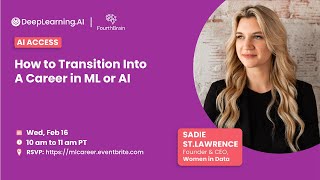
YouTube live event (Feb 16, 2022) titled “How to transition into a career in ML/AI” featuring Ishita Chaudhary (DeepLearning.AI) and speaker Sadie St. Lawrence (founder & CEO, Women in Data). Sadie presents a practical career-change framework (Learn → Do → Share → Repeat), recommended technical foundations (Python, SQL, feature engineering, ML algorithms, neural networks, cloud platforms), project and portfolio advice (Kaggle, small personal datasets, volunteer/hackathons/startups), and networking/mentorship tactics. The session includes an extended audience Q&A on education paths (MOOCs, bootcamps, master’s, PhD), resume/portfolio strategy, transitioning from domain roles (healthcare, finance, software), and diversity/representation in ML (LinkedIn cited stat: women ~22% of ML engineering roles).
Questions this video answers
February 16, 2022.
Over 350,000 people.
Approximately 22%.
Named the number one community for women in AI and tech in 2021.
Chapters
Sam. Hi everyone. Welcome to how to Transition to a career in AI and ML, a live interactive event in collaboration with Fourth Brain. Now, what is Fourth Brain? Backed by Andrew Ion's AI Fund, FourthBrain is a sister company of DeepLearning AI that provides the practical training you need to take your machine learning skills to the next level. Their unique ML programs will help you get the technical, business and communication skills you need to advance your career. So check out their website, fourthbrain AI to learn more about their upcoming programs and how they can help you build your career in AI. It's so great to see so many viewers join us from all over the world today. Why don't we share a little bit about ourselves? I'll start. I'm Ishita Chaudhary, a Product marketing manager at DeepLearning AI and I live in San Francisco. What about you guys? Where are you from? What do you do? Hi, John from Zurich. Hi Enrique. Hey Sophia from Colombia. Hi Sartak from India. So excited to have all of you here. Please keep, please keep sending these wonderful messages. We love to hear where our viewers are from, what they're doing, what they're looking for from this event. Okay, while you keep doing that, I'm gonna move on. Let's face it guys, we know transitioning careers can be super challenging. But what you can do is learn how to identify your current skill set, find the right gaps and create a roadmap to achieve the career you ultimately want to have. In today's session, you will learn about the most critical skills you need to for a machine learning career and how through education and networking and community, you can transition and reach your career goals. So if you have any questions, please post them in our online discourse community, which I'm going to talk about. So for those of you who are joining us for the first time, let me show you how to participate in today's event on this YouTube page.
Scroll.
Scroll down to the description under the video. If you are new to discourse and haven't yet created an account, click on this link to create an account. Once you have an account, click on this link so you can be redirected to the category page where we have the Q and A's for this event. To post a question on this page, simply click on New topic and start writing. If you'd like to upvote another question, click on a topic and click on Vote. If you'd like to see the most upvoted questions, just click on votes and the entire list will get sorted from increasing to decreasing and you'll be able to see all the questions that have the most votes. I hope that was helpful. If you have any more questions about Discourse, about how you can add your own questions, or anything about the event, feel free to add them to the YouTube live chat and our moderator will help you out. Today's event is all about you. We encourage you to go to Discourse and ask any questions you have and add your comments wherever you want to. So without further ado, I'd like to welcome our speaker for today, Sadie St. Lawrence, the founder and CEO of Women in Data. Women in Data was named the number one community for women in AI and tech in 2021 by the Good AI. Sadie has trained over 350,000 people in data science and designed the machine Learning certification for UC Davis. Hey Sadie, so glad to have you here.
Such a pleasure to be here. I am so excited for this event because career changers are one of my favorite people. I classify myself as a career changer myself and so I'm so excited to share some tips and tricks I've learned along the and get this conversation started so we can get everybody's questions answered.
Great.
Awesome. Well, I'll go ahead and share my screen. So welcome everyone to how to Transition into a Career in ML or AI. As mentioned, my name is Sadie St Lawrence and if we haven't met in person before, it's so nice to meet you. As I mentioned, I am a what I call a career changer myself and I've got to speak with thousands of people in this space. And what I found is most of us actually are career changers. And when I start to think about it, none of us were born being data scientists. None of us were born being ML engineers. We all have our own unique experience, experiences that we bring to the table and find our way into this space. And so today I want to share a little bit about some of my experiences and then a framework I've developed to really help career changers have a roadmap in terms of what they need to do to be able to get the job that they're looking for in ML and AI. So I actually started out my education in piano performance. I was homeschooled and had never taken a test in my life, and the one thing I knew how to do really well was piano performance. So that's where I started my education journey. And through going into university I found a deep love for science. And so I really was interested in science, but in the science of people. And that led me to Study psychology. And then when I was finished with my bachelor's degree, I really wanted to get into neuroscience and was on the track to go and get my PhD in neuroscience and was working as a neuroscience researcher studying emotional learning and memory. However, during this time, I started to realize I didn't like to work with rodents so much, and I really fell in love with the analysis side of things. So it was so much work to be able to get data from my experiments. But when I got the data, I loved it. There was nothing I loved more than being able to run the test, see the results, communicate those results, and share those stories. And that is what led me to find data science and and machine learning, because I looked at my current career path in neuroscience and said, what parts of my job do I like and what parts of my job do I not like? I love the analysis side, did not like the working with rodent side. So that led me to, within two weeks, quitting my job at the lab, saying I just need to get any job in data. And so I became a research analyst because it pulled in the title of my last job, which was researcher, and started to be able to work with data. At that time, I also realized that I had some skill gaps in terms of going on the career path I was looking to do, which was to be able to build machine learning models. And so I started taking courses on Coursera, and this was in 2014, and I really fell in love with the courses that I was taking, but felt like I wanted a richer experience and more of a community to connect with. And in 2014, there was not the breadth of community that there is today within this space. So that led me to go get my master's degree in data science while I was still working. At the same time, you can see I work through a lot of different job titles within the space as a research analyst, I loved what I was doing, but I was not connected close enough to the underlying data systems in the company that I was working with. And so that led me to transition in that company to be an analytics engineer. And this gave me a really rich foundation into the systems and the data that I would work with to later then go on to become a data scientist and then to lead a data science team at that company. From there, I was really loved what I was able to build at that organization and wanted to do it for other people. And so that led me into the world of consulting, which was a ton of fun. And I got to lead AI strategy projects for a number of companies in the us and then that leads me to where I am today. So today I had the opportunity to have a wonderful career in data science and ML and really wanted to give back. And so that led me to founding Women in Data to make sure we're creating pathways and more opportunity for diverse audiences to enter this space. At the same time, I'm a huge fan of slash careers. So and at the core of who I am, I'm a teacher. And that led me during this time to be able to teach a class on Coursera SQL for Data Science. If you're in the audience and have taken the class, thank you so much for taking the class. And then it led me later on to design the machine learning certification for UC Davis. So through these experiences, I've got to engage in the world of education. I've got to go on my own career progression myself and leading Women in Data global organization, where many of our members are career changers themselves. I get to talk to people every day about the struggles, the questions and the things they have, and I get to talk about to leaders in terms of who they're looking to hire. And so this has led me to being able to design a framework in terms of how do you most optimally transition into a career in ML and AI. And I am not one to like to waste time, so I like to get right to the point of what this process is. And so it's a pretty simple process in terms of learn, do, share and repeat. And today I'm going to dive into each of these areas because this is a tried and true process. And one of the things that I was recommended when I went on my own career progression and journey. But the thing that was really hard for me getting started was not what do I learn, but really what do I do? Because when I got started on my journey, everyone said the best way to be able to get into this field is to do projects. And I was like, that's great, I want to do project. That's what I'm trying to do. But what does that really mean? What does that do mean? And so as I look back in some things that would have been helpful for me on my journey, what I did was I formed some simple questions to ask yourself. And these questions are important because if you're at the stage where you think you're ready to do, but not sure if you can, these are great questions to go through to be able to know if you're ready to really start to build that portfolio and build out those projects. And if you can't answer all of these questions, then you can go back into the learning phase. So what are these questions? Right? Can you analyze data or identify a business need to come up with an ML or AI solutions solution? Can you determine which algorithm you should use for this solution? Once you determine what you should use, can you feature engineer the data to fit the model that you're trying to use? Can you build the model? Can you not only build the model, but can you also elevate the model performance? Can you improve that model performance and then can you deploy that model to production and elevate that performance over time? And last but not least, because this is a step that we all normally forget about because we get so lost in the model building process. But can you really communicate this use case, the problem you were trying to solve, what the results are and what the next steps are? Now, if you answered yes to all of these questions, you are ready to go into the doing state and start practicing. And we'll. I'll talk about that here in a second. But if you can't answer yes to all these questions, then there's some gaps in your knowledge that we need to work on in terms of skills that you need to learn or techniques that you need to learn. So that leads me to the first step, the learning step, and probably the first question I get asked from everyone is where do I go to learn? And we are in a great environment today where there are so many resources to be able to learn these skills. And so what I've done is broken them out into a couple of the main formats of education that exist. So you can best determine what's the best format for you to go to use. So the first one being moocs. So moocs is a term for massive open online courses. So things like Coursera, Udemy, Udacity, things like that all fall within the MOOCs. These are what we call asynchronous. So you can take them at any time at your own pace. And these work really well for self learners, self motivated people. If you have strong hacking problem solving skills, it's also a really great way to see if this is a subject you're excited about and want to learn more about. So if you're identifying that bucket, this is a really great place to start. But then there's also boot camps. So boot camps are what we call synchronous. So these usually have a live session that you have to attend at a certain time. You'll also have an instructor, you'll have a cohort of people who will be working through the same classes with you. And these are really great for people who potentially already have professional experience, but you really want more of that community support, that accountability and that access to an instructor. Then there's the Master's programs. And the Master's programs are great for people who don't have any experience, but they still also want that community support and that accountability. And then there's a portion on the Master's programs that I get to talk to people about where they really just want a Master's degree. Right? Like maybe you have a bachelor's degree and it's always been your goal to have a Master's degree and that's okay. And that's really important to identify if that's something that's really meaningful to you. And then finally there's the PhD program. So in the space we're in today, I really look at PhD programs as for people who really want to do research or want the option to be a professor and or do research later. So if that is something that is your calling and you feel really passionate about, the PhD programs are a great option for you there. So how do you choose a program? Right. Maybe you identify that, you know, MOOCs or boot camps are the best way to go. Here's a couple of things that I look for when I'm choosing one of these. So for MOOCs, I think it's really important to find the subjects that interest you, right? So if you're a self learner, you're going to have to be self motivated to be able to stick through the course, complete the assignments and finish it. And so you want to find things that really interest you and speak to you at the same time. There are a lot of options out there. So you really want to find people that you enjoy learning from and who you enjoy learning from may not be the same person as I enjoy learning from, and that's okay. What you're trying to get at is who can speak in a language that most clearly communicates and resonates with you? When picking a boot camp or instructor led course, I really look at the syllabus. So what is the content that's being taught to me? Is this really the scope of where I want to go, but also what's the time to complete it? Is this a six month program? Is it a one year program? Is it part? Is it full time? Does that work with your schedule? These are important factors to come into play. And then additionally you want to look at costs so this is something I highly recommend for people when choosing master's programs is look at this as a financial investment and say, hey, once I have this program, what should be my outcome salary so that I'm able to pay this back? I think we all hate student loans, so we want to make sure that we're able to make a solid investment not only with our money, but also with our time. So with the Master's program, it's really similar. Usually the time to complete it though is a lot longer than a boot camp and instructor led. So you may have some different factors that go into your decision making process there. And then finally there's PhD. And so for this, when choosing a program for your PhD, it's really important to know what area of research you want to be in. And then the most important portion of this is really who your advisor is going to be. This is the person you're going to work most closely with, really going to be your mentor. Who is it that you really admire and want to emulate someone in their work, but also have the freedom to create your own. So once you choose a program, then there's the what do I actually learn? Right? So there is so much out there to learn. And I have a lot of empathy for anyone in the space today because there is a lot of noise and in this space. So I tried to break it down as simply as possible in a few key points that you want to make sure that you have really solid foundation on in terms of your basics. Right? So the beginning portion of this is really just looking to be able to explore data. So thinking about this from a can you read data, can you write data, can you pull information from systems? Then there's the key factor of the feature engineering. So think of this in the data engineering space, are you able to build pipelines for the data? Are you able to reformat data into the shape that you need it to be? Then are you able to do a descriptive analysis? Right? Can you uncover what the data is currently saying today? I know we all get super excited about ML and deep learning and AI, but as a foundational standpoint, can you really just describe what the data is to today before we start to make some predictions with the data in terms of how we want to use this model from the predictive analysis, regression is really key here. And in the ML and deep learning side, you really want to look at your unsupervised learning and the algorithms that go in with that. And from the supervised learning, neural networks, computer vision and nlp so if I was starting over again in this process, I would make sure I get that first foundational of analysis and algorithms and then going into the deep learning, starting with neural networks, doing variations of those neural networks, and then expanding into computer vision and NLP from a languages and libraries. There is a lot out there that you can have access to, but as again a foundational point, really mastering Python and SQL will be your top two languages. And then listed out below are a couple of the top libraries within Python that will be essential for your learning journey too. Additionally, usually we are not working in a vacuum in this space, so you want to make sure that you have access to a cloud computing platform and getting a certification in one of these platforms is very helpful, doesn't really matter which one, but aws, gcp, Azure is a great way to get that foundational data architecture so that you can deploy these models to production. So that encapsulates the learning portion of getting some of that foundation basics. If you get all of these basics straight, you should be able to move into the do portion. And what is that do portion? It's a list of questions that I first asked at the beginning of this presentation in terms of being able to start to do projects. So there's a couple points in terms of thinking about building out a portfolio and doing projects. And the first one in terms of how to practice is to work through existing projects and notebooks. So this is a learning methodology that has been very tried and true. If you learn to play the piano, one of the first things that you do is not only learn the skills to read the music, but then usually you play other people people's music. If you are learning to do art, a lot of times you will imitate and copy another masterwork of art. And so through time we have seen that when we go to learn skills, some of the ways to start to get some of our basics straight is to work through existing either projects or practices from other masters so that we can get some of those skills ourselves. So if you're working through existing projects or notebooks, there's tons of great notebooks that already exist on Kaggle. What I would recommend is do not copy them over and just hit play to run through all the code, take a look at it, rewrite the code yourself, edit some of it, make mistakes. There's nothing that you can hurt or do wrong here. So what you're trying to do is just understand that thought process from starting a project to beginning to end. Once you feel comfortable with that, then it's time to really start your own project. So again, start with something that interests you, right? You're going out and doing this on your own, so you want to stay motivated. So pick a subject that really resonates with you. There are so many fun things that you can do in this space. There is data all around us. If you are really into YouTube, download data from YouTube and use that. I've seen people create models with some of their favorite memes. It's really endless, right? So if you are interested in health care and want to get in the healthcare space, there's tons of great data from World Bank. But pick an area that really resonates with you and that you're potentially looking to get into as your long term career goal. And there are tons of resources for data. You could just google free data sets that exist. I've listed some of my favorite ones below with the Google Data Set Search OpenML A lot of government sites have free data that they give out. So find sites that really again apply to that first problem that you're looking for. But there's plenty of resources in regards to finding data to use for your projects. And then lastly, be open to working with small data sets. So one of the things I like to say is good data is better than big data. There's a lot of opportunity in this space to even work on small data sets on yourself. So I have an iPhone and I have an icloud that I have stored all my photos on for over seven years that has allowed me to have 17,000 photos on my phone. So that is my own data. That is something that now I can use myself and that's a great opportunity for me to start a project on that. So be really open to looking at your own personal life and finding like what areas do I have on myself? Because they're probably going to be super interesting to you and it's a great opportunity to learn how to make the most of small data. So once you've started your projects, you finished your projects, you are ready to share. And sharing is probably one of the most important parts in this whole process and oftentimes gets left out. But sharing is really important because one, it allows us to practice our communication skills and connect with others. So if we complete a project but we never write an article on it or share it on our social posts, we're really missing that last phase of the questions I originally asked, which is can you communicate the results of your model? So sharing is a great way to be able to practice these communication skills. And there's a lot of platforms that you can use to share. Writing a medium article is a great way to share it. You can create a social post and create a blog post there. If you're really into video, you can create a YouTube video or a TikTok video. Never feel like it's too soon to share, because a lot of times when we're able to share, this is how we're able to network with people. We're able to find other people who maybe are working on similar projects. We find people who are interested in our project. And so be sure to not forget this last step when you're done building your portfolio. And then last but not least, the best way to share is really to teach. So if you just learn a really great new skill, find other people in your community who want to learn that skill and teach it to them. When you have the opportunity to teach, you're going to refine your ability to, to communicate. And you're also really going to solidify what you know through this process. So that finally leads us to the last step in this, which is repeat. And in the repeat phase, what I see sometimes happen, unfortunately, is people getting stuck in an infinite loop of repeating, learning, doing, sharing, learning, doing, sharing, and never get to really, what our end goal is is getting that job. So a couple things to make sure you don't get stuck in an infinite loop is take some time, use a paper and pen and write out why you want to make this career change. So this is really essential. One, so that you stay motivated through this whole process. Two, so that you have an end goal, and three, so that you're going to be able to evaluate when you reach that end goal. So take some time and write out. It can be a sentence, it can be a paragraph, whatever it is. Write out why this is important to you to make out this career change. Secondly, make sure you're continually evaluating where you are today. Right? So take that list of questions I shared, see which ones you can answer, see which ones you can do. Take the foundational skill sets, check off which ones you know or where the gaps are, and evaluate. Use yourself as an own analysis to evaluate where you are today. Then once you've seen and found where the gaps are, determine where you want to go next. So what are those gaps that you have that you need to fill in? That's a great way to build to find those classes that are able to fill in those gaps. And when you have those gaps, then it allows you to be able to build this roadmap to build a roadmap of. Okay, I have three skill set gaps. I'm going to spend two months on each of these. So this is my roadmap for how long it's going to take me. And from here you need to re evaluate and modify what you've written out. So in this portion, it's really all about being able to create your own personal roadmap to achieve your goal of what you're looking to do. And then finally, this is probably just the most important step. But don't overthink it and just start. So make sure you're starting to do that doing and that learning and that sharing and then always come back to your roadmap and plan. So that leads me to probably the most important part of all of this, which is getting the job. So a couple of things of quick tips is it can be really confusing when you're starting to search for that job because there is a lot of discrepancy today in terms of the job titles that exist. So in preparation for this presentation, I started to do my own analysis of all the job titles and realized they were all over the board. This is just a few of the job titles. There are thousands. It feels like where AI or ML is put into the title. And so what I highly recommend is make sure that you're reading the job descriptions of the title, even if the title sounds exactly like what you want to do, which is become an AI engineer. Dive into the details. Because each of the company has their own version and variation of this. And so it's really essential that you look at the, the job descriptions to be able to determine is this a good fit?
Right?
Is it a good fit from the tools that they use, is it a good fit in terms of the size of the company, the team, some of the values and the culture, all of these factors are going to come into a big play when applying for those jobs. And so finally, I just want to leave you with a few tips for success. So right now, as I mentioned, there is a lot of noise in this space. So I like to use the phrase of pick your wave, but know your ocean. So if you've ever been surfing, what happens is you go take your surfboard and you paddle out in the ocean and you lay there a little while looking for the right wave to be able to ride. And if you tried to chase every wave, you would not be very successful. And there are a lot of waves in the ocean. I find it's very similar in this space today. There are A lot of new technologies, new methodologies and things out there that you could be learning. So you need to get really clear on your goals and really clear on who you are so you can pick your one wave, stay focused on that and become successful to make this career transition. In addition, couple last few things in terms of tips for success. Probably the biggest factor that's going to help you through this whole process is your network. So community is key. I actually started Women in Data when I was in my master's program and found that there were not enough women in this space. And I knew if I was going to be able to survive in this space, I needed to have community. And so community is what allowed me to thrive and be who I am today. And you are going to need a community to be able to make it through this career journey. So when you're looking to network, so many times see people coming in trying to find people who can help them, but you need to think of it the other way around. You need to come into a community and ask yourself of how can I provide value? When you start to provide value to others, you start to build relationships. And networking is really all about that. Building of relationships. When we have that relationship form, then there's insights that we can learn from each other, they can help refer us to other jobs, etc. But really make sure that you're taking priority to build your network and coming into communities with the mindset of adding value. Secondly, active learning. So when classes get designed, the whole premise of designing a course is that if you watch one hour of a lecture, the student is spending three hours outside of class then doing work on it. So if you are sitting, sitting there taking asynchronous classes, then make sure that you are spending at least three times that amount of you listening to actually watching the videos as well. And then finally get comfortable with never being the expert again. This goes back to all of the waves in the ocean. You're never going to ride them all. You're never going to know everything. And that's okay. That's what's exciting about being in this space. So get comfortable with not being the expert. And last but not least, stay focused on the goal. But embrace the journey. It is definitely a journey. We are all on this together. But I will leave you with this last little thought that if you know your why, you can get through any how. So make sure you are really clear on why you want to do this. And I have 100% faith in you that you will be able to make it through and make this great career transition a successful one. Thank you. And back to you, Sheeta.
Wow, that was amazing. Sadie. That was such a great presentation. And I think even for someone who's like, not in the technical space, I think that all of those points made so much sense. I'm definitely going to. I'm going to use these for, like, in future. Thank you so much. You're amazing in this. I know we have about, about half an hour for our question, so I'm gonna just kick us off. I do have one question from our community before we move on to the discourse, our discourse page. So, according to LinkedIn's recent Jobs on the Rise report, women only represent 22% of the machine learning engineering professional field. And I think you've kind of already touched upon this earlier, but what can we do to encourage more women to get into the machine learning space?
Yeah, so our approach at Women in Data is really threefold, which is provide more awareness to it, help educate people, and then help those who are already in the space advance. Right. So for those who are already in the space, for the 20 some percent that are in this space, we want to elevate their voices to make sure that their voices are heard and that when new people are coming in, they can see other women and say, oh, that's someone like me. This may be something that I can do as well. And that really plays into that awareness side. Right. Of just showing the awareness that this job even exists. I know it may sound a little bit silly, but I think we all had a moment when we're like, wait, this is a career and this is something that I can do. It is a big world out there and there's a lot of information, but there are a lot more people who still need to know that this is a career option. It's a career option for them. And then the third thing is that education space. Right. I'm a big fan of that. We are all teachers. Whether you're just getting started on your journey, there's something that you know and have picked up along the way that you can share. And I think the more that we all really come together to teach and to educate and to lift one another up, that's really where we'll start to see that change.
Yep, absolutely. Okay, let's dive into the questions our learners have for us today. Our first question is, we've taken. I've taken the Coursera course. Now what is the class enough to. Sorry, can I. Do you want me to zoom in? My screen is this better?
You're good. I can see it.
Is the class enough to make me a viable candidate? And what other skills and classes do I need to show to be competitive and not get fired on the first day? How do I get my hiring manager's pension? Since this is. Since machine learning and deep learning is just a single line on my resume and I'm competing with people with computer science degrees, that's a pretty solid question. I know you covered a bunch of this already, but any high level ideas about like what this, how to help this person?
Yeah. So I want to zoom in kind of on that portion of like with that machine learning is just one line on my resume. Right. So I think this is really important here is you're going to need a lot, a lot more solid of a resume probably to be able to get their attention. And that's where that doing portion helps a lot. Right. So doing your own projects, building out your own portfolio, building a blog on medium of all the things you've done and a GitHub page of all the things you've done so that they can actually see your work. And then that sharing portion is maybe it's not just this hiring manager, maybe you start to share it on LinkedIn and some other hiring manager really likes what you're doing and they find you. So it's. I love the question here because you're saying, hey, how do I get their attention? All of those things, doing the projects, being able to share them, that will help you to get the right person's attention that you need to get that.
Job makes total sense. It's not just you need to be like focused on multiple fronts, not just like, okay, like I'm just gonna fire off my resume and hope something works out, but you need to be slowly kind of building up your profile as a machine learning professional. Absolutely.
Yeah. I'll tell you a big insight I had. Even after I finished my master's program, I thought getting my diploma in data science would automatically magically become a data scientist. Right. I really thought this. Okay. And I laugh at this. And then I realized, oh no, that didn't change anything. I'm still the same person I was the day before.
Right.
And I really, oh, I have to go do it. Like I have to do the work. And by doing the work is actually how I become this person. So totally get the question. I've had the same kind of questions myself. So just go do the work and it will help.
Yeah. Sense. Okay. How do I gain experience outside of my job? Would Working on dummy data sets add value. How do I add experience in building and deploying a model outside of my job? Any suggestions like Kaggle would be greatly appreciated.
Yeah, so this is a good question. I mean definitely start with the dummy data sets and Kaggle. Practice your skills. But there's also opportunities to potentially work pro bono. So a lot of nonprofits are looking for people who have data skills and that will give you then an opportunity to potentially, you know, deploy a model into production for them. Right. There's a lot of like data for good organizations where you can start to work on this. Hackathons are another great place, like live hackathons, because a lot of times they'll give you like AWS credits or, or Azure credit so you actually have access to the technology to deploy this. So if you're like, hey, I've done a ton of these projects on my own, I have a great portfolio, I'm ready to use this in a more real world setting. Look for volunteer opportunities or like live hackathons, because those will be the next best kind of stepping stone for you in that area.
Makes sense. Yeah. Be a hustler and figure out where you can get what from. Right?
Yeah. Another one is like startups. So attend, like participate in the startup community because a lot of times startups don't have a ton of funding and every startup wants to have ML and AI in what they're doing. So that would be another great opportunity as well.
Yeah, A lot of startups nowadays are like AI first as opposed to just adding AI later as an afterthought, just to you know, like at that, add that tank to them. So figure out where those people are, figure out where those founders are and then, yeah, talk to them. Wow, this is a big one. How good do I need to get in order to land a high paying job without a computer science degree? I'm just going to skim over the thing. So this is, this is, this person is a beginner who's currently taking our deep learning specialization and their long term goal is to get to land a high paying job. But they're wondering how good they need to be. Like how, how deep do they need to go into the field to actually reach the long term goal? And they're asking for, please, can you please provide me with examples of some projects you're aware of that we can implement on our own, which if network would properly, which if networked would properly demonstrate high enough of deep learning skills to potential employers to land an interview?
Yeah. So this question is a Little bit different than just getting a job, right? Do you have very specific. Right. You want a high paying job and I think it's maybe even like I'm not sure if you want to work at a FAANG company or not or now main company. So what I would say is since this is more than just like hey, I want to get a job in this space you have very specific goals on the type of job you have. Probably the best way is start with experience, right? So if, start with just being able to get your foot in the door somewhere because if you're looking for like a top tier position they. I rarely see people for top tier positions just picking people who have done their own projects on their own. They're looking for people who have real hands on experience. So you may have to take, you know, not that perfect job but a stepping point job. Right. So maybe it's not the optimal salary that you're looking for right now or the your dream company. That's okay. Remember this is a journey and the most important thing is that you're going to be getting experience. So maybe you take a lower salary to get more of that experience because you're getting something in return. You're getting that hands on experience and from there if you can really prove your ability and skills. Plus you'll be working with other machine learning engineers to rate yourself.
Right.
And you'll see if you're ready for that next step.
Yeah, makes total sense. Will I need to take pay decrease going from a senior software engineer to my first ML position? This person is working in a senior software engineer role.
Yeah, there's a lot of factors that come into play, right? Factors of like is it a remote position? Where are you located? Where's the new company? It's really hard to say from a one to one. I would say potentially you may not need to, but I would, I would use like pay scale and glassdoor to research, you know, what are, what's the salary range for an ML position for the target companies you're looking at to get an idea so that, that way when you know you go into negotiations you can be well prepared for that. So not necessarily but a lot of factors that come into this. So do some research when applying to those ML positions.
Yeah, makes sense. Sorry, let me just refresh the page to see if we have any other top voted questions. Okay. Do you have any advice for networking and mentorship for self taught learners? Hi, I am an archivist based in NYC hoping to switch careers into data science in the next one Year I've been this person is self taught. They've taught themselves Python, R, SQL, Stats, Data Science Theory. My trouble is networking and finding a mentor because self taught routes are rather self are rather isolating. How do you suggest I go about networking, finding mentors locally or internships?
Yeah, so a couple things, there are certain programs that do offer curated mentorship. So like within Women in Data we find mentors for people and so that's an option for people. But some of the best mentors I have found are the ones that I have built relationships with. And I will give you some advice on how to find a mentor. So I get pinged on LinkedIn all the time with people who just cold call me like, will you be a mentor? That is not going to work. So do not do that methodology. Right. What does work is take interest in people who you want to be your mentor. Right. What has been really successful for me and early on in my career I did this at ton where I would email people and say, hey, I'd like to have a curiosity meeting with you. I'd love to ask you questions about like how you got to where you are today, what you learned along the way. What I found is people love talking about themselves. So act like an interviewer, become really curious in that person and through that one, you're going to learn just through the curiosity meeting with them. But two, you may be able to form a relationship with them. You may find that they're working on some really cool projects and you can say, hey, would you want somebody to volunteer and help support you? Like, I'm willing to give you like four hours a month to work on this for you. So think of it from a standpoint of like, how can I first add value to this person? And just know that if you add value first, you'll get it back tenfold. Additionally, just become curious in the other person. Don't go in with your hand out, but really more of like a handshake and I think you'll be a lot more successful in this process.
Yep, that's. That's some really good advice. Thanks, Sadie. How do I transition from a pure software engineering role to a machine learning or data science role? I'm currently 39. I've been in data science. Oh, I'm currently 39. I've Been Learning data science, machine learning for the past year and a half on my own. Pardon me. I'm highly interested in switching my career from my current role to an AI ML1. I'm holding myself a bit as I Think at this age making a career move can be risky. Considering I have a young family and a comfortable job. I'd like to hear more from people who are in similar situations that would give me the required confidence to jump the pool. Okay, so this person is like in the middle of their career. Have not they have a young family, they've been learning data science on their own for like a couple, like a couple of years. Any advice for them at this stage, like how, how they can kind of dip a toe in the data science machine learning space?
Yeah, I love this question because I really appreciate you kind of sharing your personal situation too with like how risk averse you are. And I think that's a big factor that comes in like out, you know, evaluate like how much risk you want to take. So you're saying, hey, I'm a little bit risk averse giving, you know, my young family that I'm supporting and that's totally fine. The great news is you already have a role in software engineering. So what I would see is, is there opportunity where you can talk to your manager or maybe even another manager in your company and ask them, hey, I've been learning these skills, is there an opportunity for me on the side to practice using them? Right. I have switched jobs at least like three times in one company just from practice, just from doing projects on the side. And then they gave me the role. So I would start there, like start with, in a really secure way, which is see if you can take on some of these projects within your own company and that will one, give you confidence that you can do it. Two, who knows what will happen? I don't know your company situation, how big it is, but you may be able to even form your own role in machine learning or data science within your company, which would be great and less risk averse. And if neither of those are available, then I don't think switching careers is a risky thing. People switch all the time. Everyone's always kind of an at will employee. So it just comes down to your confidence in the role. And that's really where you doing those projects on the side will help you know that you're going to be successful at that to make that change.
That's some really good advice. Like you don't need to be, you don't need to go out to be a hustler. You can try to get these different projects, you can try to work with different teams within the same company because you know the people there, they understand your competencies. So they, they'd be A higher level of trust and higher level of faith in what you're planning on doing. So absolutely. That's a. That's a great answer. Thank you, Sadie.
All right.
Job postings call for experience with complex esoteric models, which are seldom required. How do you get your foot in the door?
Yeah, I love this question because I, like I said, doing this research for this, I looked up just like, what are the job posting these days? And I have so much empathy because they are all over the place. So how to get your foot in the door. This is where your network will become really helpful. This is where being a part of, like, a larger community. I see what happens in women in data a lot is someone will post like, hey, I'm applying for a job at XYZ Company. Does anybody work there could tell me somewhat like, about the culture, different things like that. Right. So finding other people who can tell you about the company, what tools they use, the culture, that will really help in terms of getting your foot in the door. Again, you think of the application process. Start to track your own data when you're applying, right? So I think of it like a sales funnel, right? Like, the first step is you are. You go the traditional route, submit your resume. If you're not getting any callbacks from that, then you know you need to edit your resume. Right. If you get to the second step of you get the resume and then you get the first, you know, info call, but you don't go on from that, then you know you need to work on your story of what you're sharing. So start to actually, like, map out the gaps in your process and, you know, use yourself to analyze and build a model of, like, where's the fallout in terms of being able to get your foot in that door?
That's such. That's such good idea. I mean, use your, like, use yourself as a case study for like. And what does the data say and where do you need to work more? Like, identify the right gaps. Right. And then work on them instead of maybe like needlessly working on your resume when actually it's your interview skills that need work or vice.
Yeah, I think we oftentimes forget we can, you know, do experiments on ourselves. It's probably my favorite person to experiment on is myself.
Often I feel like a lot of us can develop, like, blind spots for ourselves. So we don't, like, we can't, like, look at ourselves, like, very objectively. We're just like, no, I'm sure, like, my interview skills are fine. I'm sure like my resume is fine and I just need to find like it's just, I'm just unlucky that I'm not finding the right job. So yeah, it could be a matter of time and applying to the right places. But also like is your resume consistently getting callbacks? Are you clearing like the hiring manager around? Like those are unique job irrespective like how many months you're searching for, for jobs.
Yeah. And there are a lot of resume writing companies to help you with that too. So I, you know, like feel free to research online and you know, if you feel like you need somebody else to have a second set of eyes on it, you know, that's always a good option as well.
Yeah, and I mean I've, I've looked at these companies. I don't know if there are, if there are people who do specifically like for machine learning or data science resumes, but I'm sure they have a broader thing. And if you want like more personalized customer feedback, reach out to your network, send someone your resume and see what they have to say. Like anything that they can nitpick that you're just like not able to see.
You know, Great idea.
Okay, moving from healthcare to AI ML, where does someone without a computer science degree start from? Data science programming. Pretty broad question. Any thoughts here?
Yeah, so my first question would be is, do you have any healthcare experience? So if you're not coming in with like a computer science degree and like those hard skills, you can leverage your prior business domain experience. Experience a lot. That's going to be a good point of transition is like if you're coming from a finance company, try and find AI ML roles within your same industry because they'll know you have that domain experience. So if you have the healthcare experience already, but just not from a technical standpoint, use that to your advantage and stay within that. If you don't, again, maybe you want to have just a job to get started in the industry as some experience. So maybe you come become an analyst at a healthcare company. One just to get some more technical skills but also to get some of that business domain healthcare experience. So don't be afraid to have like some small stepping stones to be able to analyze where you're, where you're at and then in terms of the, you know, where does someone start if they don't have that? Again, start with those questions of what are your current skills and where are those gaps and then pick that program, whether it be a boot camp, etc, that best fits your learning there.
Yeah, makes Total sense. And I do want to mention at this time that DeepLearning AI does have an AI for medicine specialization. So if you are coming from a healthcare background, then that might be something you might want to consider after you've taken your basic programming and data science courses. Just so. Because you already have this wealth of healthcare experience. So it might make sense to transition into an AI ML role in the healthcare space because there's a ton of AI healthcare startups out there looking for someone who not just understands the tech but also the industry. So that's something to consider. Data science folks, can you recommend some books about data science that you like the most?
So a lot of the books I'm reading right now are more philosophy books on data science. There is a really great one, it's called the Death of Google and how the Age of Big Data is Dead. That's a really great one. I love all, pretty much all of the O'Reilly books. If you're wanting them from like a technical standpoint, those are great because it can get really specific on the type of language that there is that you're looking to specialize in. I'm reading one from O'Reilly right now. Like the Art of Storytelling with Data. That's really fantastic. So honestly, I'm going to actually say that Amazon's going to be better at this because Amazon is pulling from data of thousands of of people and what are the top books? So let's use the algorithms there. So pick your subject that you like and then Amazon has a lot of data so their top books are pretty aligned with what's going to be the best there.
Yep, absolutely. I've been using Amazon Search as a re like a product research, not just to like buy stuff, but to actually figure out what to buy.
And then that's always how we end up buying more than we need, right? Absolutely.
Everybody. Single time. I mean it's so easy, right? Like two clicks and you're done. But it works. So.
Okay, let's see.
Any advice for deep learning engineers without a PhD looking to move to research based roles? I'm an NLP engineer with a strong practical working knowledge of deep learning libraries like Hugging Face Transformers. Currently looking to transition from production based roles to roles involving purer research aimed at publications and improving the state of the art. But this person doesn't have a PhD, only a Bachelor's and a Master's. What advice do you have for someone in their shoes short of taking a PhD to move to research based roles?
Yeah, so this is going to be a little tricky because, you know, a lot of research is happening at a university and so for that you do need a PhD for. So you're going to have to find independent labs. A lot of large tech companies have labs where they're doing research. So I would look in there and network and see what type of research they're doing. It sounds like you have some great experience, but, you know, there are some different skills from the research side, which is writing papers and, you know, sharing those results, et cetera. So I would say you're going to probably have a little bit harder time with this just because there's less independent labs. But I would look for more of those independent lab roles and see if you can get your foot in the door there.
Yeah, And I think I would probably like, like something that you said earlier, Sadie. Right. Like if you're interested in a particular research, find out who is doing that research and what are the people, who are the people involved, what companies are they working for and reach out to them and figure out if, like, if you have a solid thought process on like, why you should be part of their project, then send them a demo, send them, send them an analysis of like, why and how you can contribute to their project. Right.
Yeah. I mean, even being like a lab assistant, that could be a great kind of way just to get your foot in the door. I love it.
Absolutely. I think this question is similar to the healthcare question, but this person is a, is a doctor who wants to get into data science and AI. I want to be a data science. I don't know how to start on this pathway. How is there a guide for someone who is not used to computational science? How much map do I need to know? I think this person has a more specific question, like they're a doctor, they don't know computational science. What's the best way they should start?
So I'm excited about this person transitioning to data science because I think we need more people with different experiences bringing all of this industry knowledge to the table. So when you have a really big advantage, you have great industry knowledge that you're bringing to the healthcare field. So, one, there's already a great class on deep learning AI which adds in those technical skills into the healthcare field. If you feel like you don't have some of those foundational skills yet to take that class. Usually before a class happens, they tell you the skills you need. But I'm guessing you probably need to learn Python. So I would start just like the Coursera class Python program for everybody is really popular. I would look into that and then, you know, taking like a basic statistics class to refresh some of your skills on that and then feel free to like dive in. If you dive into a class and you're like, whoa, this is getting too complex and too hard, you can always take a step back and go learn some of those foundational skills again.
Yeah, no, I'm likewise. I'm super excited for this person to get into the AI field because they'll just bring this wealth of experience and I mean they'd be a perfect fit for like AI startups. Right? Like if they have. So you should absolutely check out like what Sadie has said. You should check out these basic courses and then excited to hear from you again in like a few months or a few years and see where you're at.
Yeah, keep us posted.
Okay.
Similar.
So we do have time for like a couple more questions. I'm just gonna. How do you transition from a finance role to an aiml? I think a very similar answer. Like the. Anything else that you'd like to say to this person? Any other finance specific advice?
Yeah, this is for anyone who has previous experience. It's like, don't throw out all your experience. Right. Really, there's things that you can take that are going to be really useful for this experience. I think of it as like Venn diagram, right. Where you have your current experience and then what new. What you're going to transition into and see where there's that overlap. Right. So if you're from a finance role, then bring, like I said before, like look for AI ML roles at finance companies because they're gonna like that you have that domain knowledge. So I see too many career transitioners just thinking that like they need to throw out 20 years of prior experience. Please don't do that. That's what makes you unique. That's what's gonna make your resume stand out. Is your. Because you're going to have all that great experience before and you're going to have these additional skills on top of it, where somebody may just have the master's degree and not have that industry experience. So look at that as an advantage that you have and don't throw it all out.
Yeah, absolutely. I think we have time for just one more question so we can kind of wrap this up. Any advice in transitioning from digital regular product manager to an AI product manager? And what's the demand for artificial intelligence product managers currently?
Yeah, so these are really starting to pop up a lot more. I think the Demand is increasing. There's a lot more research and papers being done about looking at AI as an actual product. So therefore AI product managers are popular popping up again, you have the product manager experience. What you need is to understand more like AI architecture, AI strategy, those components. So you may not need to go into like the coding portion of it. But I would look at it more of like what's the overall life cycle from developing a model to deploying and maintaining that model and look at it at a high level. If you're going to do that, what you're going to search for is like executive AI courses. Right. Because at executive levels they usually don't get into the details of coding. So I will look at those types of things to add in that experience to your product management role.
Absolutely, yeah. All right. I think we have one more question. I think someone's asking, what courses, what courses can we take? Do you recommend a specific course? I do want to mention that fourth grade has some amazing machine learning courses here which can help you get like the right technical business and you know, even communication skills that you need for these roles. And so I mean Deeplearning AI has more technical courses about like specific things like GANS and NLP and dls. Do check those out. I think that's all the time we have for today's event. So I think, I think we can just, we can wrap this up. Thank you everyone for your great questions. Thank you Sadie for joining us. We hope that all of our learners, all of our viewers today have enjoyed and gotten something valuable out of this event. Thank you to Fort Brain for collaborating with us on this event. As I mentioned before, they have some interesting MLOps and systems program as well as a machine learning engineering program that's coming up which are hiring for their cohorts. Do check those out and check out their website, fortprint AI for when these programs start so you can apply for these. We're going to send out a follow up email with a survey. Please let us know if you have any ideas on how to improve our future events. We're also giving out a 50% discount code for any of our online courses for up to 200 people who submit qualifying responses. So keep an eye out and make sure to send in your feedback. If you don't want to miss out our future events, sign up by the link in the description box below. And don't worry if you can't make a live event. You can always find the recordings on our YouTube channel. Before I sign off, Sadie, I just want to open the floor and see if you have any other like ending thoughts. Anything else you'd like to talk about or anything you'd like to share with our viewers?
No, I just wanted to say thank you for letting me come and speak. I love the deep learning and fourth brain community and I just want to say, you know, a big piece of encouragement to all those on your career journey. Like I'm in the background supporting you and cheering you on and I know you can make it and I can't wait to see what you do and learning these skills and applying them to your subject of expertise.
Likewise and it was so lovely to have you here. Your presentation was just kick ass. I'm going to go over it like a few times to make sure that I understand more of it. Thank you so much for joining us today and bringing your wealth of experience and knowledge to our community. Thank you all. We look forward to seeing you next time. So stay safe and as always keep learning.










