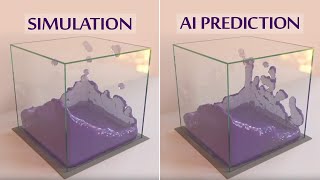
DeepMind trained neural networks to simulate physics like fluids and smoke instead of using hand-coded equations. The learned models run fast after training and generalize across different shapes and materials, but struggle with extreme cases and long-term predictions.
Chapters
Dear fellow scholars, this is Two Minute Papers with Dr. Zsolnai. If you have been watching this series for a while, you know very well that I love learning algorithms and fluid simulations. But do you know what I like even better? Learning algorithms applied to fluid simulations. So I couldn't be happier with today's paper. We can create wondrous fluid simulations like the ones you see here by studying the laws of fluid motion from physics and write a computer program that contains these laws. As you see, the amount of detail we can simulate with these programs is nothing short of amazing. However, I just mentioned neural networks. If we can write a simulator that runs the laws of physics to create these programs, why would we need learning based algorithms? The answer is in this paper that we have discussed about 300 episodes ago. The goal was to show a neural network video footage of lots and lots of fluid and smoke simulations and have it learn how the dynamics work to the point that it can continue and guess how the behavior of a smoke puff would change over time. We stopped the video and it would learn how to continue it, if you will. This definitely is an interesting take, as normally we use neural networks to solve problems that are otherwise close to impossible to tackle. For instance, it is very hard, if not impossible, to create a handcrafted algorithm that detects cats reliably because we cannot really write down the mathematical description of a cat. However, these days we can easily teach a neural network to do that. But this task here is fundamentally different. Here the neural networks are applied to solve something that we already know how to solve. Especially given that if we use a neural network to perform this task, we have to train it, which is a long and arduous process. I hope to have convinced you that this is a bad, bad idea. Why would anyone bother to do that? Does this make any sense? Well, it does make a lot of sense, and the reason for that is that this training step only has to be done once, and afterwards, querying the neural network that is predicting what happens next in the simulation runs almost immediately. This takes way less time than calculating all the forces and pressures in the simulation while retaining high quality results. So we suddenly went from thinking that an idea is useless to being amazing. What are the weaknesses of the approach? Generalization. You see, these techniques, including a newer variant that you see here, can give us detailed simulations in real time or close to real time. But if we present them with something that is far outside of the cases that they had seen in the training domain, they will fail. This does not happen with our handcrafted techniques. Only to AI based methods. So onwards to this new technique and you will see in just a moment that a key differentiator here is that its generalization capabilities are just astounding. Look here. The predicted results match the true simulation quite well. Let's look at it in slow motion too, so we can evaluate it a little better. Looking great. But we have talked about superior generalization, so what about that? Well, it can also handle sand and goop simulations. So that's a great step beyond just water and smoke. And now have a look at this one. This is a scene with the boxes it has been trained on. And now let's ask it to try to simulate the evolution of significantly different shapes. Wow. It not only does well with these previously unseen shapes, but but it also handles their interactions really well. But there is more. We can also train it on a tiny domain with only a few particles. And then it is able to learn general concepts that we can reuse to simulate a much bigger domain and also with more particles. Fantastic. But there is even more. We can train it by showing how water behaves on these water ramps and. And then let's remove the ramps and see if it understands what it has to do with all these particles. Yes, it does. Now let's give it something more difficult. I want more ramps. Yes. And now even more ramps. Yes. I love it. Let's see if it can do it with sand too. Here's the ramp for the training. And let's try an hourglass now. Absolute witchcraft. And we are even being paid to do this. I can hardly believe this. The reason why you see so many particles in many of these views is because if we look under the hood, we see that the paper proposes a really cool graph based method that represents the particles and they can pass messages to each other over these connections between them. This leads to a simple, general and accurate model that truly is a force to be reckoned with. Now this is a great leap in neural network based physics simulations. But of course not everything is perfect here. Its generalization capabilities have their limits. For instance, over longer time frames, solids may get incorrectly deformed. However, I will quietly note that during my college years I was also studying the beautiful Navier Stokes equations. And even as a highly motivated student, it took several months to understand the theory and write my first fluid simulator. You can check out the thesis and the source code in the video description if you are interested. And to see that these neural networks could learn something very similar in a matter of days. Every time I think about this, shivers run down my spine. Absolutely amazing. What a time to be alive. This episode has been supported by Lambda. If you're a researcher or a startup looking for cheap GPU compute to run these algorithms, check out Lamda GPU Cloud. I've talked about Lambda's GPU workstations in other videos and am happy to tell you that they are offering GPU cloud services as well. The Lambda GPU Cloud can train ImageNet to 93% accuracy for less than $19. Lambda's web based IDE lets you easily access your instance right in your browser. And finally, hold on to your papers because the Lambda GPU Cloud costs less than half of AWS and Azure. Make sure to go to lambdalabs.compapers and sign up for one of their amazing GPU instances today. Thanks for watching and for your generous support and I'll see you next time.