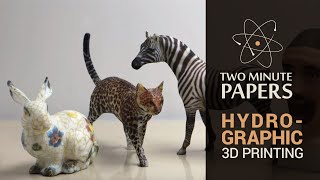
A short YouTube episode (Two Minute Papers) by Károly Zsolnai-Fehér describing hydrographic printing for adding color/textures to 3D objects. The speaker explains the basic physical process, its limitations (distortion when immersing objects), and a computational technique that simulates film distortion to produce corrected image maps for accurate printing, including support for multiple immersions on non‑planar objects.
Chapters
Dear fellow scholars, this is two minute papers with so many of you were sharing the previous episode for the first time. I just couldn't keep up and write a kind message to every single one of you. But I'm trying my best. It really means a lot. And again, just thanks so much for sharing. So delighted to see that people are coming in, checking out the series and expressing that they liked it. The feedback has been absolutely insane. You fellow scholars seem to love the show quite a bit and it really makes my day. It it's also fantastic to see that there is a hunger out there for science. People want to know more on what is happening inside the labs. That's really amazing. Thank you and let us continue together on our scholarly journey. 3D printing is a technique to create digital objects in real life. It has come a long way in the last few years. There has been excellent work done on designing deformable characters, mechanical characters, and characters of varying elasticity. You can even scan your teeth and print copies of them. And these are just a few examples of a multitude of things that you can do with 3D printing. However, this technology is mostly focused on the geometry itself. Colored patterns that people call textures still remains a challenge and we only have very rudimentary technology to do that. So check this out. This is going to be an immersive experience. Hydrographic printing on 3D surfaces is a really simple technique. You place a film in water, use a chemical activator, spray on it, and shove the object in the water. So far so good. However, since these objects start stretching the film, the technique is not very accurate. It only helps you putting repetitive patterns on these objects. Computational hydrographic printing is a technique that simulates all of these physical forces that are exerted on the film when your desired object is immersed into the water. Then it creates a no image map. Taking all of these distortions into account and this image you can print with your home inkjet printer. The results will be really accurate, close to indistinguishable from the digitally designed object. The technique also supports multiple immersions that helps putting textures on a non planar object with multiple sides to be colored. So as you can see, 3D printing is improving at a rapid pace. There's tons of great research going on in this field. It is a technology that is going to change the way we live our daily lives in ways that we cannot even imagine yet. And what would you print with this? Do you have any crazy ideas? Let me know in the comment section. And for now, thanks for watching and I'll see you next time.