Insane New AI Recreates Games Like GTA and RDR2 and Lets You Play Them Live
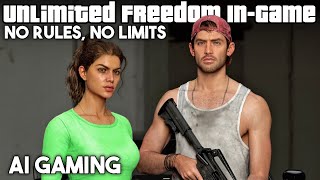
Tencent's Game Gen O is an AI model that generates playable open-world game content from text prompts, trained on 15,000 annotated video clips. It can create characters, environments, and events on the fly, letting you control what happens in real time like you're playing GTA or Red Dead Redemption 2.
Chapters
Game development is about to change in a big way. And it's all thanks to Game Gen O, the first AI model designed specifically to generate open world video games. This technology has the power to create entire game worlds, characters and events from scratch, pushing the limits of what we thought possible in gaming. Gamegen O is the first ever diffusion transformer model specifically designed to generate open world video games. I know that might sound a bit technical, but stick with me because I promise you it's worth it. We're talking about a whole new way of creating video games. So this is a model that can generate high quality open world content on the fly. It doesn't just spit out pre programmed environments or characters. It actually simulates everything. Think of innovative characters, dynamic environments, complex actions and diverse events, all generated from scratch by an AI. Oh, and did I mention that this model provides interactive controllability too? Yeah. We're talking about a future where game engines could be replaced by AI models like this one. Let's go through this step by step and by the end, you'll see why this technology marks a major breakthrough for gaming. Now, Game Gen O didn't just pop out of nowhere. The development team at Tencent, yeah, the giant company behind some of the most popular games on the planet, put in some serious work to get this off the ground. And they didn't just start with some basic game data either. They built something called O Game Data, which is a massive data set specifically tailored for open world video games. Now, O Gamedata is key here. Tencent compiled 32,000 raw videos from various sources, including the Internet and game engines. The clips range from a few minutes to several hours of gameplay. Featuring over 100 next generation open world games like Red Dead Redemption 2 and GTA 5. This massive collection forms the foundation for training Game Gen O. The team then filtered these clips down to about 15,000 usable videos, which were broken up into smaller clips using scene detection. These clips went through a process that looked at their aesthetics, optical flow and even their semantic content. In simple terms. The AI sorted through all the visual and gameplay elements, ranking and scoring the clips so that only the best made it through to the next stage. Stage? After that, they added detailed annotations. So basically there is a human expert sitting down labeling these clips with everything from environmental details to character actions. On top of that, they used multimodal large models. Think GPT4, but trained for video games to further enhance these annotations. The result? A super detailed interactive dataset that forms the core of what Game Gen O is trained on alright, so let's talk about the training process. Gamegenos development happens in two key stages. The first is called Foundation Pre Training. And here's where things get really technical. The team used something called a 2.1D VAE variational auto encoder, specifically a version of Magvit V2 to compress the video clips. This VAE was adapted specifically for the gaming domain, meaning it could handle the unique challenges of generating game like content. During this stage, the model learned to generate text to video content. So essentially, gamegen O can take a simple text description and turn it into a fully rendered video. Not just that, but it can also continue an existing video, making it perfect for open world game generation, where the story and environment evolve over time. Next up is the instruction tuning stage, which is where things get interactive. At this point, gamegeno has already learned how to generate high quality video clips and but now it's time to give it the power to respond to multimodal inputs. Things like structured text prompts, operation signals and video prompts. This is what gives the model its interactive controllability, meaning it doesn't just generate content passively. It can respond and adapt to changes based on what's happening in the game world. For example, let's say you input something like make the sky dark and stormy and the model generates a dark, moody environment. Then you could follow up with a command like move the character forward and the AI would dynamically adjust both the character and the environment in real time. Alright, now the fun part. What kind of stuff can gamegen O generate? The capabilities of this model are truly impressive because the range of what this model can create is just enormous. Character generation? Yes, it's all there. Think of characters like Geralt of Rivia, Arthur Morgan or even Robocop. But it doesn't stop with familiar faces. Game Gen O can generate completely original characters like a Venom Druid touring rune forest or a Cybermonk roaming through a futuristic Chinatown. So whether you're looking for something realistic or more fantasy based, this model has it covered. Then there's environment generation. You can create anything from lush lavender fields to vast pyramids in the desert, or even something as surreal as a traveler walking on Mars. And we're not just talking static images here. The AI can generate dynamic environments where things change over time. Seasons shift, the weather evolves, and events like snowstorms, tsunamis and tornadoes unfold in real time. Action generation is another big one. Game Gen O can generate everything from motorcycle chases in first person to horseback riding in third person. Whether your Game involves high speed action like flying or something more grounded like walking. The model can simulate it with impressive accuracy. And then there's event generation. Imagine a game where at any moment a random event like a sandstorm or sunrise could completely change the vibe. With Game Gen O, you can generate those events dynamically based on the storyline or player actions. Now, one of the most impressive aspects of this technology is its interactive control. For example, during gameplay, you can input commands such as move the character left or increase the intensity of the storm, and the AI will instantly respond, generating the next scene or action based on those instructions. This real time adaptability allows for dynamic and responsive gameplay that adjusts to your actions. The core of this interactivity is instructnet, a branch of Game Gen O designed to handle multimodal inputs. So whether you're giving it structured text like fire on the sky or operation signals like Move Right, the model knows how to generate the next set of content accordingly. It's this real time interaction that makes gamegenos stand out as more than just a fancy video generator. Right now, gamegen O can generate what you'd call simulated gameplay, meaning it's not yet fully interactive in the way traditional games are. You can't control every little movement in real time. But Tencent has already hinted that future versions will allow for more direct control over the game world. So yeah, the future of AI generated games where you can have full control isn't that far off. Game Gen O may seem similar to Roblox, where users create their own games, but the key difference is that Game Gen O targets professional developers, while Roblox is for casual creators. Game Gen O automates complex tasks that typically take large teams months or even years to complete. This model could potentially democratize game development, meaning smaller teams or even individual developers could use it to create AAA level games without the need of for massive resources. And when you think about that, the implications are huge. This could fundamentally change how games are made, opening up the industry to more diverse voices and creative ideas. The potential for Game Gen O goes beyond video games, extending into virtual reality, filmmaking and city design. Tencent's Gen X, another AI model, is already generating large scale cities. And when combined with Game Gen O, it opens up possibilities for creating entire virtual worlds and fully interactive films. However, this raises serious concerns around intellectual property and copyright. If AI generates content based on existing games, the boundaries of ownership become unclear. These are issues the industry will need to address as models like gamegen O grow in use. We're really only at the beginning stages of what this technology can do in just a few years. It's entirely possible that games could be full of fully generated and controlled by AI. So what do you think about game Gen O? Could this be the future of gaming? Or are we still far from fully realizing AI driven game worlds? It's an exciting time in tech and I'm eager to see how it all unfolds. Alright, don't forget to like subscribe and comment for more updates on tech and gaming. Thanks for watching and I'll see you in the next one.










