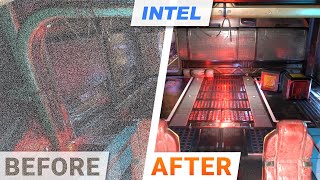
Short explainer (Two Minute Papers) demonstrating Intel’s new light-transport simulation and learned denoising/upscaling technique. The presenter contrasts noisy Monte Carlo renders and prior methods (e.g., neural bilateral grid), shows visual comparisons where Intel's method preserves detail and upsamples, and cites performance claims: light simulation ~4–12 ms, denoising/upscaling ~5–10 ms and ~200 FPS. A sponsor mention for Weights & Biases appears at the end.
Chapters
Dear fellow scholars, this is two minute papers with Dr. Zsolnai. This is my happy episode. Why is that? Well, of course, because today we are talking about light transport simulations and in particular Intel's amazing new technique that can take this and make it into this. Wow. It can also take this and make it into this. My goodness, this is amazing. But wait a second. What is going on here? What are these noisy videos for? And why? Well, if we wish to create a truly gorgeous photorealistic scene in computer graphics, we usually reach out to a light transport simulation algorithm and then this happens. Oh no. We have noise. Tons of it. But why? Well, during the simulation we have to shoot millions and millions of light rays into the scene to estimate how much light is bouncing around. And before we have simulated enough rays, the inaccuracies in our estimations show up as noise in these images. And this clears up over time, but it may take a long time. How do we know that? Well, have a look at the reference simulation footage for this paper. See, there is still some noise in here. I am sure this would clean up over time, but no one said that it would do so quickly. A video like this might still require hours to days to compute. For instance, this is from a previous paper that that took three weeks to finish and it ran on multiple computers at the same time. So is all hope lost for these beautiful photorealistic simulations? Well, not quite. Instead of waiting for hours or days, what if I told you that we can just wait for a small fraction of a second, about 10 milliseconds, and it will produce the this. And then run a previous noise filtering technique that is specifically tailored for light transport simulations. And what do we get? Probably not much, right? I can barely tell what I should be seeing here. So let's see a previous method. Whoa. That is way better. I was barely able to guess what these are, but now we know. Gratings. Great. So we don't have to wait for hours to days for a simulated world to come alive in a video like this. Just a few milliseconds at least for the simulation. We don't know how long the noise filtering takes. And now hold on to your papers because this was not today's paper's result. I hope this one can do even better. And look, instead it can do this. Wow, this is so much better. And the result of the reference simulation for comparison. This is the one that takes forever to compute. Let's also have a look at the videos and compare them. This is the noisy input simulation. Wow. This is going to Be hard. Now, the previous method. Yes, this is clearly better. But there is a problem. Do you see the problem? Oh yes, it smooths out the noise, but it smooths out the details too. Hence a lot of them are lost. So let's see what Intel's new method can do instead. Now we're talking. So much better. I absolutely love it. It is still not as sharp as the reference simulation. However, in some regions, depending on your taste, it might even be more pleasing to the eye than this reference. And it gets better. This technique does not only denoising but upsampling too. This means that it is able to create a higher resolution image with more pixels than the input footage. Now get ready. One more comparison and I'll tell you how long the noise filtering took. I wonder which what it will do with this noisy mess. I have no idea what is going on here. And neither does this previous technique. And this is not some ancient technique. This previous method is the neural bilateral grid. A learning based method from just two years ago. And now have a look at this. My goodness, is this really possible? So much progress. Just one more paper down the line. I absolutely love it. So good. So how long do we have to wait for an image like this? Still hours to days. Well, not at all. This all runs not only in real time, it runs faster than real time. Yes, that means about 200 frames per second for the new noise filtering step. And remember, the light simulation part typically takes 4 to 12 milliseconds. On these scenes, this is the noisy mess that we get. And just 5 milliseconds later we get this. I cannot believe it. Bravo. So, real time light transport simulations from now on. Oh yes, sign me up right now. What a time to be alive. So what do you think? Let me know in the comments below. This video has been supported by weights and biases. Look at this. They have a great community forum that aims to make you the best machine learning engineer you can be. You see, I always get messages from you fellow scholars telling me that you have been inspired by the series but don't really know where to start. And here it is. In this forum you can share your projects, ask for advice, look for collaborators and more. Make sure to visit WNB Me Paperforum and say hi or just click the link in the video description. Our thanks to Weights and Biases for their long standing support and for helping us make better videos for you. Thanks for watching and for your generous support and I'll see you next time.