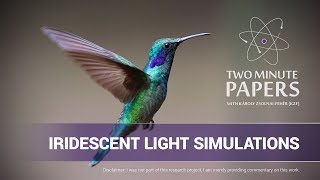
Károly Zsolnai-Fehér explains iridescence, the color shift you see in bird feathers and insect wings when light or viewing angle changes. The effect happens because surfaces scatter different wavelengths in different directions. A new paper shows how to simulate it accurately using microfacet models and spectral integration.
Chapters
Dear fellow scholars, this is two minute papers with from many fond childhood memories. Most of us are quite fond of the colorful physical appearance of bubbles and fuel water mixtures. We also know surprisingly little about this peculiar phenomenon where the color of an object changes when we either turn our head or change the lighting. This happens in a very colorful manner and physicists like to call this iridescence or goniochromism. What is even less known is that if we try to use a light simulation program to make an image with leather, we'll be surprised to see that it also shows a pronounced goniochromatic effect. An even more less known fact is that quite a few birds, insects, minerals, seashells and even some fruits are iridescent as well. I've added links to some really cool additional readings to the video description for your enjoyment. This effect is caused by materials that scatter different colors of light in different directions. A white incoming light is therefore scattered not in one direction, but in a number of different directions, sorted by their colors. This is why we get these beautiful rainbow colored patterns that we all love so much. Now that we know what iridescence is, the next step is obviously to infuse our light simulation programs to have this awesome feature. This paper is about simulating this effect with micro facets, which are tiny microstructures on the surface of rough objects. And with this it is now suddenly possible to put a thin iridescent film onto a virtual object and create a photorealistic image out of it. If you are into math and would like to read about some tasty spectral integration in the frequency space with Fourier transforms, this paper is for you. If you're not a mathematician. Also make sure to have a look because the production quality of this paper is through the roof. The methodology, derivations, comparisons are all really crisp. The Loving it if you have a look, you will get a glimpse of what it takes to create a work of this quality. This is one of the best papers in photorealistic rendering I've seen in a while. In the meantime, I'm getting more and more messages from you fellow scholars who tell their stories on how they chose to turn their lives around and started studying science because of this series. Wow, that's incredibly humbling and I really don't know how to express my joy for this. I always say that it's so great to be a part of the future and I am delighted to see that some of you want to be a part of the future and not only as an observer, but as a research scientist this sort of impact is stronger than the absolute best case scenario I have ever dreamed of for the series. Thanks for watching and for your generous support, and I'll see you next time.