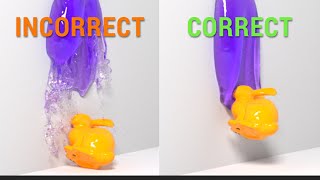
This is a Two Minute Papers (Dr. Zsolnai) video explaining a new fluid-simulation technique called "Monolith" that provides robust two-way coupling between fluids/gooey materials and solids. The narrator shows three demo experiments — "water bunnies" (demonstrating volume loss in prior methods), gooey dragons/balls (failure modes of traditional techniques), and a bunny sticking to goo (viscosity/contact correctness) — and contrasts previous methods with Monolith, which eliminates volume loss, prevents artificial melting, and produces stable contact behavior. The narration also highlights a performance claim: Monolith is up to 10× faster than previous methods. The episode closes with a sponsor mention for Weights & Biases.
Questions this video answers
December 29, 2020.
Monolith.
Up to 10× faster.
Weights & Biases.
Chapters
Dear fellow scholars, this is Two Minute Papers with Dr. Zsolnai. This new paper fixes many common problems when it comes to two way coupling in fluid simulations. And of course, the first question, what is two way coupling? It means that here the boxes are allowed to move the smoke. And the added two way coupling part means that now the smoke is also allowed to blow away the boxes. What's more, the vortices here on the right are even able to suspend the red box in the air for a few seconds. An excellent demonstration of a beautiful phenomenon. However, simulating this effect properly for water simulations and for gooey materials is a huge challenge. So let's see how traditional methods deal with them. Experiment number one. Water bunnies. Do you see what I am seeing here? Did you see the magic trick? Let's look again. Observe how much water we are starting with. A full bunny worth of water. And then by the end we have maybe a quarter of a bunny left. Oh yes. We have a substantial amount of numerical dissipation in the simulator that leads to volume loss. Can this be solved somehow? Well, let's see how this new work deals with this. Starting with one bunny and ending it with one bunny. Nice. Just look at the difference of the volume of water left with the new method compared to the previous one. Night and day difference. And this was not even the worst volume loss I've seen. Make sure to hold on to your papers and check out this one. Experiment number two. Gooey dragons and balls. When using a traditional technique. Whoa. This guy is gone. And when we try a different method, it does this. My goodness. So let's see if the new method can deal with this case. Oh yes, yes it can. And now onwards to experiment number three. If you think that research is about throwing things at the wall and seeing what sticks in the case of this scene, you are not wrong. So what should happen here, given these materials? Well, the bunny should stick to the goo and not fall too quickly. Hmm. None of which happens here. The previous method does not simulate viscosity properly and hence this artificial melting phenomenon emerges. I wonder if the new method can do this too. And yes, they stick together. And the goo correctly slows down the fall of the bunny. So how does this magic work? Normally in these simulations, we have to compute pressure, viscosity and frictional contact separately when which are three different tasks. The technique described in the paper is called Monolith because it has a monolithic pressure viscosity contact solver. Yes, this means that it does all three of these tasks in one go, which is mathematically a tiny bit more involved, but it gives us a proper simulator where water and goo can interact with solids. No volume loss, no artificial melting, no crazy jumpy behavior. And here comes the punchline. I was thinking that alright, a more accurate simulator that is always welcome, but what is the price of this accuracy? How much longer do I have to wait? If you have been holding on to your papers, now squeeze that paper because this technique is not slower but up to 10 times faster than previous methods. And that's where I fell off the chair when reading this paper. And with this I hope that we will be able to marvel at even more delightful two way coupled simulations in the near future. What a time to be alive. This episode has been supported by Weights and Biases. In this post they show you how you can get an email or Slack notification when your model crashes. With this you can check on your model performance on any device. Heavenly Weights and Biases provides tools to track your experiments in your deep learning projects. Their system is designed to save you a ton of time and money and it is actively used in projects at prestigious labs such as OpenAI, Toyota Research, GitHub and more. And the best part is that Weights and Biases is free for all individuals, academics and open source projects. It really is as good as it gets. Make sure to Visit them through wnb.com papers or just click the link in the video description and you can get a free demo today. Our thanks to WeightsAndBiases for their long standing support and for helping us make better videos for you. Thanks for watching and for your generous support and I'll see you next time.