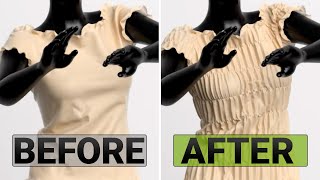
Dr. Zsolnai explains a new cloth-simulation technique that generates submillimeter wrinkles eight times faster than previous methods, achieving high-detail results in about one second per frame. The single-author work by Huamin Wang was accepted to SIGGRAPH.
Questions this video answers
November 2, 2021.
Huamin Wang.
SIGGRAPH.
About eight times faster.
Approximately 1 second per frame (often less).
Dear fellow scholars, this is Two Minute Papers with Dr. Zsolnai.
Today we are going to create beautiful virtual clothes and marvel at how quickly we can simulate them. And the kicker is that these simulations are able to create details that are so tiny they are smaller than a millimeter. And when I first saw the title.
Of this paper, I had two thoughts.
First, I asked submillimeter level, is this really necessary? Well, here is a dress rendered at the level of millimeters. And here is what it would look like with this new simulation technique. Hmm, so many crisp details suddenly appeared. Ok, you got me. I am now converted. So let's proceed to the second issue here. I also said I will believe this kind of quality in a simulation when I see it. So how does this work? Well, we can give it a piece of coarse input geometry. And this new technique synthesizes and simulates additional wrinkles on it. For instance, here we can add these vertical shirring patterns to it. And not only that, but we can still have collision detection so it can interact with other objects. And suddenly the whole piece looks beautifully lifelike. And as you see here, the direction of these patterns can be chosen by us. And it gets better because it can handle other kinds of patterns too. I am a light transport researcher by trade, and I am very pleased by how beautifully these specular highlights are playing with the light. So good. Now let's see it in practice. On the left you see the coarse geometry input. And on the right you see the magical new clothes this new method can create from them. And yes, this is it. Finally, I always wondered why virtual characters with simulated clothes always looked a little flat for many years. Now these are the details that were missing. Just look at the difference this makes. Loving it. But how does this stack up against previous methods? Well, here is a previous technique from last year. And here is the new one. Ok, how do we know which one is really better? Well, we do it in terms of mathematics. And when looking at the relative errors from a reference simulation, the new one is more accurate. Great. But hold on to your papers because here comes the best part. Whoa. It is not only more accurate, but it is blistering fast. Easily eight times faster than the previous method. So where does this put us in terms of total execution time? At approximately 1 second per frame, often even less. What? 1 second per image for a crisp sub millimeter level class simulation that is also quite accurate. Wow. The pace of progress in computer graphics research is absolutely amazing. And just imagine what we will be able to do two more papers down the line. This might run in real time easily. Now. Drawbacks? Well, not really a drawback, but there are cases where the submillimeter level simulation results materialize in a bit more crisp creases, but not much more. I really had to go to hunt for differences in this one. If you have spotted stark differences between the two here, please let me know in the comments. And here comes one more amazing thing. This paper was written by Huamin Wang and that's it. A single author paper that has been accepted to the Siggraph conference, which is perhaps the most prestigious conference in computer graphics. That is a rare sight indeed. You see, sometimes even a single researcher can make all the difference. Huge congratulations.
This episode has been supported by Lambda GPU Cloud. If you're looking for inexpensive cloud GPUs for AI, check out Lambda GPU Cloud. They've recently launched Quadro RTX 6000, RTX 8000 and V100 instances and hold on to your papers because Lambda GPU Cloud can cost less than half of aws and and Azure plus they are the only cloud service with 48 gigabyte RTX 8000. Join researchers at organizations like Apple, MIT and Caltech in using Lambda Cloud instances, workstations or servers. Make sure to go to lambdalabs.compapers to sign up for one of their amazing GPU instances today. Our thanks to Lambda for their long standing support and for helping us make.
Better videos for you. Thanks for watching and for your generous support and I'll see you next time.