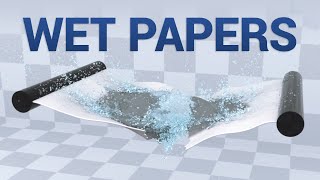
A single algorithm simulates wet papers, dissolving powder, and water-soaked biscuits all in one framework. The method handles hyperelastic, elastoplastic, and viscous fracturing behaviors, with demos including a dog shaking off water and refraction effects as materials absorb liquid.
Questions this video answers
April 27, 2021.
A bit faster than one frame per second.
About one minute per frame.
Near a quarter million particles.
The algorithm had to advance time in very small increments—"a hundred thousand times for each second of footage" (as stated).
Chapters
Dear fellow scholars, this is Two Minute Papers with Dr. Zsolnai. Yes, you see it correctly. This is a paper on paper. The paper paper, if you will. And today you will witness some amazing works in the domain of computer graphics and physics simulations. There is so much progress in this area. For instance, we can simulate honey coiling, baking and melting bouncy jelly and many related phenomena. And none of these techniques use any machine learning. These are all good old fashioned handcrafted algorithms. And using these we can simulate stretching and compression to the point that muscle movement simulations are possible when attaching muscles to bones. As we move the character, the muscles move and contract accurately. What's more, this work can even perform muscle growth simulations. So are we done here? Did these ingenious computer graphics researchers max out physics simulation where there is nothing else to do? Oh no, of course not. Look, this footage is from an earlier computer graphics paper that simulates viscosity and melting fluids. And what I would like you to look at here is not what it does, but what it doesn't do. It starts melting these armadillos beautifully. However, there is something that it doesn't do, which is mixing the materials. Start separate and remain separate. Can we improve upon that somehow? Well, this new paper promises that and so much more than that. It truly makes my head spin. For instance, it can simulate hyperelastic elastoplastic, viscous fracturing and multiphase coupling behaviors. And most importantly, all of these can be simulated within the same framework. Not one paper for each behavior. One paper that can do all of these. That is absolutely insane. So what does all that mean? Well, I say let's see them all. Right now, through five super fun experiments. Experiment one, wet papers. As you see, this technique handles the ball of water. Ok, we've seen that before. And what else? Well, it handles the paper too. Ok, that's getting better. But hold on to your papers and look, it also handles the water's interaction with with the paper. Now we're talking. And careful with holding onto that paper because if you do it correctly, this might happen. As you see, the arguments contained within this paper really hold water fracturing. As you know, most computer graphics papers on physics simulation contain creative simulations to destroying armadillos in the most spectacular fashion. This work is of course, no different. Yum. Dissolution. Here we take a glass of water, add some starch powder, it starts piling up and then slowly starts to dissolve. And note that the water itself also becomes stickier during the process. Dipping. We first take a piece of biscuit and, and Dip it into the water. Note that the coupling works correctly here. In other words, the water now moves. But what is even better is that the biscuit started absorbing some of that water and now when we rip it apart. Oh yes, excellent. And as a light transport researcher by trade, I love watching the shape of biscuits distort it here due to the refraction of the water. This is a beautiful demonstration of that phenomenon. And number five, the dog. What kind of dog, you ask? Well, this virtual dog gets a big splash of water, starts shaking it off and manages to get rid of most of it, but only most of it. And it can do all of these using one algorithm, not one per each of these beautiful phenomena. One technique that can perform all of these that is absolutely amazing. But it does not stop there. It can also simulate snow. And it not only does it well, but it does that swiftly. How swiftly? It simulated this a bit faster than one frame per second. The starch powder experiment was about one minute per frame. And the slowest example was the dog shaking off the bowl of water. The main reason for this is that it required near a quarter million particles of water and for hair. And when the algorithm computes these interactions between them, it can only advance the time in very small increments. It has to do this a hundred thousand times for each second of footage that you see here based on how much computation there is to do. That is really, really fast. And don't forget that the first law of paper says that research is a process. Do not look at where we are, look at where we will be. Two more papers down the line and even now the generality of this system is truly something to behold. Congratulations to the authors on this amazing paper. What a time to be alive. So if you wish to read a beautifully written paper today that does not dissolve in your hands, I I highly recommend this one. This episode has been supported by Weights and Biases. In this post they show you how to use their tool to perform distributed hyperparameter optimization at scale Weights and Biases provides tools to track your experiments in your deep learning projects. Their system is designed to save you a ton of time and money and it is actively used in projects at prestigious labs such as OpenAI, Toyota Research, GitHub and and more. And the best part is that Weights and Biases is free for all individuals, academics and open source projects. It really is as good as it gets. Make sure to Visit them through wnb.com papers or just click the link in the video description and you can get a free demo today. Our thanks to weights and biases for their long standing support and for helping us make better videos for you. Thanks for watching and for your generous support and I'll see you next time.