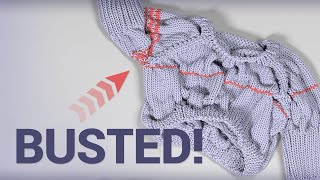
Károly Zsolnai-Fehér shows how existing simulations of chains and cloth produce fake ghost forces and broken links, then demonstrates a verification method that catches these failures. Running at 2400 Hz eliminates violations entirely, while the check itself takes only fractions of a second per frame.
Questions this video answers
35 chain links.
480 Hz, 1200 Hz, and 2400 Hz.
Over 4,000 were destroyed during this simulation.
16 links failed at 1200 Hz.
A simulation with a thousand rubber bands.
Chapters
Of other kinds of simulations. It is an absolutely amazing tool. But wait a second. Look, things are a little too busy here. And it is because artificial ghost forces appeared in a simulation even on a simple test case with 35 chain links. And we discussed a new method and wondered whether it could deal with them. The answer was a resounding yes, no ghost forces. And not only that, but it could deal with even longer chains. Let's try a hundred links. That works too. Now we always say that two more papers down the line and the technique will be improved significantly. So here is the two minute papers. Moment of truth. This is just one more paper down the line. And what are we simulating today? The physics of chains. No, give me a break. This new technique helps us computing the physics of chainmails. Now we're talking. We quickly set the simulation frequency to 480 Hz. Which means that we subdivide 1 second into 480 time instants and compute the interactions of all of these chain links. It looks something like this. This computes relatively quickly and looks great too. Until we use this new technique to verify this method. And see this huge red blob. What does this mean? It means that over 4,000 were destroyed during this simulation. So this new method helps us verify an already existing simulation. You experienced, fellow scholars, know that this is going to be a ton of fun. Finding flaws in already existing simulations. Sign me up right now. Now let's go. And more than double the frequency of the simulation to 1200 hertz. That means we get more detailed computations. Does it make a difference? Let's see if it's any better. Well, it looks different and it looks great. But we are scholars here. Just looking is not enough to tell if everything is in order. So what does the new technique say? Uh oh, still not there. Look, 16 links are still gone. Okay, now let's go all out and double the simulation frequency again to 2400 hertz. And now the number of violations is. Let's see. Finally, zero. The new technique is able to tell us that this is the correct version of the simulation. Excellent. Let's see our next opponent. Well, this simulation looks fine until we take a closer look. And yes, there are quite a few failed links here. And the fixed simulation. So does the verification step take as long as the simulation? If so, does this make sense at all? Well get this. This verification step takes only a fraction of a second for one frame. Let's do two more and then see if we can deal with the final boss simulation. Now we start twisting and some links are already breaking, but otherwise not too bad. And now. Oh my, look at that. The simulation broke down completely. In this case we already know that the verification also takes very little time. So next time we don't have to pray that the simulation does not break. We only have to simulate up until this point and when it unveils the first breakages we can decide to just abort and retry with a more detailed simulation. This saves us a ton of time and computation. So good loving also helps with these knitted cloth simulations where otherwise it is very difficult to tell for the naked eye if something went wrong, but not for this method. And now let's try the final boss, a huge simulation with a thousand rubber bands. Let's see. Yes, the technique revealed that this has tons of failed links right from the start. And let's verify the more detailed version of the same simulation. Finally, this one worked perfectly. And not only that, but it also introduced my favorite guy who wants no part of this and is just sliding away. So from now on with this tool we can not only strike a better balance of computation time and quality for linkage based simulations, but if something is about to break, we don't just have to pray for the simulation to finish successfully. We will know in advance if there are any issues. What a time to be alive. This episode has been supported by Lambda GPU Cloud. If you're looking for inexpensive cloud GPUs for AI, check out Lambda GPU Cloud. They've recently launched Quadro RTX 6000, RTX 8000 and V100 instances. And hold on to your papers because Lambda GPU Cloud can cost less than half of AWS and and Azure. Plus they are the only cloud service with 48 gigabyte RTX 8000. Join researchers at organizations like Apple, MIT and Caltech in using Lambda Cloud instances, workstations or servers. Make sure to go to lambdalabs.compapers to sign up for one of their amazing GPU instances today. Our thanks to Lambda for their long standing support and for helping us make better videos for you. Thanks for watching and for your generous support and I'll see you next time.