Is UBI DEAD? This AI CEO Thinks So...
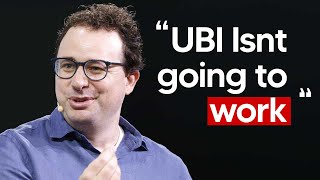
Anthropic CEO Dario Amodei says UBI won't cut it in an AI economy. He and OpenAI's Sam Altman are pushing for something bigger: Altman's idea of "Universal Basic Compute" would give people a stake in advanced AI models instead of just cash.
Chapters
So welcome back to post AGI Economics and in today's video we'll be discussing something that a top AI CEO actually stated in regards to Universal Basic Income. You have to understand that when these statements are made by the CEOs of these top AI companies, we should really be paying attention because their worlds hold a lot more weight than the average person's because they actually can see where the AI industry is going because they have access to the frontier models. And, and even if these models aren't finished yet, they probably do have access to the predictions on how those models will perform on future benchmarks, which allows them to understand how those models will be used in a day to day society. So here you can see that the anthropic CEO says that we need to think bigger than a Universal Basic Income if we want to solve the AI inequality problem. Now the Anthropic CEO is the same company that recently released Claude 3.5 Sonnet, which is actually far superior than the GPT4O recently released by OpenAI. And essentially basically what he's stating here is that the problem is that while Universal Basic Income is a good idea, the problem is that we need to think bigger than this because there are many other fundamental issues that Universal Basic Income might not solve. So this Business Insider article actually speaks about his recent interview where where he delves into a few topics and I can't believe I just said delve, I sound like an AI generated topic. But anyways he said that some fear that the rapid advances in AI may concentrate power and wealth among a small elite. This is something that I spoke about previously where the fact that if we look forward to the fact that if we have AI tools that are built by maybe just three companies like Meta, Google and OpenAI Microsoft, if those models get increasingly better in terms of their capabilities, I don't think there's going to be any other companies that can compete and the majority of the economy is going to be dependent on those models and those automations which means that the majority of the wealth is simply going to flow to those companies whilst the rest are going to be fighting over what's left. Now of course you can see here he's talking about Universal Basic Income may not sufficiently address such a shift, basically stating that the shift is going to be much larger than people do think. And he says there needs to be a broader economic reorganization. Now one person that has actually shared this viewpoint is of course Sam Altman. If you haven't recently looked at this video right here, this is where Sam Altman in the AI for Good Global Summit actually spoke about how the social contract is changing. This means that the current economic model that we use to govern society is going to have to change if we want to actually really address some of the problems that are going to come with very advanced AI system. Take a listen because it's rather insightful and this was something that many people did miss. Many people did actually miss this because the problem was, okay, was that people were focusing on the next model releases, things like GPT5, when actually I think this was arguably the most important part of this interview.
I still expect, although I don't know what and this is over a long period of time. This is not like next year or you know, the year after that kind of thing, but over a long period of time, I still expect that there will be some change required to the social contract given how powerful we expect this technology to be. I'm not a believer that there won't be any jobs. I think we always find new things to do. But I do think like the whole structure of society itself will be up for some degree of debate and reconfiguration and that reconfiguration will be led by the large language model companies. No, no, no. Just the way the whole economy works and what we like, what society decides we want to do. And this has been happening for a long time as the world so this.
Is also another AI CEO actually speaking about the social contract changing. And I think this is important to note because now we have two CEOs on record. Whilst yes, there are many other notable AI people in the space that actually also usher these same things. I think we need to take a look at the fact that the CEO of Anthropic and the CEO of OpenAI, the saying the same thing about the economy is something that is a giant concern. And the main question that many people, including myself will have is that are governments going to be behind the eight ball or are they actually going to be proactive and not reactive as they are in many different cases? In the article he basically states here, and this is how Business Insider breaks down the interview, the rapid advances in AI could consolidate power and wealth in the hands of a small few, which is why many in the tech industry have called for a universal basic income. But some AI leaders say even UBI a recurring cash payment to those in a given population, regardless of their wealth or employment status, wouldn't be enough. Essentially he does state here that I think it's better than nothing, but I would prefer a world in which everyone can contribute. It would be kind of dystopian if there are these few people that can make trillions of dollars and then the government hands it out all to the unwashed masses. Essentially what he's stating here is that yes, universal basic income is going to be something that could be needed and of course it is better than nothing, but we need to think of an economic model that works a lot better than everyone at the top. Well, whatever small group is at the top that has trillions of dollars and then everyone else at the bottom that just has a very, very basic income. This is a scenario that of course you want to try and avoid because it just of societal conflict and is extremely dystopian. So that is why Daario Amodei is basically saying that, look, whilst yes, UBI can solve the base problem of poverty and inequality to a ground extent where you have this flaw to the point that, you know, even if someone is homeless or whatnot, they can afford perhaps a starting point to which they can actually start to build their life back up from. Because there are many unfortunate rare and health conditions that these people do succumb to, especially those that are close to the poverty line. Not to mention the mental health impacts of not knowing when your next paycheck is coming, and of course the psychological effects of poverty, which are pretty damning. The point here is that UBI might not be enough to solve all of the problems. Dario Amadei also suggests that AI will alter society in such a fundamental way that we will need to design a more comprehensive solution. I think in the long run we're generally going to need to think about how do we organize the economy and how humans think about their lives. He doesn't have the answer. He said in part because he believes it needs to be a conversation among humanity. And this is pretty true and also pretty scary. One of the things that I've noticed while doing these videos and actually looking at research and research papers is that there isn't really a proposed solution. One of the only things that is currently being discussed is of course a universal basic income. But other than that being the economic model that they use to, I guess you could say, provide for people who may not have a job. There doesn't seem to be anything after capitalism that seems to sort of work. The reason that I say this is scary is because if you highlight this right here, the point where he says he doesn't have the answer, this is something that many of the tech CEOs and economists continually say they don't have the answer. They don't know what's happening. But the funny thing is, is that all of these AI CEOs are still pushing forward on their models. Now, that isn't to say that these AI CEOs are completely power hungry maniacs that are just pushing forward to be part of the elite. They're in a position where they have no choice but to keep making their models better because they are the CEOs of a very, very competitive industry that is advancing rapidly and if you slow down, you could truly lose the lead. And remember, I've always said in my videos that for these top AI CEOs, their main concern is not to think about the economy and how these AI systems are going to affect it. Their main concern is how to make the models better and how to profit from that and make their investors more money. Which means that it's going to be part of a wider conversation if we actually want to figure out the problems, solutions that this is going to bring. And of course give us. Dario Amodei also talked about, you know, some other things and this kind of brings us to the point where OpenAI CEO Sam Altman has also ushered something which is rather strange, but it's something that I think is at least some kind of different idea. But he proposed the idea of a Universal Basic computer. The idea is that large language models advance. Owning a slice of one will be more valuable than money. I guess you could call this Universal Basic AGI where an advanced AGI system. You could use it, you could sell it, and it's going to be much more valuable than money because as they discussed before, money might change in terms of its value in a post AGI world. So this is the clip here. Many of you may have seen this, but I'm going to replay this once again so you can truly understand the nature of Sam Altman.
Now that we see some of the ways that AI is developing, I wonder if there's better things to do than the traditional conceptualization of ubi. I wonder if the future looks something more like Universal Basic Compute than Universal Basic Income. And everybody gets a slice of GPT7's compute and they can use it, they can resell it, they can donate it to somebody to use for cancer research. But what you get is not dollars, but this productivity slice. Yeah, you own like part of the productivity.
A rather fascinating take on the UBI one I think maybe potentially Universal Basic Compute. If it is truly, truly advanced, it could be potentially part of the UBI because one thing that you might not understand about universal basic compute is that there is going to be a real problem with regards to the energy crisis to actually power these data centers. If we're actually looking into the future and how advanced these models are going to be, it's, it's going to be a situation where not everyone is going to get access to these advanced models either. Number one, there is going to be the energy problem where there's not going to be enough energy to sort of ration this. Like for example, right now GPT4O isn't being rolled out because they just simply don't have the infrastructure. And with future sufficiently advanced AI systems, one of the main problems is going to be distributing that globally. And if those systems are really, really advanced, it's going to be incredibly valuable to have access to those systems. So, so it's going to have to be distributed in a way where it's fair. And definitely having access to those kinds of systems are going to be leveling the playing field. So I think it's going to be, I guess you could say something that's quite like the Internet in terms of how useful it is to, you know, an individual. And although that is quite hard to conceptualize, I think that once you do see what these models are able to do or what they're able to, you know, do in a certain restricted environment or within certain companies, then people will start to understand the value of future AI systems. I know it's quite crazy to conceptualize right now, but this is basically the basis of universal basic compute. Think of it as an AI system that is so valuable and can do pretty much anything that not having it is a competitive disadvantage. Think of it like the Internet or you know, basic housing. Now in terms of universal basic income and what is actually being done at the moment, one thing that I do want to say despite Google's blunders in AI is they seem to actually be one of the only companies that are actually trying to get universal basic income going. You can see here that Google is co funding a $2.8 million guaranteed income pilot in California's Bay Area. The program will give 12,000 over a year, which is $1,000 a month, to 225 families to help them secure long term housing. Universal basic income programs have surged in popularity as a poverty fighting tool. This is actually something that we know has been a problem especially since the rise of inflation. Since 2020 they printed around, I'm not even sure, I think it was around 20% of the supply in maybe a year, but we do know that inflation is running rampant and of course this doesn't help people at the very bottom. Google's financing role is part of its billion dollar pledge to fight the housing crisis in San Francisco and the surrounding areas. So overall, I'd like to know your opinions on what you think about universal basic income and if you think there are any other solutions. I do. Basic income is something that is going to be needed. I do think that in certain states, in certain areas, universal basic income, even if it was just $500 a month or something like that, I think that is going to be something that is remarkably valuable. And I did actually want to share some of the comments from a Reddit thread where they were actually discussing this same post. So you can see here someone actually discussed universal basic resources such as housing, healthcare, utilities, basic food and clothing, education, robust public transport, etc. But I'm doubtful if we'll see that anytime soon though, if ever. I think that this is possibly a great solution to basically have, you know, just the basic kind of resources that allow you to not die on the side of the street. But you know, right now in society we still have an unfortunate scenario where capitalism allows some people to be multi billionaires and it allows some people to live on less than a dollar a day, which is not something that I think capitalism intended. But technology has sort of, you know, exaggerated things to the point where we have these extreme extremes. And if you've ever visualized the wealth distribution, you'll know that wealth inequality is truly incredible. And if it gets any further than it will now with automation, it's going to be like something that just looks out of a sci fi movie. Someone also said here the whole economic system will have to shift if AGI actually comes. Capitalism collapses without labor and humans will be freed from having to perform labor just like animals were with the invention of tractors. Hopefully we won't get factory farmed the same way, but actually get to live on a happy little farm. Quite an interesting concept here and I think one of the most scariest things, even though that sentence didn't make sense, but one of the things that is quite, not shocking but quite concerning is the fact that a lot of these solutions are based on the fact that we are hoping, praying that the government has a solution which benefits the average person and usually depending on the government in the past hasn't boded well for those who have to do so. It usually turns into a, into some kind of dictatorship or just a state where you're not exactly happy. Because of course you don't have any agency and you're dependent on the government. By the way, let me know your thoughts about this. These are the kinds of things that we discuss on school.com/agipreparedness. It's the first link in the description. I've wrote an entire framework on how to prepare for AGI, also included a 22 page guide on how you can invest for AGI. And we regularly discuss things like ubiquitous, the best jobs for the post AGI future so that you aren't automated away, and many of the solutions to the existing problems that will face us in the future. If you enjoyed this video, let me know your thoughts down below and hopefully you enjoyed this content.










