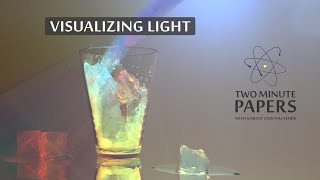
Károly Zsolnai-Fehér explains how finite light speed means we see reflections slightly in the past. Femtophotography captures light traveling in real time, and transient rendering simulates how light propagates through caustics frame by frame.
Chapters
Dear fellow scholars, this is two minute papers with Dr. Have you heard the saying that whenever we look into the mirror, strictly speaking, we don't really see ourselves, but we see ourselves from the past, from a few nanoseconds ago. Is that true? If so, why? This is indeed true. And the reason for this is that the speed of light is finite and it has to travel back from the mirror to our eyes. If you feel that this is really hard to imagine, you are in luck. Because a legendary paper from 2013 by the name femtophotography captured this effect. I would say it is safe to start holding onto your papers from this point basically until the end of this video. Here you can see a super high speed camera capturing how a wave of light propagates through a bottle. Most makes it through and some gets absorbed by the bottle cap. But this means that this mirror example we talked about shall not only be a thought experiment, but we can even witness it ourselves. Yup. Toy first, mirror image second. Approximately a nanosecond apart. So if someone says that you look old, you have an excellent excuse. Now, the first author of this work was Andreas Welten, who worked on this at mit and he is now a professor leading an incredible research group called at the University of Wisconsin, Madison. But wait. Since it is possible to create light transport simulations in which we simulate the path of many, many millions of light rays to create a beautiful photorealistic image, Adrian Jarabo thought that he would create a simulator that wouldn't just give us the final image, but he would show us the propagation of light in a digital simulated environment, as you see here. With this we can create even crazier experiments. Because we are not limited to the real world light conditions and limitations of the camera. The beauty of this technique is just unparalleled. He calls this method transient rendering. And this particular work is tailored to excel at rendering caustic patterns. A caustic is a beautiful phenomenon in nature where curved surfaces reflect or refract light, thereby concentrating it to a relatively small area. I hope that you are not surprised when I say that this is the favorite phenomenon of most light transport researchers. Now a word about these caustics. We need a super efficient technique to be able to pull this off. For instance, back in 2013 we showcased a fantastic scene made by Vlad Miller that was a nightmare to compute. And it took a community effort and more than a month to accomplish it. Beyond that, the transient renderer only uses very little memory, builds on the photon beams technique we talked about a few videos ago. And always arrives to a correct solution given enough time. Bravo. And we can do all this through the power of science. Isn't it incredible? And if you feel a little stranded at home and are yearning to learn more about light transport I held a master level course on light transport simulations at the Technical University of Vienna. Since I was always teaching it to a handful of motivated students, I thought that the teachings shouldn't only be available for the privileged few who can afford a college education, but the teachings should be available for everyone. So the course is now available free of charge for everyone. No strings attached. So make sure to click the link in the video description to get started. We write a full light simulation program from scratch there and learn about physics, the world around us and more. This episode has been supported by Weights and Biases. In this post they show you how to build and track a simple neural network in Keras to recognize characters from the Simpsons series. You can even fork this piece of code and start right away. Also, Weights and Biases provides tools to track your experiments in your deep learning projects. Their system is designed to save you a ton of time and money and it is actively used in projects at prestigious labs such as OpenAI, Toyota Research, GitHub and more. And the best part is is that if you're an academic or have an open source project, you can use their tools for free. It really is as good as it gets. Make sure to Visit them through wnb.com papers or just click the link in the video description and you can get a free demo today. Our thanks to WeightsAndBiases for their long standing support and for helping us make better videos for you. Thanks for watching and for your generous support and I'll see you next time.