Landing a Job in AI: Hiring Secrets from Technical Recruiters
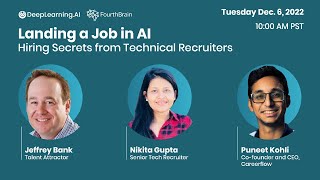
This content was created by LARRUZ. This content was uploaded by LARRUZ. This is a YouTube live panel/webinar titled "Landing a Job in AI: Hiring Secrets from Technical Recruiters" (recorded Dec 6, 2022). Hosted by Linda (Talent Partner at AI Fund), the session brings together panelists Jeffrey Bank (technical recruiter with long experience including LinkedIn/Roblox), Nikita (senior tech recruiter and recruiting influencer), and Puneet (CEO/co‑founder of CareerFlow AI and hiring manager). The live global audience (noted attendees from 140+ countries) joined via YouTube with Q&A handled through Slido/chat. The discussion focuses on practical hiring and job‑search advice for AI/ML roles: how to make resumes/LinkedIn stand out after layoffs, best practices for reaching out to recruiters and hiring managers, role types in AI (ML engineer, data scientist, MLOps, prompt engineering, annotation/QA), interview prep resources (LeetCode, CodeSignal, system‑design practice, mock interviews), handling rejection, networking/referrals, and hiring outlook for AI in 2023.
Chapters
Sa.
Hi everyone and welcome to Landing a Job in AI Hiring Secrets from Technical Recruiters. My name is Linda and I'm the Talent Partner for AI Fund. I'll be your host and moderator today. We appreciate you taking the time to join us for this event. We're so glad to see you tuning in from all over the world. We have attendees from over 140 countries today and if it's late for you, thank you for staying up to join us. Our event today focuses on bringing together the deep learning AI in Fourth Brain communities to share recruiting insights to help learners prepare for technical interviews. While millions of job seekers are enrolling for AI courses, finding a machine learning job that matches your skill set remains challenging. So we aim to provide an event to help support our global community as they continue to look and apply for jobs in tech in other industries. So we're going to get right into it today. If you hear anything during our discussion that prompts a question you'd like to.
Ask.
One of our panelists, please follow the slido link in the description box on your YouTube page. Even if you're just listening, you can click the link to see the questions others have asked and upvote your favorites. Our speakers will do their best to answer all of the most upvoted questions during the Q and A portion of this event. So a little bit about me. I got my start as a technical recruiter back in the mid-90s and I remember people were freaking out about hiring COBOL developers to combat the Y2K bug, so that tells you how long I've been around. Now, technical recruiting hasn't changed too much in my personal opinion. There are new tools and new assessments, but in large people want to work with people that they like and can do the job. So we'll be hearing from a few technical recruiters today on what you need to know to land that dream job in AI and machine learning. So without further ado, let's welcome our speakers. I'm honored to introduce Jeffrey bank to be one of our panelist speakers today. He and I actually go way back.
To the dot com days and the.
Thing that always amazes me about Jeff is his positive attitude and his ability to pick awesome companies to work for.
So welcome Jeff.
Now, next, I'm also delighted to introduce Nikita as one of our panel speakers today. Nikita is one of the first influencers that I've met in the recruiting space. She's got over 140,000 followers and I know she's got lots of goodies to.
Share with all of you today.
And then last but not least, please meet Puneet, our experienced hiring manager on the panel today. In fact, he's so well versed in hiring that he started his own company to help job seekers land their dream job using AI enabled recruiting tools. So I would love to have Jeff, Nikita and Puneet to just do a quick short introduction of yourself. We'll start with you Jeff.
Okay, thank you. Thank you Linda and appreciate this opportunity to join you all. Like Linda said, my experience dates back to pre commercial Internet in Boston. Coming out of school I got connected to the MIT AI Lab, Patrick Winston and an early stage startup company that was doing natural language processing systems, decision support systems. So I think of myself as a failed engineer. Long story short, it led me into recruiting and I love talking to engineers about why I'm interested in the company and where they have an angle to come in there. The first company I recruited for that anybody would have heard of is Microsoft. Microsoft led me to LinkedIn. LinkedIn is where it got interesting as far as machine learning, data science. That's where we started building up those teams from a group of 200 for a five year old company up to what it is today, 20,000 plus and part of Microsoft more recently. I moved over to Roblox last year building out some of those teams as they became a publicly traded company and then this year moving over to a smaller cybersecurity startup company called Q Secure Software. This particular space, AI, ML, data science, this is my, my primary interest. So thank you.
All right Nikita, let's hear from you.
Yeah, thank you Linda for having me and hi everyone, this is Nikita. I'm currently working as a senior tech recruiter. My background has been like core tech background. Like I've been a software engineer, then I moved into business analytics. I was in Singapore for five years and then in Covid in 2020 I moved to US and I started my journey into recruitment. And I worked for AWS as well as other big tech companies and being a career influencer in terms of interacting with 100/plus job seekers on day to day basis, I'm more than happy today to guide or provide any insights around recruitment. And if you guys have any question, feel free to write it in the comment section. We are more than happy to help as many folks as we can.
Thanks.
All right Puneet. Last but not least.
Yeah. Hey everyone, I'm Puneet. As Linda mentioned, I'm the CEO and co founder of CareerFlow AI. This is a new company that I recently started a couple months ago to help job seekers, hopefully, like some of you in the audience today, to land your dream jobs faster using AI enabled recruitment and job search tools. My background has been in tech pretty much since the start. I was a teenage entrepreneur. At the age of like 18, I started my first company where I did games and apps development for this mobile app platform called BlackBerry 10, which maybe some people know, maybe some people don't. But since then, I've also worked in a ton of different big tech companies. I worked at Amazon, Apple, et cetera. And the last five years of my career has been completely focused on the field of machine learning and AI, primarily computer vision, which I started in my role at Leia Inc. Which was a startup. I joined as like one of the first 30 people there, and by the time I left that company, it was 200 plus people. So I got to actually join as one of the first people working, you know, on computer vision. And by the time I left, I was actually leading the whole group there. So a lot of learning for me there. And I joined Apple after that soon to do computer vision for one of their teams. And there also I got to contribute a lot. Now with career flow, you know, I'm still roughly within the space, but instead of computer vision, focusing more on natural language, because we're building tools to like, you know, automatically review your Resume, improve your LinkedIn profile, etc. And as you can imagine, that's made basically text and natural language. So I'm really excited to talk more today with everybody from a technical side and just see what, you know, sort of technical questions I can answer about landing a job in AI.
Wonderful. Thank you guys so much for that introduction. And it's so good that actually all of you have some engineering background, because I think that'll really speak to the audience today. So without further ado, let's dive right into our discussion. So for the next half hour, I'm going to be asking questions directly directed at specific members of our panel, and I encourage all of our panelists to jump in and offer their own input to enhance the conversation. Now, similarly, for all of you in the audience, please provide any feedback on the discussion or questions you have directly in the YouTube live chat.
Okay?
All right, so now this is more for Jeff and and Nikita because you're the one actually looking at the resumes or the LinkedIn profile first. So what is your recommendation to job seekers on how to stand out when there have been so many tech layoffs as of late?
Go ahead, Jeff.
Yeah, I'll go first. I want I'm interested in what Nikita is going to say too. I like to think that the LinkedIn profiles will have enough information that will draw attention to what is it that you actually do. Are you an experienced practitioner of these technologies or are you a user of these, these technologies or you're just adding in words that you think will draw the attention of, of somebody who's looking at your, your profiles. I like to see the resumes being a little more detailed in terms of, more about what it is that you did. What I'm looking for is some indication that it's going to be a fruitful conversation. So that when I talk to the candidate, I'm gonna be able to write up some nice notes so that when I talk to the hiring manager like Puneet, he's not just going to see the LinkedIn profile, the resume, but my notes, that will be meaningful. So the interviewer can determine how interested they are and build off of that conversation. Interviews are a short period of time, 30 seconds to just get started. It's five minutes. Just when people make up their minds initially if they like you or not. And then maybe it's maybe a 30 minute or less type of conversation. Let's hear more from Nick and his perspective.
Yeah, sure. So from my perspective where I'm interacting with so many job seekers on day to day basis, you need to stand out. Like I mean with layoffs, recession and everything coming into the picture. Also the thing is like if, if a single job application is getting 200 plus job applicants, as a recruiter, why I should select you, if you don't have the answer to that question, then I think it becomes very difficult for me as a recruiter to select your profile and pass it to the next step. So make sure to stand out in terms of that. Have all your projects, your experience section, all the links, what you're saying, and, and also make an impact by making an impact. I made add numbers, as many numbers as you can. So rather than writing that I have developed a website, you can say that I developed a website which helped in the hundred plus conversion or increase the like visitor rate by 2% or 5%. So it directly made an impact on my mind as a recruiter that okay, this was an impact you were making while you were working as a developer. So try to understand that when you are posting or when you are selecting or posting that resume or your profile, you have to stand out from the crowd. And for that make sure that you go each and everything, what you're writing in your profile and the last thing which I can say is please make sure that you are not writing something which you are not aware of just to get an interview call. Because as a recruiter, again, I have gone through so many profiles and I've talked to candidates based on their profile, but they don't even know what they're writing, so which clearly shows that they're writing it. But in the end they don't have really hands on experience on that particular area. Passing the mic back to Linda.
Yeah, substance definitely matters, that's for sure. All right, so now any suggestions to job seekers on the balance of when, how often, et cetera, to reach out to either the recruiter or the hiring manager. So I'll give an example. When a candidate reach outs to a bunch of us at AI Fund, there aren't that many of us and sending all of us the same canned message is for me a turn off. So any suggestions? Puneet, let's hear from you from a hiring manager's perspective.
So the question is when should people reach out to the hiring manager?
Yeah, when, how, how often to follow up, etc.
Yeah. So I think, you know, if you have direct line of access to a hiring manager that's also hiring for a role that you know, you specifically think you're like a good fit for, then by all means, you know, you should reach out directly. And the easiest way today happens to be LinkedIn because, you know, most of hiring managers that are actively hiring, they put in their like profile, I'm hiring or we're hiring. And so you can actually use that as a search, you know, criteria to find hiring managers that are, that are looking or sorry for people like, you know, drop them a DM on LinkedIn. You can put a connection request and also add a personalized note. And the best thing to do is mention like, why are you a good fit for that role, what specific one or two lines. And if you have anything in common with that person or that company or team, that's kind of what you should do. And as a hiring manager, I used to get those a lot and I often responded to people. People. Right. Because ultimately filling my role is my responsibility. Right. And the recruitment team's here to help me do that. So if someone actually like makes my job easier, you know, I'm more than happy to take it forward.
Thank you, Puneet. Jeff, what is your thought about the balance?
Puneet just made a great call out in terms of ownership of filling the position. I see it as a partnership. Right. And the candidate is part of that partnership, the recruiting resources, the hiring manager, the interviewers, for the recruiters themselves. We're communicating with candidates via LinkedIn, other recruiting platforms, Email, of course, text messaging, voicemail. So my big recommendation is after you've had a point of contact with a recruiter and you feel like they've missed a window to update you or get back to you when they said they would because they've set that expectation, try a different way. Like if you left them a voicemail and didn't hear back, try an email or a text message. If you exchange the phone numbers in that fashion there, don't just leave it like, well, you left a message. They didn't get back to me. But also, don't badger them multiple times during the week. Some recruiters like Will goes candidates. But that's an indication of maybe that's not the team or the company you want to be part of. Candid experience is what the recruiters are supposed to be focusing on. Even if you're not a great fit for that particular position, perhaps there's some relationship that we're going to build on. It's going to lead to something fruitful in the future. Networking is the last thought that I want to share in terms of. Besides the hiring manager or interviewer or recruiter, are there other people at that company that you know that you can stay in contact with, get some information about the company, prepare for the interviews, maybe check with them. Hey, I haven't heard back from that recruiter or Jeff or that hiring manager and Pune, could you maybe see if they could get back to me and then you'll see how people be more responsive in that fashion?
Yeah.
Thanks, Jeff. Nikita, do you have anything you'd like to add?
Yeah, so, I mean, I definitely, like share my personal experience as well here. Definitely try to reach out to the people other than the recruiters as well. And the reason why I'm saying is obviously I'm a recruiter. I'm not saying that you should not. But on the same hand, a lot of times recruiters get overwhelmed with the, with the messages they are getting from multiple job seekers because they are working as a recruiter. So try to understand that and it's fine. I mean, I agree to the Jeff's point that no one should ghost anyone. But on the same hand, if you're not getting response back, just like follow up once. Like, don't like keep on sending the messages or don't be like too pushy about it. Just move on and find someone who is like at a manager level director, level, partner, level folk, and you can send them. But when you are reaching out, like, because there's a way also to reach out, I get messages like, hi, Nikita, Hey, Nikita. I mean, Nick. I mean random things. And like, from, from morning to evening, I'm like, why I'm getting these messages which are very random. So when you're reaching out, try to make sure your message is very clear. At least have three pointers that these are the three pointers, why I am standing out. This is my resume. And if you are like not having any role seen in the profile of the person, you can check the career page and you can like, hey, I saw this role which is aligned to my profile. So can you please refer me or connect me internally with someone so you have a very clear cta, you have very clear ask. And, and that made the person also reply back to you and help you to the next step. I hope that helps. Yeah.
Thank you. Thank you so much.
Yeah.
I think one additional thing to add is don't, don't throw the recruiter under the bus if they're not getting back to you. Don't send a message to hiring manager and be like, well, you know, I sent Jeff a message like a week ago and he never got back to me. That doesn't really help your case. It just makes a hiring manager feel like, not sure if I really want somebody who's going to throw someone under the bus, you know, before I even hire them. So. So yeah, doesn't do anyone any good. All right, so now in regards to the realm of AI machine learning, I just want to know, and this is a question I don't have an answer for now. What are the typical positions that are available within the realm of AI and how do they differ? And this is for Puneet.
Yeah, that's a great question. And I think there's a lot of, especially like every year someone asks this question, there's a different answer because of how rapidly this field is evolving. But I'll just kick it off with some high level, very commonly heard of roles, and then I'll also go into some specific ones. So to start with, there's machine learning engineering, which is very similar to software engineering. And so that's, you know, kind of the most common one you'll hear about, which is specific to building infrastructure or building data pipelines or building anything around, you know, actual machine learning models. And then when you talk about machine learning models itself, there's, you know, two major kind of roles. There's the machine learning Practitioner slash researcher Persona, where your goal is to actually, you know, build, improve or maintain a machine learning model itself. That could just mean, you know, over time, like adding new data sources, it could mean changing the model itself, parameter tuning, etc. Then there's also data scientists which are like more data oriented but still have to use a lot of statistics, machine learning, etc. To kind of predict or uncover things from data. On the other hand, there's also data analytics, which is the other side which says, hey, I have a bunch of data and can we figure something out from this? Now going forward, I think there's going to be a couple more roles in this space. There's also going to be what I want to call prompt engineers because we're doing a bunch of generative and diffusion based modeling going forward. So the goal of a prompt engineer would actually be to like figure out the best prompts to give these kind of new models. And so that would be slightly less technically oriented but still a role in the AI field. And then on the less technical side there's also two roles. One is sort of data quality assurance or just ML quality assurance. And so this is more of similar to like a software testing role but for machine learning models. And the second is also annotation engineering. So as we know a lot of machine learning focuses on data, data quality and annotating data. So that itself is a big role in this space. So yeah, I hope that's a lot of different roles but hopefully that gives a good idea of what's available in the market.
So as a follow up question to that, Puni, you mentioned a couple of roles. Do you recommend that for a new grad where they don't have a lot of actual hands on experience? Do you recommend that they just try to get in to any of these roles even if it's not like their long term career, but at least it's within the same department or within the same org. And that question actually is for Jeff and Nikita as well. But Puneet, as a follow up to your answer.
Yeah, yeah, that's a good question as well. I think a lot of it depends on what you did know during your grad, undergrad or graduate degree. If like, if you've just done you know, basic like computer science courses and you don't have the background, say like the statistical or machine learning courses to kind of, you know, help you break into like a science role, then maybe you'd want to, you know, try for data engineering or machine learning engineering, which is like the closest fit to just a general computer science background. But if you're someone who's actually taken a bunch of, you know, data science, statistics, machine learning courses, then because there's a lot of new grad opportunities in data science, in research, you know, you could kind of target those. So it really depends on like what as a student you were focused on and how you can leverage your student experience to kind of break into your next role.
Thank you for that. Nikita, Any thoughts you'd like to share about that?
No, I think I agree with Puneet and I think I'm good for this one, but would pass to Jeff.
Okay, so here's some thoughts for those in the audience who are at larger, more established companies where there are different types of engineering teams, applications, front end mobile infrastructure teams, and you have an interest in getting into a machine learning infrastructure, data science type of role, there are opportunities to transfer internally. If you can identify different teams that might have some projects that interest you, you could offer to help in your free time to show some initiative. If there's an internal training class or an external training class, again to show some initiative there. I've transferred many people at LinkedIn, for example, not so much at Roblox, which is smaller and growing, but at LinkedIn as it grew to thousands, multiple thousands of people, it was very opportunistic to hire in interns, new college grads, early in career, engineers into one type of team and attracted into machine learning infrastructure, data science types of teams. And you can see that evolution. So you don't feel like you have to change companies necessarily for internships. I think there's a tremendous opportunity to do something that's related to algorithms. You don't have to be a full on machine learning engineer, but get some experience working on algorithms, looking at data, data sets, some types of recommendation, types of systems, study existing well known ones. There's a lot of open source projects and technologies to become familiar with. Contribute to Open source is something that is available for everybody to contribute to and call attention to on your LinkedIn profiles and resumes. I think people like Puneet appreciate that.
Okay, thank you. All right, so in terms of preparing for an interview, are there any blogs, resources, books or whatever that would help a candidate better prepare for an AI machine learning interview? Any, any better? Yeah, go ahead, Puneet.
Yeah, I was going to say. So again, it depends specifically where in the spectrum of roles that you're trying to target. But for example, machine learning engineering, data engineering, they all have some aspect of the general like programming and algorithms kind of you Know what Jeff was mentioning where the general software engineering background helps. So there's this website called leetcode where you can practice these kind of questions. That's like one thing you should definitely do. And the other aspect specifically for machine learning and AI roles that people get asked a lot is like the machine learning system design question. And that's one that I've personally also struggled with to find resources online. There's a couple like resources and if you just Google, you'll find stuff eventually but nothing really structured in a way that I would personally recommend someone to go through. And so yeah, I wish there was better resources for machine learning system design or at least I haven't found any in my experience. What actually helps to prepare for these interviews is like just the more you do like project based work, right, the more equipped you are to answer like these questions because the questions they'll ask you in an interview will be like, hey, help me design this particular machine learning system to recommend a product to purchase on Amazon.com and so you can answer that mostly based on like learning from your theory, etc. But then when they ask you the follow ups, it's like, oh, okay, well how would you handle this scenario and how would you handle this other thing? And that's when people usually get stuck. And the way to answer those questions without having a resource that tells you the best answers is to just practice and practice and answer from your own experiences. So that's kind of my take on the system design part.
Go ahead, Nikita.
Yeah, I can suggest one thing is like when you get an interview, call for any role, whether it's AI or any other, go back to the recruiter or hiring manager and ask them for some resources which is internally provided by any company, which is like a, like a basic level of starting you can go with. And those resources will help you to understand that what lab, what type of, or what level of technical expertise you need to work on. And if you're still unclear, you can still reach out to the team and you can be like, hey, do you recommend anything else? Because all these companies have like some internal resources which they share with their candidates. The second thing is like lot of people now nowadays share a lot of resources, like obviously including myself on LinkedIn, right? Like they, they share, they consolidate all the resources. So try to go through their profiles, try to reach out to them, try to see their post. But one suggestion is like when you get so much information online or on social media, try to, don't get overwhelmed because when you, when we get so much information we, we have 10 more links to go through it. So try to understand that. And for that you can actually post on different websites. One of them obviously which I can suggest is blind. You can say, hey, I got these five resources. Which of these five resources are good resources for me to go with. And then you will get feedback from people and then you can tap on it because getting 100 links is sometimes can be like more overwhelming. But passing to the Jeff, if he wanted to add anything. Thank you.
You know, I really appreciate hearing somebody like Puneet drawing attention to even some of his experience and seniority would have an expectation to do a coding type of interview in line with a different level type of interview or if you're earlier in career, more senior. So looking at sites like Leetcode that he mentioned, that's a well known one. There are other sites like Code Signal is something that we used at Roblox. The idea of, of collaborating with an interviewer on how to think through a problem and then put some of those ideas to some sort of code so they can get an idea of your coding style. If you can find and fix bugs, everybody has bugs. Even puny has a bug or two in his code on the first pass. So being able to find and spot tools or use some type of different tools and automation to find things. HackerRank is another tool maybe for people who are earlier in career the companies like to use. It's good to practice. All of you who are listening to this are probably experience educated and experienced in writing code. But practicing how to do that for somebody the first time on a new idea and collaborating and iterating, that's the coding part. It's a whole separate conversation to talk about designing. But the idea of communicating what's in your mind into words and communicating with somebody else for the first time in 30 minutes, that is the true skill that's going to help a company get really interested.
Yeah, absolutely. If you're able to find a couple of friends that you can practice interviewing with, I think that's very, very helpful. There are a lot of resources, you know, even if you just Google like, you know, Google like how, how do I prepare myself for a AI or machine learning interview? I bet you there will be sites that have some suggestions. So, so doing the research I think is, is very use very helpful. Now any suggestions to job seekers on what to do when they keep getting rejected? Nikita, you have a smile on your face.
Yeah. So I think, I mean everyone goes through rejection. I can say that I have gone through thousands of rejections in my life and if I will still apply for jobs, I'm not going. I mean it's wrong on my side to say that I won't get any rejection. So first understand that you will get rejected. Be prepared for it. Don't like, I mean sad part is fine, you can like after, but don't just stuck to it like I am getting rejected today, it will continue and I won't ever get a job. I think things change sooner or later. You will eventually start getting interview calls, you will start eventually getting job offers. You need to understand which part of the job search process are you getting rejected. Like are you getting rejected on first applying? Obviously there is something wrong in your resume which is not picking up. There's something Wrong in your LinkedIn profile if you're not getting directly in mails from recruiters like me and Jeff. And if you are getting interview calls, if you're getting rejected after that, then definitely there's something wrong in your interview preparation. You're not able to clear the interviews. So try to understand that which part of the job search process you are getting rejected. Try to work on it and if you yourself are not able to figure it out, then you can reach out to someone within your network or outside your network and try to be like, hey, I went through this interview round, I would love to have or see or like have a virtual coffee chat or want to chat with you and learn little bit more that why I'm getting those rejections. Because in the end companies are not going to send you like a feedback note or they're not going to tell you that why or what is not working. So try to connect with anyone in the industry and try to take advice from them and try to rework on the profile again. And I think then no one can stop you to like land your dream job or reach out wherever you want to do it. But try to make a proper strategy. Even if you want to start from zero, start from it, but don't stop. Because if you stop and if you think I am the only one who is getting rejection, I think then you are in the wrong side or you're not thinking in the right direction.
Jeff, what are your thoughts?
Oh, so many thoughts. Everything Nikita said and thinking. When you're a software engineer, nobody's code works the first time. Nobody's code is bug free or perfect. So you got to keep iterating. So in your job search you're iterating, are you applying to jobs or going after jobs? In an industry that's similar to where you have experience, are you expressing interest in the right level jobs? Are you at an engineer with 5 years of experience applying to principal level or management types of jobs? Is it the right geography? When you look at the engineers who are at these companies already, does your background look anything like the engineers who already work there? And lastly, I want to harp on networking. Everybody has a network. Where you went to school, where you live, your friends, your friend or friends, your current co workers, your former co workers. You're everybody's network is so expensive, expansive. Like where, where are people working with? That sounds interesting to you. And where can you come in? Like Nicoda referred to for a copy chat before COVID that was a big way that we recruited especially for local jobs, inviting people in for a tech talk or a coffee talk, walk around the campus, getting to know them. And now people are just starting to come back to the office. Now there's a lot more remote types of jobs. So you have to think about your strategy of do you prefer to work in the office with co workers? A hybrid model, A remote, remote type of model. Are you leveraging your network? The worst way to get attention is to just apply, reach out to some recruiter randomly or apply to a job, networking your way in and having an employee refer you coming to some sort of industry event like you're all attending here right now. If we were recruiting for a company, if Nick and I were Punit's recruiters, like that would show any real indication of interest in the company. We'd be much more likely to engage you and learn more about you. If we had some sort of open source type of technology contributing towards that, I could go on about this, but definitely the idea is not to draw attention to, hey, I've already applied to your company, been rejected. Maybe there are companies you interviewed for previously and got an interview or an offer and to circle back with those companies and build on top of that, that's another thing to consider. But let me pause there because we have a lot more to talk about.
Yeah, thanks, Jeff. Yeah, I think it's super important to be self aware. So looking at other folks who work for that organization in the same job, what did they have that you don't? That's a really good way to understand, sort of like, you know, through that lens of what you might be missing. So being very self aware I think is very critical now. Punee, what would you like to add?
Yeah, so I think, you know, people I kind of over the conversation, lost the original question, but I believe it was that, you know, what for people that are getting rejected again and again, I, I can say, you know, I, I really empathize because I know it's tough, you know, having been a job seeker multiple times. The biggest thing which I think, you know, Jeff and Nikita both touched upon is to really like, not lose hope, right? Like, it's not you, it's usually like the other side. And I just want to put like, you know, this the other side of the table in front to like make it more obvious like why that might be happening. Right. So if I post a job online, you know, on average we're seeing about, you know, 100 applicants, right? Whether they're relevant or not is a different question, but there's about 100 applicants. And so, you know, by the time, you know, you might be like, say seventh or eighth on the list of like the top candidates, you know, by the time you get reached out, like, maybe we've already started interviewing someone else and there's just like so many things that could happen behind the scenes that like, don't involve you, the person. Right. And so it's not necessarily you, it might just be like some other thing. And that being said, I think all the tips that like we've shared so far are meant to sort of, you know, help everyone, like supercharge and improve your profiles, you know, improve your reach out networking strategies so that you like minimize this, the chances of that happening. And I believe there was a statistic I read online. I don't know if it still holds true, but like for every 100, like messages you send on LinkedIn to managers or recruiters, like, you should expect like one response. So if that's just the industry average, then like, you know, and you're like getting one response for every 100 you're still doing okay.
All right, thanks so much. All right, so we have, let's see, we have a lot of questions in slido, but I did want to ask one last question. So imagine if you have a crystal ball, you know, what do you predict the hiring landscape is going to look like for AI machine learning in 2023? We'll start with Nikita.
I think, like, it's going like, I mean, AI is the future. And with AI, like obviously new tech and new technologies coming, new developments coming, there will be lot of more opportunities or roles opening up in AI for sure. But on the same hand, we need to understand that why first of all are we going into AI or machine learning domain? Because as a job Seeker. When you don't have that clarity, it becomes very difficult for you to like really understand and land that job offer. The second thing is when you are going for that, you should be very clear that what is my strategy and what is the roles I am applying for? Because in machine learning, as Puneet mentioned, or AI field, there are multiple job opportunities or roles which are very different from each other and people actually keep on applying with one profile and one resume to multiple different jobs. So, so make sure that you understand that and you are very clear on your journey in terms of that. What are these different roles? So make sure that you do that. But definitely AI roles will be there. Make your search very crisp in terms of targeting these roles and you can start reaching out to the people who are hiring in AI field for sure.
Okay, thank you Puneet.
Yeah, so I, I have like two bold predictions for, for where AI ML hiring is going. Number one, I think there's going to be a lot more specific roles, right? So we talked about like the seven or eight high levels, but there's also like stuff I didn't touch upon like MLOps is becoming a big, you know, subset ML software engineers. So you're just, they're not doing ML engineering. There's now just ML software engineers, which means you're just a software engineer working on software. But then the nature of the software has to do with machine learning. And so there's going to be like more of these specific roles and we'll see like less and less, you know, general roles like say data scientist for example. But then the same, you know, job function that you're doing will have a more specific title just because as the field grows we're seeing like there's more specificity needed for the roles. That's number one and then number two, I think. So historically we've kind of bucketed, you know, domain wise of say computer vision and natural language and you know, these other like reinforcement learning type roles. As we go further, we're actually going to see a lot more cross pollination just because of the way the industry is shifting where like there's you know, very little difference between the way you now train natural language models to computer vision models. And so it's going to open up a lot more like transitions from like, hey, I'm a computer vision person to now I'm a natural language person. And that's actually useful especially for you know, people earlier in their career because you don't like have to decide right away which, you know, specific domain you want to get into. And it's also useful for people who have been in one specific domain for a long time, like myself. I was in computer vision for five years, but it's been a very easy transition into natural language for me.
Okay, that's great. Yeah. So what you're saying is the skills between the different disciplines are definitely transferable.
Right.
Okay. All right, Jeff, what does your crystal ball do?
My crystal ball in terms of demand, job growth, income. There's no field that I think there's going to be more job opportunities with than AI, machine learning, data science. I group them together. I think about when I first went to LinkedIn in 2008. It's a five year old company. DJ Patil was somebody that Reid Hoffman wanted to bring in from his working experience at ebay. And we just wanted to hire people that we called data engineers. And some of them are doing regular coding, some of them are doing some type of algorithm type of writing. The idea is to take a large and growing data set and do something that could be done much faster with these algorithms than any one engineer writing, you know, code. We wanted to develop recommendation systems, predictive sorts of fat, predictive types of offerings there. And that's what all these technologies are about, going fast and something that could be more predictive and scale. These types of jobs are, are not so specialized now, even within like an applications team. They want machine learning and AI types of engineers. Right. The idea is that they're all engineering backgrounds. Your coding expertise might be in R or C, Java, JavaScript, Python. Python seems to be something that I see more commonly coming up. Keep working on your coding skills, keep working on your algorithm skills, keep working on your understanding of what do these ML teams do at the companies you've worked at or even reading about. So when you talk to a recruiter like Nikita or myself and you talk, talk to a hiring manager like Kunique that you can articulate why are they important and what was your role in all of this? What is your interest and how do you go about doing this? That's what's going to help you get attention and be the one that gets picked. I know that right now the pickings are slim. There's one job here at this company and one opening there at that company. But as the economy improves here over the next one to two quarters, that's what we're talking about here. I think you can expect to see multiple hires at small, medium, large companies alike. And, and then it goes back to what I referred to earlier. Like, are you most Effective. Are you most interested in working remote in the office, a hybrid type of model. And be thoughtful about what companies you're applying to.
Yep.
Know what you're looking for. Exactly. Okay, so we're actually going to take a look at all the questions that have come in. There's actually over 100 questions that's come in. And please use the upvote button so that. Because we're going to go in that order and try to answer as many questions as possible. The one that got 34 upvotes from someone who is anonymous. The question is often technical. AI roles ask for so many requirements, how to manage this when we don't know them all, but are willing to learn throughout the role. So who would like to take that one first?
Puni.
Okay, I, I can take this, I guess, and then. But I, I'd love to hear, you know, also the recruiter's perspective because I think it's, you know, interesting to see what other hiring managers and like, teams think about this. But from my perspective, you know, at least in the roles I've posted online, I've been very intentional about, like, the basic requirements versus the nice to haves because I understand, like, there's so many, you know, things in this, in the field that like, not everyone's gonna know everything. And oftentimes, like, I, as a job seeker have faced this issue of like, well, I don't know if I know, like, at least 70% of the stuff they're asking for in this role. And it's not because, like, I'm not smart or I don't, you know, I can't learn it. It's really because, like, the field is so vast and it changes so often that like, whatever I learned last year, like, might not be relevant this year, but, you know, I would encourage people to apply anyway as long as you meet like, some percentage of those skills. And the other thing is, companies are being more aware of this as well. So, for example, both Facebook and Google have adopted this, like, new, new, like hiring, you know, I guess interviewing strategy where they just ask you which, you know, subdomain your, like, expertise lies in. So they'll say, hey, are you a computer vision person, a natural language person? Are you a generalist? Or, you know, like, there's a whole laundry list. And then they structure your interview based on that. And that doesn't mean you work specifically in that domain. It's just like they're going to interview based on what, you know, as opposed to, like, asking you everything and then you fail the Interview because exactly this problem. Right. So yeah, that's my take, but I'd love to hear everyone else's.
Yeah, Jeff, go ahead.
Okay, so you know, some of the job descriptions at larger companies could be more generic, they could be more focused because they have so many different teams. And some of the job descriptions at smaller companies, you know, when I think about the job descriptions that I worked with at Google, you know, in 2000 or LinkedIn, you know, 2008, the Lab 126 group there, you know, in 2010, this Q Secure company I've been working at this year, there's only so many employees, there's less than 100 employees. So we tend to collect a larger number of requirements in the job description. So the recruiters are always asking the hiring managers and the candidates should be poking at the recruiters asking like really, what are the must haves, what is most important needs? And being very frank and honest about what your experience and your expertise is. Were you an expert and a developer with something or were you a user of something? The company you worked at had that technology and you're just, it's in your resume, your LinkedIn profile and I'm interested. But if you're honest and say I was really just a user of, I only have so much proficiency with that, we won't emphasize that like you want to help the recruiter steer you towards the right type of role. It's very often the case I'm talking to a candidate that's interesting to me. But I determine it's not going to be a great match or a great timing for the role that we're talking about. But I may want to introduce you to another hiring manager or another recruiter who's working on something similar. So it's going to behoove you to be honest about what you're really experienced with and your level of proficiency. That's what's going to get you the best outcome.
Yeah, Penny, I'm sorry, Nikita.
Yeah, I agree with both Puneet and Jeff. Definitely do apply. Like, even if you're not matching 100% of the like each and every word what's written in the job description. Because I mean I'm a strong advocate of that and I do say that, that even if you're matching like at least 60 to 70 or you think that this role is something you are looking for as your next role, please go ahead and apply. But on the same hand, recruiters and hiring managers and internally we know that like it's very hard to find 100 matching for sure. But on the same hand, obviously they are must haves and mandatory things required which I think you should align with. Like for example, if someone needs to be in us, you need to be in us. Otherwise if you're applying from outside us, then the chances of you. So if you are applying still, then you should be ready for rejection because these are the some of the mandatory things required in the job description. Yeah.
And really emphasize your willingness to learn and have examples of where you were able to learn some new technology from scratch. That I think is very important. So while you're answering honestly and you know transparently about what you know, be sure to also add on that, you know, I don't know this. However, let me give you an example of when I had to learn something brand new from scratch and that'll hopefully, you know, help with your specific situation. All right, so the next most popular question is from Francisco. Do you look into candidates personal projects, for example, like on GitHub or have you spoken to recruiters who do it? So Jeff, let's go ahead and start with you.
Yeah, I think I have a bias on this coming from LinkedIn which is primarily open source. So I look for it proactively in LinkedIn profiles, resumes and I ask for it when I talk to a candidate. And if it's not documented, have you contributed to an open source? I desperately want to draw attention to it. If they were a contributor to something that was a big attraction point to it. There's nothing stopping anybody from being an open source contributor to something that interests you, starting right now is what I would say. It's a big thing. I know that interviewers and hiring managers look upon it very favorably. If you have a side hustle, a side project, an app, you could even be the founder of a company, it turns out. So having a side hustle, you've worked on something that was maybe a school project or in your part time, a hobby, doing something with neighbors, kids, friends, co workers, definitely draw attention to it. We like interesting people.
Okay, great. Well, because we have a lot of questions, I'm actually going to run through more, more questions if it's okay. Now, which one of you have experience recruiting in Europe?
Okay, great.
So this next question is going to be for Nikita. So this came from someone who's also anonymous. And the question is, what about the current job market in Europe versus us? I have the impression there is a lack of entry level positions in eu.
Yep. So based on the current market in Europe versus us, I think in Us the situation is comparatively more, I should not say worse, but obviously bad as compared to anywhere else because of the recessions and layoffs happening. But on the same hand one thing is there in Europe we do have entry level positions and I myself have hired for like a mid level company in Europe. So definitely there are openings. It depends on what platforms are you using to search for those opportunities, whether are you doing proper networking to reach out to the people who are hiring for these roles and then obviously how you are standing out. Because that is also one thing which is very important when you apply for entry level role or you are new grad because you don't have experience, you are just showcasing your certificates, degrees, you are showing your personal projects, academic projects and other things. So those are the things which are there. But definitely I can suggest few websites which obviously add on top of LinkedIn because I think LinkedIn is something which everyone knows. But other than that definitely do try for Angellist. I don't know how many people know about it or not, but Angellist is a website which is very famous for startups. That is something which you can directly reach out even to the founders of the company. The other website is Y Combinator there all the funded startups are there. So they fund startups and they have a career page and they list all the like startups which are funded from Y Combinator. So you can reach out to them and you can apply for them. So these two websites are important in terms of when you are looking for an opportunity not in big tech but also in a company which is like a startup or a unicorn startup. So definitely try them out. And last thing, for new grad or entry level role there is a like a fixed time period for every company. Like they open it like a summer batch or a winter batch. So make sure when you're applying for a new grad or entry level rules you follow those dates because when you don't follow and miss those opportunities then you don't see those roles open.
Yeah, actually Nikita brings up a good point. Actually a lot of the VCs, NEA, Sequoia, AI Fund, etc, we all post all of the positions that we have available in our ecosystem. So all of the portfolio companies jobs are posted there. So you can go to fewer websites but know exactly who's looking if you're interested in going to more of a startup or a private company versus a large Fortune 500. Okay, so another question here is what is the golden point you see when hiring someone? Is it the portfolio certification or what so this is also from someone who's anonymous. Puneet, would you like to take this one?
Yeah, sure. I think there's no specific golden point. You know, it's always like, what is it that you bring to the table as, as an individual? And can I see that clearly from your like resume or documentation or LinkedIn? So for someone that might be that they've done this really amazing research project as a student, right? And they're looking for a new gradual for another person that might be a publication, for another person that just might be the previous experiences that they had. And for another person it might be their communication, right? Like maybe they didn't stand out from their resume, but just because of the way they've been communicating in their interview process or like we can kind of see that, oh wow, they're actually, you know, interested to learn or we can see them learning really fast. And so there's like so many different things that it could be. And it's really about you yourself, like what is the X factor that you bring to the table and can you make it clearly obvious to me in a short amount of time?
Okay, thank you so much. Okay, so this next question is going to be for Jeff and it's also from someone anonymous. Do you think age matters when seeking AI positions? Is there age discrimination against people who are over 45?
Okay, great question. You know, I, I think more about people having preferences, so I choose to look at the experience level. Some people are further along in their career than others and I think it's a matter of being able to explain, like, how could I be useful in this role? How could I stand out and fit in with the existing team? How can I draw upon past experiences? What have I done to prepare myself experience wise? Am I really interested in this type of company? You know, so many people make up their, their mind if they like somebody, you know, in the first few minutes of talking to somebody. So really focusing on making a great first impression versus you know, maybe somebody didn't choose me or didn't connect with me because of some factor that I went to college or I didn't go to college or I got this degree, didn't go to this degree, right? This age or I live here. Everybody has biases and preferences. So plugging into those and really trying to connect with people that you're networking with and interviewing with, I think that's going to be the key to getting people to be like minded versus feeling like they don't like me because of the following. Like, think about why they might like you and connect with them on that.
Yeah. And I think the other thing is for folks who a bit more experienced sometimes you have so much experience that maybe you've been with a lot of different companies. So one of the things that I look for is how long were you at each company? You know, I think in the Valley especially retention is not great. People job hop quite a bit. But. But there's also a certain degree which when, when it becomes a little bit too much in the. And it turns off the recruiter.
So.
And then Nikita, do you also have anything you'd like to add about that question?
Yeah, so definitely. I mean according to me it varies from companies to companies. Also it depends like what exactly are they targeting? What type of people are they really looking to hire? So it depends on that. But for sure it's not going like, I mean on the resume on LinkedIn no one writes their age right? Like no one. I mean as a recruiter I've never calculated anyone's age. So I don't think so that we do that. Obviously if it has happened with someone at the later stages then that's a different story. But at least for the first few initial rounds or even when a recruiter reaching out or selecting the profiles, we never calculate the age. I mean we don't have the time width as well to kind of calculate. So I don't think so that discrimination or resume rejections happen on the part of that. Okay, you are older than 45 or you are actually getting into AI and we do have like leadership level roles, director level, VP level, like even partner level roles. And I don't think so that these are the people who are actually like very young. Right. I mean majority of them are pretty like I should not say old but obviously older enough to yeah experienced people for like and they are, they are looking or to they are getting jobs in AI field. So I don't think so that that discrimination ever happens in any company.
Okay, excellent. Now I think we have time for one more question. And that's it. So again it is from someone anonymous. The question is, is it more advantageous to showcase a breadth or specialization of work in AI to share how you understand new advancements in AI or all of the above. Any who would like to take that one? Puneet?
Yeah, sure, I can take that. I think this kind of just like I feel like I'm repeating all my previous answers. But it really depends right on what you're trying to achieve in your role. So say there's an open role at a company you like for a, you know, machine learning scientists. And then everything in the job description is about natural language processing. So then probably you want to talk about your, you know, natural language processing experience. However, at another company, say there's an opening for a, you know, data science generalist. And this is very often the case in like companies that offer consulting services to other companies. So then it makes sense to talk about the breadth of the experience that you have. It's always nice to have, you know, like showcasing understanding of new investments, whether that's breadth or general. And you can do that through various ways or you can showcase independent projects. You can just talk about it even in your like, LinkedIn about section that, hey, I'm also trying out these things. But yeah, the answer from my side is like, it really depends on the role you're targeting and like, what's the best, you know, what's in your best interest to make yourself a good fit for that role.
Okay, thank you, Punee. I'm going to squeeze in one more question. I hope that's okay with everyone. This has to do with certifications. So the question from Anonymous is, does certifications like Micromasters in Data Science from MIT, TensorFlow certificate from Google have any significance in hiring in salary negotiation? I see Nikita shaking her head.
Go ahead. No, no, definitely no. I think it's not like you will come back to me and be like, oh, I have the certificate from certificate from mit. I, I should get more salary or I should like, obviously, as I said that it's going to make you stand out that, okay, you are learning skills, you are having experience or you are taking step one in data science. But on the same hand it will like, you need to clear the interview rounds. If you're not clearing the interview rounds, definitely not going to reach the offer stage. And even if you reach the offer stage, you need to learn the skill of negotiation. Salary negotiation is an art. So if you don't know how to do the salary negotiation, if you're coming in, obviously you can add this as an extra point saying that, yes, I have relevant skills and the reason is because I've done data science course or certificate from mit. But other than that, it's not be like, okay, because you have done this, so you should get more salary.
Okay, Jeff, anything you'd like to add?
I'm chuckling because I think it's great to get all these certifications, to take all these online classes. It helps to draw interest. I'm definitely drawing my eye when I see that Somebody took the initiative to learn something new as their career is progressing. But as far as compensation, I'm always urging the candidates, like worry about that at the end. If this is the right company and these are the right people to work with and you can see yourself like being happy here, the compensation will take care of itself. Encourage people to think about the compensation they're going to earn over the long time with the company versus what are we going to call you with the title what are we going to pay you and award you with initially versus what are you going to get in terms of recognition and promotability and promotions and advancements and more stock grants and things? Worry less about the compensation at the end. If all those other things are in place, it will take care of itself. But now they shouldn't have any expectation like Nikita was saying, that because of their education or because of some certification that they took, that that's going to necessarily equate to more compensation. The compensation is going to be based on interview performance and what the company's business needs are and how they align to other people. Too often I think candidates come into the interview being like, well, at my current company I'm called this and I'm paid that. And with this other company, they want to call me this and pay me that. Good for you. At this company, we interviewed you, we assessed you this way and we want to align you this way. I could go on about this, but I'll stop there and no. The short answer is that the education doesn't equate dollar for dollar.
Okay, well, thank you all so much for your participation and thank you for those who also send in the questions. This brings us to the end of today's event hosted by 4th Brain and Deep Learning AI. Deep Learning AI is also going to send a follow up email with a survey for all of our attendees today. We would love to hear about how to make our future events better. A selected 100 attendees will receive a promo code for 50% off of one month subscription to any of deep learning AI courses on Coursera. So thank you also to all of the speakers and everyone else for joining. Keep learning and stay safe. See you next time.










