Landing an ML Job- secrets from technical recruiters
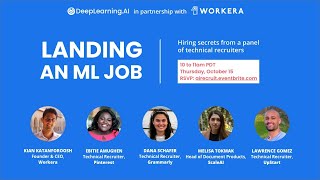
Six technical recruiters discuss how to land an ML job. They explain what hiring managers want on resumes, the differences between startups and big companies, and why PhDs aren't required but help. They also cover non-engineering roles in AI like model governance and sales.
Chapters
Sandhya, I think you're mute.
Hi everyone.
There we go.
Welcome.
My name is Sandhya Simhan. I'm the Director of Marketing at Deep Learning AI. We appreciate you taking some time out today to join us for this event at DeepLearning AI. Our mission is to make world class AI education accessible to everyone. We aim to empower a community of aspiring and current machine learning practitioners to be part of the AI transformation that is happening across so many industries. Besides building new courses, part of that work is is to help our learners sort out the steps after finishing our material, including how to land an ML job. So today we're very excited to bring you a panel of technical recruiters. They'll be sharing their suggestions on potential career paths as well as tips and best practices for interview prep. After the panel discussion, we'll be taking questions from our learners in the SPAC community. You're currently taking the AI for Medicine, Natural Language Processing or GAN to Specializations. Check your Coursera Platform Classroom for the invitation link if you haven't joined the respective Slack workspaces already. This event is in collaboration with workera. Workera is a self assessment platform which allows data scientists, machine learning engineers and software engineers to assess their skills against industry standards and receive a personalized learning path. Thank you Workera for supporting the event. And now, without further ado, I'd like to welcome our keynote speaker, Kian Khattan Farouche. Kian is the Founder and CEO of workera and a lecturer in the Computer Science Department at Stanford University. Welcome Kian.
Hey Sandhya. Hey everyone. Thank you for having us and really excited about this event. I'll kick things off with a quick five minute presentation and then I'll introduce our panelists. So let's get started. I'm going to share my screen with everyone. So before we start, I'd like to take five quick minutes in order to talk about AI careers. Obviously, because that's why we're here for this year again. LinkedIn reported that in their emerging jobs report that AI is the fastest growing job category and it's been the case for four consecutive years. However, if you compare to software, AI as a job category is still in the process of maturing. Software career pathways are not a secret anymore and in a software team you'd find backend engineers, front end engineers, deployment engineers, DevOps. You'll also find site reliability engineers, QA engineers, mobile engineers, many more. However, these career pathways are not as clearly defined in AI and consequently companies are writing fuzzy AI job description with confusing titles oftentimes so can we clarify all that? And I actually did a a quick exercise yesterday browsing through AI job on the web and had interesting findings that I wanted to share. I found that certain job titles were short and to the point differentiated between engineering roles, scientific roles, researcher roles and analyst roles if you will. And then it starts deviating. It seems that hiring managers or recruiters were mixing the terms and coming up with wonky titles such as Data Scientist Engineer, a Machine Learning Research Scientist, AI Deep Learning Software Engineer, Machine Learning Research Engineer. And it gets quickly confusing for applicants if you go beyond Sometimes you would even find a departmental or a functional naming within the job title such as Product Data Scientist or Senior Business Data Analyst. And another trend is to add full stack to a job description and getting to the full stack Data Scientist or the full stack AI ML engineer. And so it can get very, very confusing. And what we get from that is that companies are as confused as applicants when it comes to defining the right career pathways. So it makes it very difficult for job seekers to apply to the job that's right for them. And the question here is how? How can we as applicants, how can you find the right role and stand out? And in the rest of time I'm going to cover two very quick tips far from a holistic solution, and they're based on my experience at workera, but also at Stanford. The first one is to identify your career pathway and benchmark your skills regularly. My team at Workera and along with Andrew have interviewed more than 100 AI organizations in order to understand what tasks make up their AI projects, what roles carry out those tasks and what skills they need. And this graphic shows you five career pathways and the tasks of the AI project development lifecycle that they focus on. For example, a machine learning engineer will focus typically on data engineering modeling and deployment, while data scientists focus on data engineering, modeling and business analysis. So try to find yourself on this map and self assess yourself regularly if you're interested in learning more. These findings are summarized in a report called the AI Care Pathways Report and available on Worker's website. The second tip is really as you're transitioning because many may be transitioning from other fields as AI is impacting a lot of industries. I see more and more accomplished students and professionals considering abandoning their current career track to focus exclusively on AI. And my suggestion there is to develop your AI skill in addition to rather than instead of your subject matter expertise. Because solving real world problems with AI require subject matter expertise. When Andrew and I surveyed our students in the deep Learning class at Stanford. We were very surprised at first to see that 68% of those students were not from the computer science department. Even more surprising, the fact that non CTS students were performing on par with CS students and many award winning projects were coming from authors that were non CS students. And these are a few examples of them such as students from material science and engineering working on AI plus chemical structure, students from mechanical engineering working on AI plus power grid simulation. We also have ancestry inference on genomics project as well as the Parkinson disease which is an AI plus healthcare project. And we think that there are many reasons why these are successful individuals. One, they have the subject matter expertise outside CSAI that allows them to understand the data and to iterate and interpret the results rapidly to visualize how critically this works. Imagine if a non Hindi speaker was asked to write a text to speech synthesizer in Hindi. Very hard. They also have quicker access to data through their own work or laboratory and they spend more time on the project because this is something they like. And so I'll just conclude here by saying that if you're familiar with the T shape individual type of pathway, one mental model is to have a variety of tasks that you can carry out along the AI project development lifecycle. Not necessarily all of them obviously. And along with that you have a depth that could be speech, that could be genomics, that could also be autonomous vehicles. And if you identify your T, call it out on your resume by saying I'm a data scientist with expertise in speech, I'm an MLE with expertise in genomics, I'm a data analyst with expertise in marketing, or I'm a data software engineer with expertise in manufacturing automation. And companies are looking for these AI +X individuals. You have the Toyotas of the world looking for people with AI plus fuel cell expertise. Illumina is looking for graduates with AI plus genomics expertise, Medtronic, AI plus medical device. And by finding your T, you're going to find a niche that really you can impact. And so I'll stop right here in order to welcome our panelists. Each of them have a unique perspective on data science and machine learning and I hope we can learn a lot from them while they share some of their tips and war stories. So hello everyone.
Thank you Kian. Thank you Kian for that great talk. So I actually find it really interesting what you said about AI plus X competency. I think it's really important for us in the field to rob that AI is a tool, not just an end in and of itself as it has been over the last couple decades. And that brings us to how many companies today are now utilizing AI talent in their own products and teams? So let's continue this conversation by welcoming our panelists today. They are Ibita Mugand, who's a technical recruiter at Pinterest. Lawrence Gomez, who's a technical technical recruiter at Upstart. Dana Schaefer, who's a technical recruiter at Grammarly, and Melissa Tokmak, who's head of Doc document products at Scale AI. Welcome folks.
Hello.
Super.
So Kiyan will be facilitating this panel discussion. And just a reminder to our audience, if you have questions for the speakers, please post them in the Slack channel. If you're currently taking AI for M. NLP or GAN specialization, we'll be selecting questions from there for the Q and A session following the panel discussion. Kian, I'll turn it over to you now.
Thank you. I'd love to get started with a quick roundtable of a 30 seconds intro for each of you and I'm gonna call you out in the order that I see you on my screen starting with Ebite.
Absolutely. My name's Ebita. I am a technical recruiter at Pinterest and I specifically work on hiring machine learning engineers and leaders.
Good, Dana.
Hey everybody. My name is Dana. I'm a technical recruiter at Grammarly and similarly to Obita, I focus on our machine learning research and NLP positions.
Lawrence.
Hello everybody. Similar to the previous two, my name is Lawrence Gomez. I work for upstart and I am focused on data science and machine learning recruiting for the Upstart team.
And Melissa.
Hi, I'm Melissa. I lead our document products at Scale and I have a computer science background from Stanford where I met Kian. Actually that led to this event and I work very closely with machine learning engineers at Scale.
Good, good, good. Well, welcome everyone and let's kick things off. I wanted to start with a with a question around trends. AI as a market, as a job market is booming. On the one hand you have the demand growing. LinkedIn reports that hiring growth for artificial intelligence roles has grown 74% annually in the past four years, making it the fastest growing job category. On the other hand, the supply of AI talent continues to expand. With the rise of online learning, it has opened up a significantly larger and more distributed talent pool in AI. And when you look at your applicant pool, do you see a match or a mismatch between your job requirements and the skills that applicants have during the interview process?
Sure, I can take this one first.
Yeah, go for it.
On my side, I think it does depend a little bit on the role specifically. Like, my tip here is for folks to look at the job description for that role, and typically the first couple bullet points on what the requirements are usually are what's like, really critical and important for the role. Because as a recruiter, I sit down with the hiring manager, and hiring manager is like, okay, I'm looking for this, this, and this. And usually those first couple things are really critical, not always. And so it does depend. Sometimes I do see a match, sometimes I do see a mismatch. But it's important to know that your resume is just one part of the whole picture. And so specifically, if someone's trying to pivot roles where it's not always as clear on your resume what that next step is or how it relates to the job, and make sure to call that out in your objective statement or include different links or projects and just basically just help us connect those dots and talk about how your parallel skills apply to that role.
Great. Thank you.
Yeah, I'll go on. I mean, there are more experts on this. Call on this. There are a lot of recruiters, but kind of my perspective, it's less so mismatch or a match. But it is just trying to find the best fit to a role. Right. Because there are a lot of people who have absolutely, like, unique skills and point of views, whether it be that they have a lot of experience on the research side or they have a lot of experience, they're a builder, you know, like, they go and like really deploy or they're looking for a combination. And, you know, they might be very strong in one area, but they're very interested in trying out the others as well. So the more important point is like, okay, looking at these pool, how do we find the best fit where in terms of the role description, that they really shine in the role, while they might be really gaining the skill skills in the areas that they want to as well. So that's why I would say, like, it is very important to be able to get those snippets right from the resumes very quickly. So if you're interested in research, maybe what research you worked on, what are the papers maybe you wrote, or if you looked, did side projects. That's also amazing. I mean, I just love people who work on side projects. What are those? Is there a way for me to quickly see, like, what it was about or your work experience as well? So it's more about that. And I would try to highlight the Those parts that helps, I'm sure, like recruiters or like on my team side, me to be able to quickly assess, okay, which, which part I should funnel that. And I'm sure, like, everyone will join me in this call, but everyone talks in the company as well. So, like, let's say, you know, one of us only looking for one job description, but if we know it might be a good fit for something else, we'll definitely make sure at least like at scale the other person who might be looking at that pipeline, like gets to see it. So I would, I would recommend that.
Yeah, the only thing I would add is from a really practical perspective, which is just remember that the recruiters that are reviewing your applications are probably looking at many, many, like in the scale of hundreds per week. So the more clear you can make it, the better chance you have of actually connecting with that person over the physical.
Good, good, good. Yeah, I think it's important. I like Melissa's emphasis on the aspirational journey that the candidate is looking at. Oftentimes they can be supported in building up those skills and moving toward the career decision process. And by the way, going back to what you just said, Dana, as well, I think some studies show that a hiring manager or recruiter spends average of 7 seconds on the resume. And so I'm really thinking, actually, what do you see in seven seconds?
Yeah, I think in that seven seconds, I hope it's slightly longer, but I trust the study. It's those things that Evita was mentioning, like those top three things that you hear from the hiring manager every week. You're doing a quick scan just to say, bing, boop bop, is that there? So the most, the best thing you can do is make those main points abundantly clear on your resume.
Got it, got it. And then going back to what Evita said about looking at the first few lines of a job description, and this is probably the most important thing that the recruiter and the hiring manager is looking at. Yeah. Thank you. Moving toward a question on career decision, and I'm going to ask that to Lawrence here. The world's largest machine learning data science employers are IBM, Amazon, Facebook, Google, Oracle, Apple. But there are also hundreds of startups that are emerging every year. So as an AI practitioner today, what are the benefits to join a startup versus a large enterprise?
Yeah, I like to kind of tackle this question in three parts. The first one being impacted. So of course, being part of a smaller organization where you're one of only a few hundred, the impact that you make, the projects you work on and what you produce is going to have a much bigger impact on the product of the company. That also allows you to see how what you're working on also fits into the larger org. So coming from a big company and you're kind of working on maybe one small thing, you're a part of thousands of employees, you may not see, okay, what I just worked on, where did it go after I handed it off, how did it fit into the organization, what did it do to the bottom line? So you're working on a much more impactful projects. And then next is challenges. Of course, generally, hopefully the startup you're joining is trying to tackle something that no one else in the industry has been doing. And so just the nature of that, you're going to be working on things from a different angle or working on new technologies that no one else has, which brings about new challenges. But then also too, speaking of upstart in particular too, and I'm sure it's true for all the companies here as well, our data scientists and machine learning engineers, they get to work on their projects from end to end. They don't pass things on to some other team. They are working on a project from start to finish, from getting their data, trying out different models, building their proof of concepts, all the way to productionizing models. And so just being able to be a part of everything that you're working on versus just one small part will challenge you in ways that you may not get. And again, I'm speaking in general, of course, but you may not get at a larger company where a lot of times you'll be siloed into one area of a project or of a team.
Or something like that.
And then lastly is growth startups. Hopefully you start your joining is a fast growing company and so you will be able to make a bigger name for yourself just because of the fact that when you join you are part of a smaller group. So I know for me when I walk down the halls, I get to see the CEO, the cto, all the C suites and all that, you get access to higher level management and of course doing a good job. And all that will reflect much better on you and much quicker. And so your access to or ability to grow in the organization, whether that's a IC type of role or maybe into management, is generally much quicker. And the challenges you work on and all that will allow you to take those skills and take that growth to a next company after your startup and have a much bigger impact there because you've already been through so much more than what, say, your peers have been through at a Google where, yes, they have access to a lot of different groups and Google's working on everything from hardware, the software to going to Mars and all that. However, you know, you don't always get a lot of great experience in one area. And so that's kind of how I sum it up. Of course, big companies do a lot of great things and I generally use the Googles and Apples as a good example. Like I said, they're in all different types of areas. So you do get access potentially to work on different groups, maybe doing a rotation program, but generally it's going to be slower growth. What you work on is only going to be a small part of the big pie. You're going to be one of a, you know, 100,000 employees or whatever it is. And so it's just a much different experience kind of early in your career that joining a startup can give you a lot more growth and challenges and.
All that kind of awesome.
Something else that I think is really important to be aware of is what can happen if you start your career in a place where there is so much existing infrastructure or something like proprietary languages that are so specific to the company you land in that could get you into a little bit of a predicament for the next job after that. I think it's absolutely possible to be successful still, but you'll want to probably put in a little bit of extra effort to make sure you're keeping up with what's happening in the open source community or what's going on outside of your large company. Because when you put yourself back into that interview process for the next role, you want to make sure that you're still seen as agile, adaptable and able to take on new challenges.
Yeah, I mean, I would agree with all of that. And additionally, I think it gives. There's something special to be in a place where machine learning is really core to the company, right? Like it's such a huge part of it. And those startups, like, who are really investing in it, the machine learning startups, right, like they really have to make it happen for their future. So I think, at least even in my own life, right, Like, I'm kind of trying to look, okay, how can I really work in places or like areas where it's core, like to the company, right, because it gives you a lot of opportunity for growth, but also get your hands on the interesting things. And I would say, especially in startups, when you're, you know, Dana was actually Making a great point about, you know, it's many times you're building it, like if something needs to be happening, like, you are the one building it. So it offers a lot of opportunities for creativity as well. Like, how do I get this done? How can I, you know, grow by doing as well? Those are really exciting for people who are looking for that type of an experience.
This makes sense. And thank you for sharing those insights. I think one thing that echoes what you said that I saw over the past few years in my Stanford students who are joining for a big part, large corporations and some of them startups, is that in a large organization, sometimes you don't know what team you're going to fall. And it can be a bet. I've seen students being very successful at large companies, falling under a team that moves very quickly with good mentorship and a product that is core. And other students that have not been satisfied with their career outcome because they did not expect to join the team that they joined. And so I'm going through a question here, which is the interview process is a unique moment for the team to evaluate the applicant, but it's also a unique moment for the applicant to evaluate the team. So in your opinion, what are the do's and don'ts for applicants during the interview process?
Yeah, so it's a great question. I tell my candidates that I prepare them just as much as I do with the interviewers as well, too. So on that, definitely do prepare for the interview. And your recruiter will give you a really great layout about what to expect. And I go in a lot of detail about what the technical aspects are of how we do the interview as well too, because I want to make sure that as you're preparing, it's definitely focused on relevant topics that we may cover in the interview. So do prepare. Interviewing is a muscle as well too. So especially if you haven't interviewed in a while, it's definitely good to kind of go through problems on your own. Especially some of our coding interviews, they're 45 minutes long on a different platform. So it might be good to just being able to answer a question in a particular time frame. And then something else that I've been sharing with my candidates as well too, is to look back on your past performance reviews. And this kind of just gets you in the mindset of talking about what the impact of your work is. Just like Lawrence mentioned, being able to see what your individual contributions were. And sometimes that exercise allows you to go back and read, okay, here's what I did here's how it contributed to an OKR which an objective key result which feeds into the company's mission and goals. And we were able to do X. And being able to talk about that is something that's definitely really helpful. And then also ask great and insightful questions, ask about how technical decisions are made, ask about what the engineering culture is like where we're continuing to have more investments. Great questions to ask on the don't side of things, you know, definitely don't skirt around the answer to the problem. If you don't know the answer, that's totally fine. I mean, I think it's, it's fine to just share that. You know, this isn't something that I'm familiar with, but here's how I would approach it or here's how I would get more information to learn versus not answering the question at all.
And one more summed it up very well. And one more thing I'd like to add on the do side of things is a big thing for us is also curiosity. And you know, we want to hire people that want to kind of think outside the box and also, you know, stay on top of open source stuff and all that kind of things. And so being able to show that in an interview setting where yes, you may not know all the answers and we're not looking for you to know all the answers, but we also want to see that are you very curious about what you want to get into. The AI field is a very big field. There's new things coming up every day. But we're going to be judging to or kind of probing on kind of your curiosity and your potential as well. So even if you don't know everything, but you show that you know, you love our products, you love the AI field, you're doing things on the on your side time and all that, that means a lot to us too because that shows a lot more about what you could turn into and what you could grow into. Because again, no one's ever going to have all the skills and we're not looking for someone to have all the skills. So don't be afraid to not have all the skills but still show that kind of curious side of you and all that.
I think the interview, the opportunity to keep diving deeper into this question that I think we'll talk a lot about, which is what is the key difference between potentially an ML engineer role at this company and an applied research role at this company? And you should of course ask your recruiter that question. But I also think you should definitely ask your interviewers that question. The truth is, we have our own impression of it, but they live it every day. So if you can ask, how are you tasked differently, how are you evaluated differently in performance reviews than your. The teams that you partner with, that'll really get you the clarity to make sure that you are targeting the right opportunity and that you can, like Melissa said, shine in your role.
Good, good, good.
I can also add one thing about the interview process as well, too. Definitely do take feedback during the interview process. So we're not asking you a question to trip you up in any way, but if, for example, we see that you're veering away from what the intended solution could be, it's definitely a chance for us to see how you incorporate feedback on the spot as well, too. So just make sure that you're also open to that and know that we can, you know, give you tips to make sure we want to see you succeed, to make sure that you succeed in the interview.
Good, good, good, good. Thank you for. For sharing your insights. I think this makes very much sense, and it seems to be actually even a bad sign if someone doesn't ask enough questions on an interview. I imagine it's. It's not a good sign. And. And I'm gonna. I'm gonna move toward another career decision question that a lot of students and professionals ask in the community, which is, you know, do you think that it is important to have a PhD in order to apply to the roles that you have?
I can take the first stab at this one. So there will be some roles where it's a requirement. I think whether that's valid or not is maybe a question for another panel, but what we can focus on is kind of what to do in that scenario. So, yes, in some ways, there are amazing things that come out of getting a PhD. One of them is becoming a true expert over many years in something that's extremely valuable, especially if you're going for this model of AI plus something, and it aligns to the company really well. I think the other piece is there are a set of skills that are assumed to come from going through defining a PhD. Things like critical reasoning, really hard work and focus, academic collaboration, technical collaboration, and those are all things that are really important in these roles. So whether you get that from a PhD degree or you're just very clear about how you've developed those skills in another way, I think at a company definitely, like Grammarly and I imagine like the other companies on the call, that's okay too. You Just have to be ready to go a little bit further to tell that story clearly and tell that narrative.
Yeah, I can add on this one plus one on Dana on different debate about whether or not it should be required. I think this is a conversation that I definitely have with my hiring managers as well, too. Recently I also pushed back on a role to make sure that that was, that wasn't a requirement. I've hired someone at a senior level without a PhD in ML and he's absolutely crushing it as well too. So I'm on the spectrum date. It's not always needed, but it does depend on the role in the scope. Like Dana shared, I also think that it's a good chance to ask about the company on where their investments are within machine learning. I know at Pinterest we're also investing in upcoming upskilling our internal engineering talent as well too. So for folks that are interested in machine learning, we are offering an ML academy to kind of train our internal talent who are coming from different backgrounds as well too. So we're not only saying that we're an inclusive company, but from the engineering side, we're definitely trying to do that as well too, starting with folks who are already at the company.
Got it. Got it. And on the flip side, on June 26 this year, 2020, President Trump signed an executive order that directs the federal government to take the emphasis off whether a job candidate has a degree, even a college degree, and instead assess an applicant based on their job skills. So some large employers have already made the move and adopted that point of view. But what are your thoughts on the subject? Would you hire someone who does not have a bachelor's degree or a master's degree?
Yeah, I can kick off this one. Definitely. We would hire that. I mean, I guess the funny thing, right, I can say our CEO is a dropout from mit, right? Doesn't have a bachelor's degree. So I think it's more important. It's not the fact that whether you have a bachelor's degree or not have a bachelor's degree, it's more about, okay, if you haven't gotten bachelor's degree in that time period or like, can I see more like, what you have spent your time on? Like, how did you focus on developing skills, exploring interests, and creating work, right? Creating, like, outputs. That is more important to me. So to your question, I think definitely I would not want anybody to feel discouraged to apply to any roles if they don't have bachelor's degree just because of that. It is more important for us to find people who are very excited about the mission and they are willing to learn and grow. They have skills that they have developed in that time by learning themselves through, you know, a lot of the courses that you guys throw either or other. Other things. So definitely that's a lot more important. I hope that nobody feels discouraged.
Good. Good. I love this answer.
I can add an additional.
Oh, sorry, go for it.
I can add additional point here too, and I'll be realistic. So especially like with President Trump and what we're seeing, there's a lot of Talk with like H1B visas for those in the United States and unfortunately, recent guidelines is actually a little bit more stricter than what this originally shared. And so in that meaning that if you have a software engineering, if you have a degree in cs, but it's focused on like electrical engineering, to be eligible for an H1B, you need to have a specific. So it needs to be a CS degree, not just like a general engineering degree as well too. And so I mean, there's definitely a lot there and a lot up for debate. But I will take this moment to say please vote however you decide to vote. I will plug that in right now. But that is something that's also very realistic as we think about it too.
Yeah, I would definitely say the international students like these issues are completely different. Somebody who went through it, I guess myself, so different. I think you're totally right to make that point. Unfortunately, I mean, those aren't the things the people on this panel can't like change at the moment. But in the roles like we can or in the situations, definitely. I wouldn't feel anyone to feel discouraged to apply for the roles if they don't have bachelor degrees.
Good. I'm going to keep going and going back to the interview process. What we saw in the map that I shared earlier is that in an AI role, you perform a variety of tasks such as data engineering, modeling, deployments, business analysis, and AI infrastructure. But you also collaborate with teammates and you lead by example. You prove yourself to be creative to solve some of the world's hardest problems. So on the job, softer skills can matter as much as hard skills. So what are non AI skills that you would value and look for in a candidate applying to an AI role?
Yeah, I think some of the skills that we look for are technical communication. So how you are communicating your ideas, you know, throughout the interview and some tips that I share is to code out loud. So just kind of talking as you're coding and asking clarifying questions to Your interviewer before jumping directly into the problem. It's definitely some of those softer skills that we look for. But I don't like the word soft skills. They are critical skills. So they are, you know, definitely part of how we evaluate. So I wouldn't necessarily say say soft skills. And then of course, like I shared this earlier, how you incorporate and respond to some of that feedback and then alignment to our company values, you know, showing the way you say you have really either done that in your past experience or, you know, something that you would be able to do in the role as well.
Yeah, I think that for a lot of companies, and I can definitely speak for Grammarly, this is where we kind of tie into the company values, where in any role having our values and aligning with our values is going to be really important, but it kind of is speaks to the way that you'd go about solving hard problems. So at Grammarly, that means one of our core values is gritty. You're going to be solving problems that aren't solved yet. So it's hard and you're going to have to stay at it when it's hard and boring. Maybe it's remarkability, which could be stay humble and work well with your teammates, be a really curious learner. And those are all things that are important to be successful at Grammarly overall, but especially in a role like this one.
And there's one more thing on the communication thing too, the technical communication, all that. One thing that I've often seen in feedback from interviewers is that when it comes to communication, it's also like getting to the root of the problem. Not over communicating, not kind of beating around the bush, but actually knowing how to attack the problem at its roots. Again, like Abita said, kind of speaking out loud, going through your code, but not just adding a lot of fluff. We want to see how you solve problems. And so we don't want to just hear a bunch of fluff and all that. We want to see you attack the problem. So knowing how to get deep into the problem, first, ask the right questions, take the feedback well, change your thinking, be curious, you know, know how to take feedback and all that.
Yeah. And the last one I would add, I agree with everyone, especially also thinking about the company values and how the interview process relates to that. But also one thing to add is collaboration coming from the interview. I mean, that is for us, for example, really tied to the company values as well. One of them is positive sum players. So how you really think about this in an interview? Is a little bit Lawrence was alluding to this is are you taking the feedback? How are you responding? How are you changing your answers? How are you including like the person that you're really interviewing with in the problem? And this also comes handy, right? Especially if you don't know the answer, it's okay. And saying that, hey, I'm not familiar with this, but also like if we can talk about some pointers, let me, you know, attack the problem this way. So really collaborating around it so that we can get a glimpse of how you would collaborate. Right. Within the company when you're working on a lot of projects.
And I can add one more here really quickly too. Another one that we also look for is leadership. So not only like in your technical communication, but how you share technical decisions and then how you also mentor others as well too. So. Or mentor what you would want out of a mentor relationship. So just leadership is another one that's also important.
Good, good, good. Yeah, so I understand values matter. Technical communication matters a lot. Leadership. We mentioned collaboration actually on technical communication. You know, as an applicant I think many are wondering how do I look like a technical communicator? How do I show that I'm a technical communicator? What I found is that it's a lot about the words you use in the context that you use them. I've seen candidates calling a covariance matrix a correlation matrix and vice versa. And sometimes those are very tiny details that matter to the interviewer because they show the depth of thoughts that the candidate has put into choosing the right words. I will keep going and I will ask another question that relates to really building a career in AI, but not necessarily as a data scientist or as a machine learning engine. Today, if you're a job seeker that is dreaming of joining an AI company or working with AI and the latest technologies, are there any other routes than applying as a data scientist, software engineer or machine learning engineer? What other non engineering roles exist in AI?
Yeah, I can start this one. So speaking in particular with upstarts and I think this would generally apply to kind of the greater field as, as AI moves so quickly and is a very, very technical field, there's a lot more non technical people that don't know what's really going on and we'll see that we'll want more kind of explain, you know, people to explain it to them and all that. So I think this like explainability in AI is becoming a lot bigger field right now. And one thing for us upstarts, we're in the lending field. So we are under a lot of regulations and we do a lot of regulators and outside stakeholders that, you know, contribute to our business. And so one role that we recently opened up is called a modern model governance director. And basically what this role is doing is kind of taking what the AI ML team is doing, all that highly technical stuff that we don't know about and communicating and putting it to a way that can be given to the regulators and to the outside stakeholders so that they understand what we're doing. And again, this really ties for us because of the fact that we can't deny someone a loan and say, oh.
There was a black box model that.
Spit out the score that we have no clue about. We have to explain it, we have to be fair as well. And so it's really key for us now, especially as we grow and become a much bigger company, to be able to explain what's going on. And so we're looking, we look for people that, you know, don't necessarily, you know, we're not looking for just a CS background that has good communication, but other kind of, you know, still technical people that have very strong communication but you know, have worked in maybe an AI field or close to an ML team in the past, have been technical, good writing skills, that kind of thing. So not necessarily needing that CS degree, stats degree, but can still be very close to what's going on. Still up to date on all the new models, all that kind of fun stuff, but then working with outside parties and that kind of thing. So that's one, one way that upstart is, I guess opening up a role that is in AI but not building models and doing all that core technical stuff.
Yeah, For AI startups and I can give, dive deep a little bit for scale. We are a machine learning company. That means almost every role is related to machine learning. You might not be coding day to day or deploying models, but it is a huge plus. If you're interested in machine learning, have some knowledge in all the other roles as well. For example, even in sales. Right. That is, it has incredible opportunity to be able to really, you need to really understand the technology, you need to be able to talk about it, you need to be able to answer questions and you need to be able to be creative when you're hearing more problems, whether we can solve them or not in your meetings. Right. Or business operations. So that's very important as we decide on different industries, what to do in those, what are the problems, really understand those problems in depth and of course, to do that we do. Like people need to have some knowledge of artificial intelligence, machine learning, these industries, even I would say on the marketing side, everything we're doing right, how are we talking about it, how are we making it more accessible in terms of marketing? Right. And I mean, probably the people here will join me recruiting. Right. So how do you look for the best people in the areas? How can you really understand the field very well to be able to, you know, come up with what to look for, what not to look for, how do you communicate that? And I think, you know, someone was mentioning it, I forgot who. But recently they had to push back on a PhD requirements. So to be able to do that, right. You need to be familiar as well on and have good, strong opinions. Okay. Does this role really require a PhD or not? And the role is in machine learning.
Right.
So you have to be familiar. So I would say, especially for companies where machine learning is core, like there are machine learning companies, there are a lot of roles, if you're interested in AI, to combine your experience with different fields within.
Yeah.










