Learner Spotlight: My Journey into AI
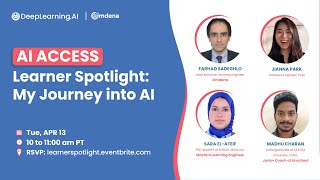
Gianna Park, Sarah Latif, Madhu Cheran, and Farhad Sadiglo share how they got into AI through bootcamps, MOOCs, and community projects. They built NLP systems, predictive maintenance models, and malnutrition detection tools, and advise beginners to start with hands-on projects, master data cleaning, and find mentors.
Chapters
Sam.
Hi everyone and welcome. My name is Lucy, I'm the head of community at Omdena. Welcome to Learner Spotlight, my journey into AI. So this event is co hosted by Deep Learning AI and Omdina. Just to give you a little background, Omdina is a bottom up collaborative AI development platform where change makers from all over the world come together to build ethical and efficient AI solutions for some of the world's most pressing problems with NGOs, social enterprises and impact driven startups globally. So I'm really excited to be here today, facilitating the event and representing Amdina and our community. Today we've assembled a panel of machine learning practitioners from different backgrounds as they share firsthand experiences in building a career. This event is designed for AI beginners, so hopefully you'll walk away with a with a better understanding and some practical career guidance and inspiration for your next steps in your career. You can also find the list of topics that we'll be covering in the description box below the video. And after the panel discussion we'll be taking questions from you via slido. So make sure that if you have signed up for the slido ticket to check your email for the access link to post and upvote your questions so that they can get answered. So now, without further ado, I'd like to welcome our panel today. We have Farhad Sadiglo, who's a lead machine learning engineer at Ondena. We have Gianna park, who's the software engineer and a poet. We have Sarah El atief, who's a PhD student at NCS in Morocco. And we also have Madhu Sharan, who's an undergraduate at Sastra University in India and he's also junior coach at UN school. So welcome guys. And also just logistically, for the next 40 minutes or so I'll be asking some questions to our panelists while I'll direct some. So I'll direct some of the questions to the panelists, but you guys feel free to jump in and offer your input into the conversation. So let's start off with a brief introduction introduction from everyone. If you want to go ahead and introduce yourself, we can start with Gianna.
Sure. Thanks Lucy. So hi everyone, my name is Gianna. It's really nice to be here. I studied psychology and creative writing. Then more recently I graduated from a coding bootcamp to become a software engineer. Last month I started working at Bloomberg and just wanted to make a quick note that everything that I'll be sharing today is my personal views and my companies. And with that being said, I'M very happy to be here.
Welcome. Sarah, you want to go next?
Yeah, sure. So hello everyone. First, thank you for inviting me to this amazing event then. I am Sarah Latif and I graduated from NSOF El Jedida from Morocco as a computer science and emerging technologies engineer and I am currently doing my PhD at NCS in machine learning, applied to healthcare.
Awesome.
Madhu. Hi everyone, my name is Madhu Cheran. I'm an undergraduate student from India. I've been learning and working in the AI field for the past one year and I'm an ML engineer at Omdena and I've been mentoring my fellow students at Unschool and it's an elearning platform and I'm happy to be here to answer all your questions. Thank you.
All right, and Farhad, finally.
Hello everyone, my name is Farhad and I'm one of the Omdan collaborators who have joined Omden over a year ago and. Become a lead machine learning engineer in less than a year. And my background is mechanical engineering and mechanics engineering. And currently it's about a couple of years that about three years that I've switched to data science and machine learning with programming. Thank you. I hope I can answer all of your questions.
Thank you.
Thank you.
All right, so it looks like we have a very interesting panel here today, so I would love to just jump into the question. So maybe I'm going to start with a question for all of you, which is how did you get interested in AI and how did you decide which fields in AI to focus on? We can start with Gianna, let's say.
Okay, sure, I can talk about how I got interested in AI in the first place. So I actually first heard about natural language processing while I was still in the coding bootcamp last year and I came across an article written by an alum of the bootcamp that explained how a music recommendation system works based on several mechanisms. But one of them was based on word embeddings and text similarity. And as a writer and as a poet, that notion of translating words into numbers and representing semantic relationships with with numbers was just super fascinating to me. It wasn't my first exposure to AI, but my first exposure to it was my first exposure to nlp. And before that when I was thinking about AI, it felt like some very distant feature that had little to do with my day to day life. But after reading the article about word embeddings, the article kind of made AI relevant for me, which led me to want to learn more about the field in general and of course, particularly the field of NLP because of my personal connections to language.
Awesome. Whoever wants to go next, let's have a conversation about it. Does someone have a similar experience as Gianna or completely different?
I can share my story. So I remember. So like the first time I got really interested was when we had like in my second engineering year. Usually we have to choose like what option we want to continue on. So there was like big data IoT, then software development as a wall. And I was actually at the time there were lots and lots of articles about big data and I was really interested to know what is this big data? Like what is it all about? And then I searched and then I stumbled upon, you know, like lots of resources at that time. And my friend who was interested about it like before me had already started several MOOCs online and then he was always like telling me what he was learning. And from him I learned, you know, like I learned what are the best courses that I could start with. That's how I got started, you know, like through data camp and then going over several courses and finally Instant Blood Open, Stanford's machine learning, you know, like the best course that everyone tries to go to first. So that was the one that really hooked me and got me into the field.
All right, cool. So Gianna has a little personal connection to NLP and she, you know, she kind of thought about her past experiences and found a way to contribute. And I guess Sara, you were motivated by friends of yours who were interested in the field first. What about you guys? Madhu and Farahad?
I got because I got to interest into this field because I had previous exposure and experience with that data and it was about predictive maintenance and vibration in vibration and industrial machine machines, vibration analysis. And it was a really great experience for me to get into this field. I wanted to change my field from what I had before to something in relation with kind of programming opportunity. And as I had the experience with data, I searched about how what's the closest field to that and I found that data science and machine learning are the closest one. And I really enjoy them because of this kind of opportunity for prediction and predicting and providing future, future results. I mean making predictions about what would happen in the future kind of opportunity. That's really great. That was really great for me and I hope you can enjoy it too.
So mine was some of the kind of different story. So 14 months ago, before this COVID 19 situation, we, I, with a group of three more friends were participating in a hackathon where we had to implement a solution for the goat. The government, the district collector were proposed a challenge to actually to provide a solution to the like One of the biggest problem in India that is malnutrition for in children to find a way to eradicate that. So everyone was implementing some apps and some websites and we didn't know anything. We know app development but we wanted to really do something about it. And we started researching about it. We consulted some of the doctors and we made our own formula to actually identify the severity of malnutrition on a scale of 1 to 10. And then we were afraid that how credible that will be because it depends on entirely on what the researcher does. Like to give weightage to particular features or something researched about it. And we got to know there is something called machine learning which does this complex analysis task and give out these predictions. Then I started with deeplearning AI Stanford machine learning course. We implemented this machine learning based solution and recommender system. And. And then I thought like I wanted to continue this. I was very interested in learning and further continuing it. And that's how my journey has started into AI.
Cool. Cool.
So it seems like you all have one thing in common. You all were very curious for some reason and that's why you jumped into the field. So this kind of leads me to my second question which is Sara already answered. So she started the first course that she got into was the machine learning from Stanford. So Farhad, I guess I'll direct this question to you. How did you get started in terms of courses? Is there like a certain curriculum that you started? What types of projects did you do first? How was that first initial thing into the field?
Well, I did it from a kind of way to understand what's going on in the AI field. So I started by volunteering for companies seminars for their seminars and opportunities which provide with collaboration and cooperating with companies. And I found that there are a lot of opportunities in this field. So in those seminars was that I joined. They did change my life for forever. Two of the most companies that I got introduced with was Lantern Institute which I which I got the classes and the courses with them. And it was really awesome. It was a really awesome opportunity for me. And another company was Omdena that I got introduced with the CEO. The CEO and the founder of the company Rudrapid Mitro. And he was really great guy. And I thought that I really this guy can be the future. I mean this guy can does manage the company which I'm really happy with. And I really it Would be really awesome for me to work for him. And that's, that's me, that's how I got it into this field. And one of the main projects that I, I mean first projects that I did was prediction and housing markets and it was really awesome opportunity and also prediction on employees churn if they would churn. And the main, one of the main fields that one needs to start with this in this field is statistics and understanding about sample or population data, fundamentals of descriptive analysis, descriptive statistics and different types of distributions and central limit theorem and hypothesis testing. And in machine learning topics there are a lot of topics that one can start with but I would suggest starting with artificial neural networks and providing, I mean understanding what's the forward propagation, backward propagation and understanding linear regression and multilayer networks and feed forward networks or refitting concepts and also activation functions, batch normalization, gradient clipping and faster optimizers, model evaluation and concepts like that. And with all having all of these and knowing all of these, you can fairly provide a kind of model by yourself to predict, to do a kind of prediction on a data set. And it's really awesome. It's really awesome. Cool.
And what about you Madhu? So I know you first got introduced through your project, but are there any other courses or curriculums that you did afterwards perhaps that helped you?
Yeah, so as I said, I started with Stanford's machine learning course and it was in Matlab so I wanted to do it in Python. So I quickly took the. I jumped into deep learning as well through deep learning specialization and it was in tensorflow1 but it got updated recently. So congratulations to you guys who are going to learn it from now and I wanted to learn something like which was updated. So I took Udacity's deep learning nano degree suggested by one of the omdina collaborator. So I took that and then I started doing all the projects mentioned there. But before going deep dive into this deep learning field I concentrated on statistics and mathematics as well. Because most of the deep learning and machine learning concepts are the mathematics which is underlying under them will give a better intuition if we concentrate on them. I don't suggest going through solving all these, all the models, what is the underlying mathematics behind them, but understanding is what I would suggest and these questions helped me to understand the mathematics. And then I did some basic projects through Kaggle data sets and I wanted to really get into some exciting project and then I found Omdena at that time, which was really challenging for me at that time. And I took it as a challenge to Actually get into real world, like how it works and all. So that was my journey.
So there's one thing I would like to add before you go on, Lucy, is that, you know, as a beginners, there is something that we try to avoid and that is learning how to pre process and clean data while it is like the most important part because like all the data scientists say they spend over 60 to 70% just cleaning the data and getting it into the right shape. So it's really important to start with that. And I found that so far the best course that really teached me that was the data camp courses, the data science for Python ones. They really, really stress on several processes on how you can clean your data in different ways.
And would you say it's more important to understand that, get a good grasp of data and cleaning it rather than getting into the math and statistics and all of that?
No, I would say try to get a bit of everything. Like this is how usually to get the best of something. Like for example, the thing, for example that I found out that my friends like it to do. Like, because me, I like to get into the theatrical part. But for example, when they want to, you know, start, what they do is they start with a project, for example, then they go over it and each time they come across something they just found new, they go search for it and learn about it and then they move on.
Okay, okay, cool. Yeah, that's interesting. And I guess one other one question that I would have to Gianna, actually because, you know, you gave a little bit of background behind how you transitioned, how you drew parallels between your previous experience and this new data science field and AI field. So I'm wondering for others transitioning into AI from a different field, how would you suggest for them to get started how to draw those parallels?
Great.
So I'm going to rephrase the question a little bit because I'm speaking from a slightly different position here where I'm talking, where I am interested in AI as someone who is open to, but not necessarily actively seeking to transition or seek a professional position there. But with that being said, my personal journey was I. So during the bootcamp when I first learned about word embeddings and first got interested in nlp, I just started off by reading a lot of articles on medium, mostly towards data science, which is a great publications where you get to taste a little bit of everything about statistics, data science, nlp, other ML topics. That was a good starting point. And after the bootcamp I enrolled in Deep Learning AI's NLP specialization course. And I had audited another course by Deep Learning called AI for Everyone about a couple of years ago out of curiosity. And I think I saw that ad on social media and I just really appreciated the teaching style and how they explained the materials in a very accessible way. So in those courses you get to do guided assignments where you can try and implement algorithms that were covered that week or things like that. And those hands on exercises really helped me feel grounded and solidify learning. So after I enrolled in that course, I got invited to join a slack community of deep learning AI where you could just ask questions about the course materials or just hang out. Because I didn't know anyone who was working in that field. I tried to go to as many meetups and events as I could when possible, just to hear from other people, their stories, how they got started, what AI was all about for them, what projects they're working on and what are some possible applications and use cases and so on. So those events were crucial for me in helping me understand the context where I could put the things that I was learning into perspective. It was one of those meetups by Deep Learning called PI and AI. And I think maybe MO is currently listening to this event. And thank you Mo for organizing a lot of the great events. I first heard about UMDENA in one of those events and I thought it was such a great thing that you, Lucy and others at UMDENA were doing, which is connecting people from around the world to solve problems that had real world impact. And so the one project that I did with MDENNA was using NLP to help alleviate the administrative burden of social workers at a nonprofit. And the reason why I chose to participate in this project was because I have worked at a nonprofit before and understood some of the pain points often experienced by social workers. And the goal of the project was a sort of change that I had wished that I had seen while I was working at that nonprofit, but didn't yet know how to bring about those changes. I didn't have the knowledge or skill set to implement those changes. So it was a really exciting opportunity for me to bring in both my past experience and the newfound knowledge and skills and see what was possible. Now let's see. I don't know about you guys, but for this project we didn't have a clean data set. We didn't have much data to work with in the beginning. So we got to experience the whole pipeline of gathering data, deciding even what kind of data to collect, and then pre processing it. Sarah, you were on point in saying that this is a super, super important process and then either building a model or finding what other pre trained models are out there that we could use and then finally delivering the outcome in a way that our stakeholders who may not have the technical background could understand easily. And Farad, you mentioned the statistics and all these important things to learn, but for me it was slightly different. When this project began. I was only halfway through the NLP specialization course and maybe I had some pretty good grasp on word embeddings and a few basic things, but that was about it. But what was great about this project was that there were around 40 people working together from different backgrounds and we were all just learning as we went. We would look up things. If things like new tools or topics came up, we would ask on Slack openly and someone who had more experience with that would comment on that. And we're just open discussion all the time. So that was a really good experience in not only learning about the topics of NLP by doing it, but also practicing teamwork and leadership and time management and all that. So yeah, that was my experience. I started by taking the course on my own, but as soon as I started getting involved and getting myself out there to be around other people who are already doing the work and finding opportunities to collaborate with them, that's when I learn the most within the shortest time.
Nice.
Thanks.
Thanks for sharing your story. Yeah, so it seems like, you know, you all chose, you learn through the courses, but then a very important aspect of it is then applying it to real world problems and really getting out there and doing the work that maybe not everyone wants to do, like the data pre processing. But you know, that's probably the biggest part of the job. I'm going to jump a little bit forward. So now we know kind of you know how to get started and it seems there's a bit of a trend between all of you guys. But Sarah and Madhu, I know that the two of you have been actively mentoring AI enthusiasts and students and that's why I want to ask, how important would you say is having a mentor in the AI field? How important is it to help with the learning and where can you find mentors?
Yes. So when I started I didn't have any mentor. All I had is time. Due to this COVID 19 I had plenty of time. So I just started it off. But soon after I realized it, I'm going in a wrong way. Like it's not only courses, it's about applying what I have learned. So what I did Was I was looking for some slack groups like what Gianna has after doing deep learning specialization I have joined some slack groups. There are very, really an interesting and very active community out there. We just have to search for it. If it is not possible, we just need to find someone who can actually if they are not available for mentoring even like learning co learning kind of thing. So I directly I was going to the LinkedIn feed and I found two to three friends like who were active in the machine learning field and I just DM them like whether they are available for like co learning. So they said yeah they are so and then we started discussing on WhatsApp groups and we created a WhatsApp group and we have learned learned on the grow. And soon after that I realized that having a mentor has given me a very large amount of boost to actually improve within a shorter span of time. Because AI is something a different field. I realized that I have something to give it to some other person and I can take some knowledge from other person. Everyone has some part of the AI which they are specialized in it. So like my interest lies in computer vision and one of my friends interest is in nlp. So so we were learning so. And he has also become a member of OMD N later. Yeah, so and after that on LinkedIn a guy actually gathered all the people, almost 250 people into a WhatsApp group. That was the major like effect in my journey because it was very active, he maintained it very well and everyone is an AI enthusiast there. So we were actively sharing and helping each other. So having a mentor will definitely boost your journey. And now I am mentoring others like with patience and so yes.
What about you Sarah? So it seems like all you have to do is ask for help and then, and then doors will open.
What about you Sarah?
Definitely so similar to Madhu for me as well. I didn't have a mentor but the thing that helped me a lot was the fact that my friend already was trying several courses before me. So he was always giving me feedback like for example, don't start like this and start like that. So from time to time he helped me shape, you know, like the way to actually learn and find my way out. But the thing that, I mean apart from of course the you know, like the things I learned from as well, like the mistakes I made, the things for example I shouldn't have like started with this or started with that or you know, go for this course, it was too advanced or something like that. What I actually do right now is try to Help others, you know, like, understand, like what they can start with. Because, for example, when I do workshops, like, for example, explore my workshops or any kind of talk I give, always people at the end come to me, like, how did you start with this? Like, how can I, for example, learn this? What do I need to start with so I can know or do this learning, for example, or do machine learning or even data science. So it is true, of course, these mistakes I made before my friends learning that actually give advice like that. So like Madhu said, what actually a mentor can give you is a boost. Like, for example, instead of thinking one year, you could think, for example, six months or less if you have a mentor now, let's say, for example, it's really difficult to find a mentor, especially someone who can really help you out. So what I suggest always is to try and get involved with different communities. And there are a lot of amazing opportunities where you can get involved. For example, Omdena always has lots of challenges every month. So this is like the opportunity to learn from other people that are more advanced than you in skills and then, you know, like, build up on other people's knowledge and make your own actual curriculum cool.
And where, where do you find these people? So in Madhu's case, he said LinkedIn was the place for him. What about for you?
So for me, I usually try and go around and see what other people are doing, for example, let's say the big people, what we call founders of AI, for example, I try to see what they suggest to do in LinkedIn, for example, or I try to read medium articles from other people and see what they suggest will be a good starting point. And then I try it as well and see if it's really a good starting point for not or, you know, for me or not as well. And then of course, I fine tune every time until I learn what I need. But for example, the thing that, the thing that is great is that if you can ask people around, like communities, you know, there are lots of communities everywhere around the world, either in machine learning, in programming or anything. Always try to go to these small ants and learn from other people that are more advanced than you. So this is like most of the knowledge I got, I got this, of course, from other people. Okay, cool, cool.
And I also want to ask a question that probably some people are dreading or asking themselves. And Farhad, I'd probably want to ask you that one first is to what extent is having a Master's or PhD degree important in getting a job in the AI ML field, coming from someone who has that you might have some.
Perspective, I guess, I mean, I believe it's really important because in this field you would have a lot of challenges, a lot of problems to solve. And the more challenges and the problems that you have solved in the past and the more experience that you have in the past would help you a lot in solving the future challenges that you would face. And in this field you need to be a self learner, complete self learner, to be at the highest rate of the best people in this field. So you would need to, I mean, if the only person on earth is you, you should be able to do this opportunity as well. I mean, by all means, without any help from anyone. And you should be able to read alt articles, papers, academic ones definitely, and the textbooks and you should be able to use any material that is out there. And also you need to know that in addition to the school question, one of the answers that I remember from the previous questions is that you need to understand that before getting into this field, you need to wrap up basics for yourself, what you know and what, how quickly you can learn. And also you should know that this field is not just about one software or two. So try not to get fooled by some institutions or mentors would say to you just join this course and everything would be fine. No, it's not. You need to understand that this is only you who can spark this great opportunity in your life. And also you need to understand that having this kind of opportunity, if others have succeeded in this opportunity, it doesn't mean that you would succeeded too. And you need to understand what are your capabilities, what challenges you can face and how, how can you provide the best solutions and answers to your questions that any, any textbook or any article, any, any, any kind of sources would ask. You need to understand them and perfectly and provide answers for them. So it's really challenging. It's a lot of fun, but challenging you cannot. I mean the fun camp comes after solving that challenge. So understanding all of these is a key factor in becoming successful in this field. And like one of the cases that you really need to understand is like if your employer tells you that we need this software, we need someone to do this, to work with this software. You would only have one day or two days to work with. Also with the same stands for programming too. Like maybe they say tell you that okay, you need to do this for me with Java or C or other languages, you, you need to just say, okay, I do it in two days, or that's the most of the time. I mean, that's the most of the time. The they would give it to you. You need to do the project. So you need to be a quick learner. And you also, you need to know that despite of other fields that, like mechanical engineering, that like 30 years ago someone learned something in this field and got a master's degree or Ph.D. or whatever and he's repeating whatever he did in before. It's not like that in this field. This field is changing all the time. I mean, every single day that a paper or article comes out of the academic resources, that's going to be the solution probably for your problems. So you cannot say that, okay, I have learned this product or software and I want to stick to it. No, it's not like that. Others would learn new stuff and others would come into your path and they would definitely get your position. So you definitely need to match your capabilities with what the employers and companies are looking for.
Okay, so constantly learning and involve yourself.
Involving yourself, evolving with the projects as, I mean as the concepts and the projects are evolving, you should involve yourself too. That's what it is. It's really, it's really challenging.
Yeah, people don't have a choice, I think these days. What about you, Sarah? So you're doing, you did your master's and you're doing your PhD. How important is that?
So in some countries, like I don't know in US but in some countries having an actual degree is very important to get you into the job. Like, it's like, you know, it's like your actual passport. So it's not the fact that you're actually skilled, but just to get into the job, just to get through the selection process. And then of course everything that comes after, you will learn it by yourself. So, so try to get a degree. Like try to see what you know, for example, in the country you want to apply jobs to what is happening there, what is really needed, what is the, you know, the strict minimum. And then of course you can work in parallel on actually, you know, like training yourself to understand exactly what is happening in AI and what are the skills that you can build upon later.
Okay, I really like that. I really like. So to be able to set yourself up for success, you need to do your research and understand, you know, the credentials that you need. But actually the learning and the doing and the self evolving, that's coming from you and you do that. Awesome. So before jumping into this lido, I want to also ask Gianna one more question. So how did your non ML background experiences and skills translate for you?
Yeah, that's a good question and I can share a little bit about how my background as a writer mostly helped me with learning when I was getting started. So writing has always been the way for me to learn about myself first. So when I first was learning about word embeddings during the bootcamp, I decided to write an article about it because I knew that that was going to forced me to really know what I knew and also really know what I didn't know. So it was a good way to ask myself honest questions. Do I really understand this topic or do I merely think that I do or feel like I do? So if I got stuck or wasn't sure of something while I was writing the article, I would go back and read more articles to make sure I understood that correctly or perhaps ask different clarifying questions and being able to communicate with myself honestly with honesty and.










