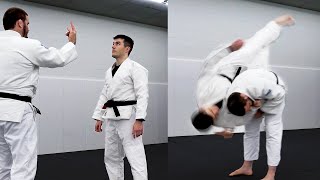
A recorded judo training session hosted by Lex Fridman featuring 2016 Olympic silver medalist Travis Stevens. Lex introduces the session and thanks local gyms in Austin; Travis demonstrates and teaches a variation of the seoi-nage throw and core judo fundamentals — grips, splitting/hip movement, off‑balancing, foot placement, angle creation, and timing — while coaching live drills.
Chapters
That was intense.
This video is a judo training session with Travis Stevens from a while back. He's a 2016 Olympic silver medalist in judo and one of the greatest American judoka ever. I've trained judo and jiu jitsu for many years and took some time off on the judo side, focusing more on submission grappling than throwing. But I'm hoping to get back into it with Jimmy Pedro, the legendary judo coach out in Boston. I love judo too much. I miss it big. Thank you to Craig Jones and the B team for letting us use their gym for this judo session. And I should also say that Austin in general is amazing for martial arts. We got 10th planet with Gabe Tuttle, New Wave with John Donahar, Gordon Ryan, Nicholas Meragale and others. B team with Craig Jones, Nikki Rod, Nikki Ryan and others, and many more. I highly recommend you check out these places and who knows, maybe you'll see me there and we'll get a chance to train. And now, dear friends, here's the 2016 Olympic silver medalist in judo, Travis Stevens.
Been a fan of yours for a long time. Thank you for talking a little judo.
With me today, man.
Spread the knowledge. Here we go. My goal is to make you go up and then I'm going to go under and then put you on your back right where you're standing. That's the idea. But I actually don't have to do much lifting. So when I come down and I split, I hold tight, I get a strong pull when I back up. Now you're right where you were standing.
The fundamental movement here is the splitting, either the hips or you're doing like.
Some leg to the outside.
You're always just gotten really good at.
Doing this step and generating power from it. Where when I kick it, not yet, like I press it hard enough where I'm not overextending this leg and this moves. What a lot of people try to do is they go here and they over commit. Now this foot can't take that step. I try to hike and let that slide into place naturally. It's important that the angle is here instead of straight on. Unless you're going to get me to turn and give you that angle. Okay. So it's very difficult for you, like if you take a grip here on this side and then you were to try to come in and split my legs. But right there you see how like I can start to slide and there's a gap on this side. A lot of times when I do this, people slip off to this side and you end up missing. But if I change your angle to here now, come in. Boom. See how you got my hip?
And so you're not worried about coming.
Around from this because the second I try to lift and jump over, that leg will be sliding back. And that's gonna. If I try to step over, my weight's going up. When you back up, you're gonna amplify that.
This is a dream come true, by the way. So you're known for this interesting variation of the Seinagi throw where you grab the most power.
Can you explain how that works in a basic sense? You're going to take a grip here. Don't get pushed, like resist there. And then this happens. I get that back and forth push so that it's effortless on my front leg. So that there. See how you naturally get pulled through when I slip? The pressure. That's the basics of it. Now I have to get you to a point where you can't sprawl and lower your center of gravity. So what I do for that is when I. I lower that weight and I lift that weight so I can hold it. That way when you pop up on your toes, the hand at the top of the arc holds you while I slip underneath. And then I can catch you on my hips. So I've got to get there before you get lower than I do.
And then you're doing this big.
Yes. So it's so typically like if I find my point at the center, my foot starts there and then I replace. Nice flip. And then we come back up. If you're gripping and I'm holding your hand, which sometimes I do. If I press you at some point there. See how you. I'm getting you to stand up. That leg is light. Now I can come back through. Yeah, but I. I press them until they press back hard enough where we go from this angle to up. And then I can side eye on and let's say like. Right. I can't attack because this leg is in front. I also, if you have a good stable position, I can't necessarily move that foot. But your off balance point is here at the front and there at the rear. So if I take my pinky and I hit that point, you're gonna turn and face me. Thank you. Now it's not in front anymore. So I didn't. I never had to move it. And so when you're in this position and then knock me to that front position.
Boom.
Wait. The second you see me starting to rotate, add to that. Yeah, yeah. There go.