Llama 3.2 is Beating OpenAI at Their Own Game (Real-Time AI Voice, Vision...)
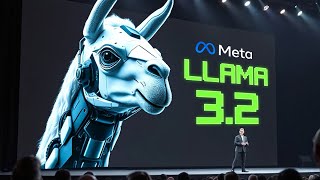
Meta's Llama 3.2 handles text, images, and real-time voice without relying on OpenAI's tech. The models power new Orion AR glasses and Quest VR headsets, plus AI-driven advertising tools that Meta is rolling out across its platforms.
Chapters
From text and image analysis to real time voice interactions, Meta's llama 3point 2 may be the most significant AI innovation they've launched to date. The Llama 3.2 lineup spans mobile friendly models to the powerful 90B vision, supporting eight languages with a 128,000 token context limit. Beyond AI, Meta pushes forward with new AR glasses, Orion VR tech and AI powered advertising. Even Meta AI now responds in celebrity voices, making interaction smoother. So let's talk about it. First off, Llama 3.2 offers a range of different sizes depending on what you need. There are the lightweight models like the 1b and 3b parameter versions that are perfect for text only tasks. These are great if you're building something for mobile apps or edge devices where you don't want the AI to be too heavy on the system. But if you're working on something more complex, the 11B and 90B Vision models are where the real magic happens. These ones can handle both text and images, meaning they can actually see and process visual information, making them perfect for tasks like image captioning, document analysis and visual question answering. What's really impressive is that Meta didn't just toss these models together, they went all out testing llama 3.2 on more than 150 benchmark data sets across multiple languages. And we're not talking about some basic testing. These models have been evaluated by real humans and compared against other big players in the AI game like Anthropic's Claude 3 Haiku and OpenAI's GPT4O Mini. So these models are serious contenders in the AI space. Now let's break down the numbers a bit more because they're actually pretty interesting. The Llama 3.2 models can handle a 128,000 token context length. What does that mean in practical terms? Basically, they can process enormous amounts of data. Think of it like feeding the AI several hundred pages of a textbook all at once and it just keeps going without a problem. This makes it a game changer for tasks that involve lots of information like generating long form content, analyzing detailed reports, or dealing with big data sets. And here's the part that makes these models even more versatile. They support eight languages right out of the box. These include English, Spanish, French, German, Italian, Portuguese, Hindi and Thai. So if you're building something that needs to work in different parts of the world, or handle multilingual tasks, you're covered. For those who are more interested in mobile or Edge applications, the 1B and 3B models are your go to. They're lightweight, but still super capable when it comes to things like text summarization, language translation and customer service automation. And the best part is that these models can run locally on the device, which means faster response times and better privacy since you don't always need to connect to the cloud. Now, if you're looking for some serious power, the 11B and 90B Vision models are where things really kick into high gear. These models integrate image encoder representations, which is just a fancy way of saying they can process images and text together. This makes them ideal for tasks like document analysis, where you've got a mix of text and images to deal with. Lets say you're working on something that requires analyzing a scanned document with charts and tables. The 90B Vision model can handle that effortlessly. It's designed for high resolution images and can even reason about what it sees, making it perfect for industries that need advanced image processing and visual reasoning. On the technical side, Meta also introduced the Llama stack, which is basically a toolkit to make it easier for developers to integrate and deploy these models. The stack includes API adapters and other tools to benchmark Llama models across different platforms. What this means for developers is that you can mix and match components to build AI applications without having to start from scratch every time. Meta also made sure these models are accessible whether you're working in the cloud or on local devices. You can use Amazon Bedrock to access them, but they're also available on platforms like hugging face and llama.com meta is really doubling down on making these models open source with which means you can customize and fine tune them to meet your specific needs. Zuckerberg himself said it's like creating the Linux of AI, meaning these tools are designed to be open, flexible and available to everyone. If we move away from just the AI models for a second. Meta has also been pushing forward with other technologies, especially augmented reality. At their annual developer conference they unveiled their new Orion glasses, which are basically next gen AR glasses that can project digital digital images, media, games and even people into the real world. These aren't just a cool concept, they have the widest field of view in the industry, meaning they're a lot more immersive than anything else out there right now. The AR glasses aren't quite ready for consumers yet. They're still in development and Meta expects to release the first generation of these glasses around 2027, but probably even sooner. For now, they're being tested internally and with a few select developers, but Meta is serious about this tech and they're already making strides with their Ray Ban Meta smart glasses, which have been a surprising hit. According to reports, these smart glasses sold more units in just a few months than the previous generation did in two years. That's a pretty clear sign that people are interested in AI powered wearables. Speaking of wearables, Meta also announced a lower cost version of their Quest 3 virtual reality headset called the Quest for This new model is set to launch on October 15th and will be priced at $299 for the base version. The Quest 3S is designed to be more affordable, making VR accessible to a wider audience. Meta is also Discontinuing the older Quest 2 and Quest Pro models, while dropping the price of the standard Quest 3, which originally launched at $649, down to $499. If you're someone who's looking to get into VR without spending a Fortune or the Quest 3s might be a good entry point. One of the more interesting updates Meta rolled out during the conference is the new voice capabilities for Meta AI. This is where things get a little fun. Meta AI can now talk back to you, and not just in any voice. You can choose from a range of celebrity voices like Judi Dench, John Cena, Kristen Bell and Keegan Michael Key. I can help you with things like creating images, answering your questions, or giving you advice. I can help you with things like creating images. So if you're chatting with your AI Assistant on WhatsApp, Messenger, Facebook or Instagram, you can now have it respond to you with a familiar voice. Meta's goal here is to make AI interactions feel more natural, and they believe that voice is a more intuitive way for people to communicate with their AI assistants. Meta AI's voice capabilities go beyond simple conversations. The AI can also analyze images shared in chat and even make edits like like removing objects or changing backgrounds. This is a huge step forward for practical AI use, especially in everyday scenarios where you might want quick edits on the go. The assistant can even reply to voice or text commands, which adds a lot of flexibility to how people interact with AI. On the business side, Meta is continuing to expand its AI powered tools for advertisers. More than 1 million advertisers are using Meta's AI to create ad campaigns and and in just the past month, over 15 million ads were generated using these tools. Meta's reports show that campaigns utilizing AI have an 11% higher click through rate and a 7.6% higher conversion rate compared to traditional campaigns. That's a significant boost and it shows how effective AI can be when it comes to digital marketing. Meta is also working on personalizing content even further with AI. They're developing systems that can generate custom images based on user preferences and and are even experimenting with AI generated avatars that could use a person's likeness. This tech could eventually allow for fully personalized content, making social media even more tailored to individual users. Alright, if you're interested in more deep dives into AI, robotics and the future of tech, make sure to like, subscribe and leave a comment. Thanks for tuning in and I'll catch you in the next one.










