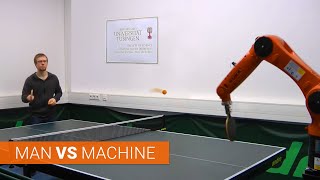
A robot learned to play table tennis in simulation, then nailed it in the real world with 98% return accuracy. It trained in just 1.5 hours and handles most shots within 10 inches, but backspin still trips it up because of joint speed limits.
Questions this video answers
1.5 hours
98% of the balls
Within 25 centimeters (about 10 inches)
Quadro RTX 6000, RTX 8000 and V100 instances
48 gigabyte RTX 8000 instances
Chapters
Dear fellow scholars, this is Two Minute Papers with Dr. Zsolnai. Today we are going to see if a robot can learn to play table tennis. Spoiler alert. The answer is yes, quite well. In fact, that is surprising. But what is even more surprising is how quickly it learned to do that. Recently we have seen a growing number of techniques where robots learn in a computer simulation and then get deployed into the real world. Yes, that sounds like science fiction. So does this work in practice? Well, I'll give you two recent examples and you can decide for yourself. What you see here is example number one, where OpenAI's robot hand learned to dexterously rotate this ruby cube to a given target state. How did it do it? Yes, you guessed it right, it learned in a simulation. However, no simulation is as detailed as the real world. So they used a technique called automatic domain randomization in which they create a large number of random environments, each of which are a little different. And the AI is meant to learn how to solve many different variants of the same problem. And the result? Did it learn general knowledge from that? Yes. What's more, this became not only a dexterous robot hand that can execute these rotations, but we can make up creative ways to torment this little machine. And it still stood its ground. Ok, so this works, but is this concept good enough for commercial applications? You bet. Tesla uses no less than a simulated game world to train their self driving cars. For instance, when we are in this synthetic video game, it is suddenly much easier to teach the algorithm safely. You can also make any scenario easier, harder, replace a car with a dog or a pack of dogs and make many similar examples so that the AI can learn from these what if situations as much as possible. Now all that's great, but today we are going to see whether this concept can be generalized to playing table tennis. And I have to be honest, I am very enthused, but a little skeptical too. This task requires finesse, rapid movement and predicting what is about to happen in the near future. It really is the whole package, isn't it? Now let's enter the training simulation and see how it goes. First we hit the ball over to its side, specify a desired return position and ask it to practice returning the ball around this desired position. Then, after a quick retraining step against the ball throwing machine, we observe the first amazing thing. You see, the first cool thing here is that it practices against side spin and topspin balls. What are those? These are techniques where the players hit the ball in ways to make their trajectory much more difficult to predict. Okay, enough of this. Now hold on to your papers and let's see how the final version of the AI fares against a player. And whoa. It really made the transition into the real world. Look at that. This seems like it could go on forever. Let's watch for a few seconds. Yep, still going, still going. But we are not done yet. Not even close. We said at the start of the video that this training is quick. How quick? Well, if you have been holding on to your papers, now squeeze that paper because all the robot took was one and a half hours of training. And wait, there are two more mind blowing numbers here. It can return 98% of the balls and most of them are within 25 centimeters or about 10 inches of the desired spot. And again, great news. This is also one of those techniques that does not require Google or OpenAI level resources to make something really amazing. Loving it. And you know, this is the way to make an excellent excuse to play table tennis during work hours. They really made it work. Huge congratulations to the team. Now of course, not even this technique is perfect. We noted that it can handle side spin and topspin balls, but it can't deal with backspin balls yet because get this quoting, it causes too much acceleration in a robot joint. Yes, a robot with joint pain. What a time to be alive. Now one more thing. As of the making of this video, this was seen by a grand total of 54 people. Again, there is a real possibility that if we don't talk about this amazing work, no one will. And this is why I started two Minute Papers. Thank you very much for coming on this journey with me. Please subscribe if you wish to see more of these. This episode has been supported by Lambda GPU Cloud. If you're looking for inexpensive cloud GPUs for AI, check out Lambda GPU Cloud. They've recently launched Quadro RTX 6000, RTX 8000 and V100 instances and hold on to your papers because Lambda GPU Cloud can cost less than half of AWS and Azure. Plus they are the only cloud service with 48 gigabyte RTX 8000. Join researchers at organizations like Apple, MIT and Caltech in using Lambda Cloud instances, workstations or servers. Make sure to go to lambdalabs.compapers to sign up for one of their amazing GPU instances today. Our thanks to Lamda for their long standing support and for helping us make better videos for you. Thanks for watching and for your generous support and I'll see you next time.