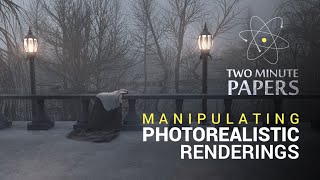
Károly Zsolnai-Fehér explains how photorealistic rendering works and describes a new method that lets you tweak specific details like reflections or shadows while keeping the rest of the image physically accurate. The technique has been used in Game of Thrones and automotive ads.
Chapters
Dear fellow scholars, this is two minute papers with Photorealistic rendering is a really exciting field in computer graphics. It works the following. We use a piece of modeling software to create the geometry of objects. Then we assign material models to them. After that, we would like to know how these objects would look like in real life. To achieve this, we use computer programs that simulate the behavior of light. So this is how the scene would look like with photorealistic rendering. If it is possible to create digital objects that look like if they were real, then artists have an extremely powerful tool they can create wonderful images and animations with. It is not a surprise that we see photorealistic rendered cities next to real actors in many feature length movies nowadays. Game of Thrones is also a great example of this. I've linked two jaw dropping examples in the description box below. Take a look. The automotive industry also has lots of ads where people don't even know that they are not looking at reality, but a computer simulation. But in the movie industry, the Pixar people were reluctant to use photorealistic rendering for the longest time. And it is because it constrained their artistic freedom. One classical example is when the artist says that I, I want those shadows to be brighter. Then the engineer says, okay, let's put brighter light sources in the scene. But then the artist goes, no, no, no, no, no. Don't ruin the rest of the scene. Just change those shadows. It is not possible. If you change something, everything else in the surroundings changes. This is how physics works. But artists did not want any of that. But now things are changing. With this piece of work, you can both use photorealistic rendering and manipulate the results according to your art. For instance, the reflection of the car in the mirror here doesn't look really great. In order to overcome this, we could rotate the mirror to have a better looking reflection, but we want it to stay where it is now. So we'll just pretend as if we rotated it so the reflection looks different, but everything else remains the same. Or we can change the angle of the incoming sunlight, but we don't want to put the sun itself to a different place because it would change the entire scene. The artist wants only this one effect to change and she is now able to do that which is spectacular. Removing the green splotch from the wall is now also not much of a problem. And also, if I don't like that only half of the reflection of the sphere is visible on the face of the bunny, I could move the entire sphere, but I don't want to. I just want to grab the reflection and move it without changing anything else in the scene. Great. It has a much better cinematic look now. This is an amazing piece of work. And what's even better, these guys didn't only publish the paper, but they went all the way and founded a startup on top of it. Way to go. The next episode of Two Minute Papers will be very slightly delayed because I will be holding a one hour seminar at an event soon, soon and I'm trying to make it the best I can. My apologies for the delay. Hmm, this one got a bit longer. It's a bit more like 3 minute papers, but I really hope that you liked it. Thanks for watching and if you like this series, become a fellow scholar by hitting that subscribe button. I am looking forward to have you in our growing group of scholars. Thanks and I'll see you next time.