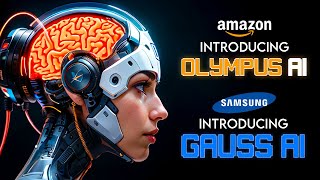
This content was created by LARRUZ. This content was uploaded by LARRUZ. This is a YouTube video titled "Meet Samsung & Amazon's Answers to ChatGPT: New AI Models GAUSS and OLYMPUS" (created 2023-11-10) in which a single presenter, Sam, gives an explanatory overview of three recent AI models: Samsung's Gauss (a triad: Gauss Language, Gauss Code, Gauss Image, built around a "Global Unified Semantic System" with on‑device ambitions and Exynos integration), Amazon's Olympus (a reported ~2 trillion‑parameter model led by Rohit Prasad with ties to Amazon's broader AI investments and potential integration into Alexa and commerce), and Finn's V7 (a coding‑focused model emphasizing much faster response times, large context windows, and GPU/TensorRT acceleration, alongside noted limitations in consistency). The content is a tech summary/commentary covering architectures, capabilities, use cases, ethical/efficiency considerations, and industry implications.
Chapters
We're going to delve into three of the latest AI models that are turning heads in the tech community. First up, we'll explore Samsung's Gauss, an AI triad that's mastering language, code and even image generation. Then we'll shift our focus to Amazon's latest titan in the AI arena, Olympus. It's a behemoth with double the parameters of GPT4. And we can't leave out Finn's V7 model, the new kid on the block that's out to prove it's not just about size, but also about speed and precision in coding assistance. So let's get into it. Okay. Samsung has just unveiled its latest creation in the realm of AI, a language model known as Gauss. Designed as a generative pre trained transformer, Gauss is versatile, capable of handling a slew of tasks from processing natural language to translating between languages and even creating original text. Now Samsung has structured Gauss into three distinct Gauss language, Gauss Code and Gauss image. This triad enables it to tackle tasks spanning from understanding and processing human language to to generating images from textual descriptions. It's quite the multi talented AI adept at understanding several languages, coding in various programming languages and bringing images to life from mere words. The real question is how does Gauss stack up against the conversational AI titan, chatgpt? Gauss is more than a sophisticated chatbot. It's a versatile AI capable of managing diverse inputs and outputs such as text, speech and Visuals. It outpaces ChatGPT with a new AI architecture that Samsung has developed developed, leading to enhancements in speed, accuracy and overall intelligence. At its core, Gauss operates on what Samsung has termed the Global Unified Semantic System or gus. This system is a blend of deep learning knowledge graphs and natural language understanding, which together form an extensive model of global knowledge and phenomena. GUS is the key to Gauss's ability to assimilate new data, discern intricate patterns and and produce pertinent and cohesive responses. Plus, with on device processing, Gauss promises a fast and secure experience without the privacy concerns that cloud based processing might entail. Samsung's ambition for Gauss is grand. They envision it becoming an integral part of their ecosystem, starting internally with their workforce and eventually extending to consumer facing products. They anticipate that Gauss will bolster employee efficiency in research, communication and creative tasks. Moreover, Samsung is looking to combine Gauss with their Exynos 2400 chip tailored for heightened AI performance and energy efficiency. The goal is to feature Gauss in future flagship products like the galaxy S24 aiming to deliver a smooth, personalized user experience. Gauss applications are vast and varied. It could revolutionize content creation, software development, education and entertainment. The potential seems massive. Plus Samsung has proactively set up an AI Red team to scrutinize the ethical and security dimensions of their AI offerings. They're also focusing on on device processing to maintain user privacy and provide quicker, more dependable AI services. Looking ahead, Samsung's aspirations for Gauss are to leverage the ever evolving global knowledge base to augment user experiences. They're not just aiming for an AI model, they're aiming for an AI companion that can understand, interact and co create with humans, influencing the future of mobile technology and and more. Now, Amazon has also stepped into the ring with an AI model called Olympus. Positioned to rival the likes of OpenAI's ChatGPT and Google's Bard. Olympus is what's at the forefront of Amazon's AI endeavors, boasting a remarkable 2 trillion parameters. To put that into perspective, it's double what GPT4 offers. This isn't just a step up, it's a leap towards a new frontier in AI technology spearheaded by Amazon's CEO Andy Jassy. With the introduction of Olympus, Amazon is signaling its intention to become a heavyweight in the high stakes world of AI, with potential repercussions across all their products and services. The development of Olympus is being steered by Rohit Prasad, previously at the helm of Alexa, Amazon's widely recognized voice assistant. Prasad's now leading the charge in Amazon's AI division, orchestrating their AI initiatives. The consolidation of Amazon's AI resources with Prasad's guidance points towards Olympus being a pivotal change agent for the company. Moreover, Amazon's $4 billion investment into AI startup Anthropic, co founded by a former director of OpenAI, Ilya Sutskever, suggests a heavy emphasis on scaling their AI capabilities, particularly with Olympus. Olympus is poised to transform Amazon's vast ecosystem, especially its online store and Alexa ecosystem. The integration of this AI could bring about a conversational shopping experience where interactions with Olympus yield tailored recommendations and efficient query resolutions. Imagine having a dialogue with Olympus and receiving personalized advice, deals or even subscribing to premium AI features. This integration has the potential to redefine the shopping and smart home experience. Now let's size up Olympus against ChatGPT and Bard. Olympus is said to be more capable handling a wider array of inputs and generating more nuanced responses, all due to its extensive parameters and advanced processing. However, a larger model doesn't always mean a superior one. Experts caution that There are numerous factors at play when assessing AI performance, and larger models bring their own set of ethical, social and ecological challenges. The unveiling of Olympus is not just about a new AI model. It's about Amazon's declaration of its commitment to AI. After the delay of their earlier AI model Titan, Amazon has regrouped with a stronger focus on Olympus, aiming to overtake OpenAI and Google. This move also reflects the industry's trajectory towards large language models as stepping stones to AGI, a goal that Amazon is well positioned to pursue with its dominance in cloud computing through aws. Of course, Olympus does come with its share of challenges, including the technical complexities of managing such a vast model and the competitive landscape it enters into. Plus, there are the regulatory hurdles that often accompany such pioneering technology. Yet the opportunities Olympus presents are equally compelling, potentially elevating Amazon's standing in the AI domain and paving the way for innovative products and partnerships. Alright, now let's talk about another exciting development that's capturing the AI community's attention. Fin's latest AI model. What's intriguing here is that it's not merely matching the pace of the leading AI powerhouses, it's setting a new speed. Think of it as coding assistance that's been supercharged. Here's the if you've worked with AI for coding, you know the struggle. There's always been this tug of war between getting your answers quickly and getting them right. GPT4, as groundbreaking as it is, has had us tapping our fingers with its response times. For developers racing against the clock, every second counts, and waiting for an AI to churn out answers is less than ideal. Enter Finn's V7 model. It's not only on par with GPT4's coding prowess, it's better. And when it comes to speed, we're talking about a model that's five times faster. Imagine firing off a complex question and getting a high quality response in just 10 seconds. That's down from the 50 seconds you might expect from earlier models. So what's under the hood of this seventh generation AI? From finding it's built on the back of code llama34B fine tunes the very first models to give GPT4 a run for its money in coding evaluations, Finn's new AI has been trained on a vast ocean of data. 70 billion tokens of top notch code and problem solving content. And it's not just about the numbers. With a human Evil score hitting 74.7%, it's setting new standards. But as we all know, numbers don't tell the whole story. It's real world performance that counts, and Fin's model is proving its worth in the trenches, delivering the goods where it matters most to users. Speed is the name of the game with Fin's AI. Thanks to Nvidia's H1 hundreds hardware and TensorRT LLM library. This model processes data at lightning speed, 100 tokens every second. But the Find model isn't just quick, it's also deep. It can handle a massive 16,000 tokens in its responses. To put that into perspective, the you can feed it inputs of up to 12,000 tokens on their website and it still has room to include 4,000 tokens of results from the web. Now we've got to be fair. Finn's model isn't perfect. No AI is. It's still grappling with consistency, especially when the questions are complex and the answers aren't straightforward. Sometimes it might need a few more tries to nail the correct answer compared to GPT4. But as we watch this model continue to grow and refine itself, we're not just spectators, we're witnessing a shift in the technological landscape. This is where AI stops being just an assistant and starts being an extension of the coder's mind. Alright, that's it for now. These new models are very exciting developments in AI and we'll be keeping a close eye on them. So stay tuned for more updates and as always, keep pushing the boundaries of tech. Thanks for watching and see you in the next one. Sam.