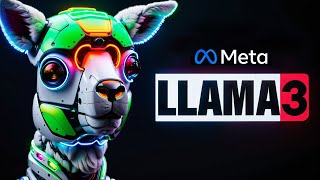
Meta's upcoming Llama 3 model, expected in July, aims to outperform GPT-4 and Gemini while staying fully open-source. Zuckerberg plans to add audio and video capabilities, integrate it with Ray-Ban glasses, and build infrastructure with 350,000 Nvidia H100 GPUs by year's end.
Questions this video answers
March 3, 2024.
In July (year implied by context).
Around 350,000 Nvidia H100 GPUs by the end of 2024.
Fully open source (per the narrator's statement).
Chapters
So Meta is at the forefront of the next wave in artificial intelligence, aiming to redefine the landscape with the introduction of Llama 3 in July. This ambitious endeavor marks a significant milestone not just for Meta but for the entire AI community, as the company seeks to outshine rivals like OpenAI's GPT4 and Google's Gemini with a model that's more responsive, nuanced, and equipped with better multimodal capabilities. The generative AI group at Meta, under the leadership of CEO Mark Zuckerberg, is not only enhancing user engagement across its platforms, but also refining the model to adeptly handle complex image based queries. Demonstrating a commitment to balancing technological advancement with ethical AI development considerations, Meta's Llama 3 isn't merely an incremental addition to the AI sphere it represents a substantial leap toward more sophisticated and safer AI interactions. While OpenAI has been making strides with its text to video generation model, Sora and Google's Gemini has faced criticism for its cautious approach. Meta's strategy with llama3 emphasizes a nuanced handling of contentious questions, offering context rather than evading or simplifying responses. This strategic enhancement underscores Meta's ambition not just to compete, but to lead in the AI race, setting new benchmarks for what AI can achieve in digital communication. The development of llama 3 is particularly noteworthy in the context of Meta's broader AI strategy, which extends beyond mere advertising tools to enrich the social media experience. By focusing on multimodal capabilities, enabling the AI to understand and process information across different data formats, Meta is pioneering a future where AI can offer more immersive and interactive experiences. Zuckerberg's vision for Llama 3 includes not just advancements in text and image processing, but also the potential for very advanced audio and video capabilities, suggesting a future where AI can seamlessly integrate with technologies like Meta's Ray Ban smart Glasses to offer real time assistance based on what the user sees and hears. However, the road to perfecting AI models like Llama 3 is fraught with challenges, notably ensuring a balance between user engagement and preventing inappropriate responses. Meta plans to appoint an internal figure to oversee the tone and safety training of LLAMA 3 and aiming for outputs that are nuanced and capable of handling sensitive topics responsibly. This reflects the complex process of AI development, where technological capabilities must be aligned with ethical standards and societal norms to ensure a positive impact on users. Meta's commitment to open source development is a critical aspect of Llama 3's rollout. Unlike its predecessors Llama 1 and Llama 2, which were released with varying degrees of open licensing. Llama 3 is expected to be fully open source, allowing developers, researchers and hobbyists to access and build upon the model, potentially accelerating innovation across the AI ecosystem. This move towards openness is part of Zuckerberg's broader vision to democratize access to powerful AI technologies, mitigating the risk of a future where AI advancements are concentrated in the hands of a few. The implications of Llama 3's release are profound, not just for Meta, but for the future of AI in digital communication. With its huge potential, llama3 is poised to set new standards for engaging and safe digital experiences. This comes at a time when the AI community is eagerly exploring the possibilities of artificial general intelligence, a theoretical stage of AI development where models could demonstrate intelligence comparable to or surpassing human capabilities. While Llama 3 itself may not achieve AGI, Meta's approach to its development focusing on multimodal understanding, reasoning and cognitive abilities, suggests a deliberate stride towards realizing this long term goal. Furthermore, Meta's substantial investments in training infrastructure, including plans to have around 350,000 Nvidia H100 GPUs by the end of 2024, indicate the company's commitment to pushing the boundaries of what's possible possible in AI. These resources will enable more robust pre training for models of any size, potentially enhancing Llama 3's performance relative to its predecessors and competitors. The emphasis on increasing the model's context, length and understanding capabilities hints at a future where AI can more effectively mimic human like interactions, remember more context in conversations and process a broader range of information. Meta's new Llama 3AI is a big step forward, focusing on better and safer technology that everyone can use. It shows Meta's lead in making AI smarter and more responsible for everyone's benefit. Alright, that wraps up our video. If you liked it, please consider subscribing and sharing so we can keep bringing more content like this. Thanks for watching and see you in the next one.