Meta's New AI Tool DESTROYS GOOGLE! (Now Released)
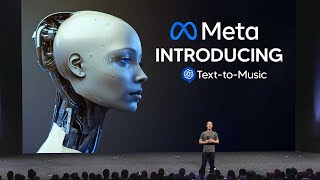
LARRUZ compares Meta's MusicGen AI music generator against Google's MusicLM. MusicGen uses a single-stage transformer trained on over 20,000 hours of music and can condition on melodies. Meta released it open-source on Hugging Face, and the paper claims it outperforms MusicLM on standard benchmarks, though it still struggles with some genres like upbeat arcade music.
Questions this video answers
"They trained this model on a data set of over 20,000 hours of music, which includes an internal data set of around 10,000 high quality music tracks, as well as Shutterstock and 0.5 music data."
Yes — the presenter states "musicgen is actually open source."
MusicGen is described as a "single-stage transformer language model" that operates over several streams of compressed discrete music representation and supports conditioning on melodies.
On a Hugging Face demo (the presenter: "Meta actually did open up a hugging face spot where you can actually use this product").
The paper reports MusicGen outperformed MusicLM on a standard text-to-music benchmark (both objective and subjective metrics), but notes the comparison may be unfair because MusicLM evaluations used the public API while MusicGen authors retrained models on the same dataset.
Chapters
Okay, so one thing that you might not have known is that Meta actually has an AI division in which they release new products all the time. And today was no different. They decided to release a new paper in which they discover a new way to generate music. So they released this paper today and called it simple and controllable music generation. So we tackle the task of conditional music generation. We introduce musicgen, a simple language model that operates over several streams of compressed discrete music representation. Unlike prior work, musicgen is comprised of a single stage transformer language model together with efficient token into leaving patterns, which eliminates the need for cascading several models. So following this approach, they're able to generate high quality audio. And through their studies they've shown that this improves on previous benchmarks. You might be thinking this is just another research paper in which they talk about products but never allow people to demo it or use it. But actually Meta actually did open up a hugging space spot where you can actually use this product if you want to. Now, it's important to note that Hugging Face isn't exactly a final product website. There are many different various projects that you can use for for applications that are going to be released in the future, but it is a place where you can test them and see how effective they are. And as you can see from here, musicgen is no different. Now another thing that I really do like about musicgen is that they offer the ability to condition on a melody, which essentially means that when you try to generate your soundtrack, you can actually use a different kind of soundtrack in order to influence how it sounds. It's essentially quite similar to Runway where you sometimes do need a driving image or driving video in in order to create that text to video. So I did actually test this with a specific type of music and I'll show you exactly what it sounds like. And then I'm going to compare it to another company that produced another music generator and that company is Google. So if you hadn't known already, Google also produced a music generator. Now I got to be honest with you guys, the results are very, very interesting because they are both actually very high quality. Now something you may have not known is that before we did make a video on Google's music generator, however at the current time it wasn't actually open for usage to the average user. But now Google has actually opened up the wait list a little bit and let some people through. So if you did watch that video and you did apply when I said then, it is likely that now your application is probably going to be accepted. So this is going to be another tool that you can also use in your AI music generation. So I'm going to firstly show you three different soundtracks. Number one, I'm going to show you the kind of soundtrack that is completely professional. That is a soundtrack that I actually paid for for use on a different project. Then I'll show you the Facebook's or Meta's AI soundtrack, which was generated using a description of that soundtrack. And then I'll show you Google's other soundtrack, which was also generated using the same exact description. And then we're going to be able to compare these and see just how far Meta has come. So this is premiumbeat. It's a website in which you can get music tracks for whatever project you're working on. Now, there's many different music tracks for whatever creative project you might want, but they do sound very, very high quality. Now, a recent project that I did work on was one that involved funky downtown music. And you're going to hear exactly what these soundtracks sounded like. The reason I'm going to play these is so that when I generate the music by the AI generator, you're going to be able to compare to see how realistic it does sound. So I'm going to play three of these tracks so you get a sense of to what the track should kind of sound like. And then I'm going to play Facebook. So now that you've heard those three soundtracks, let's go ahead to Meta's soundtrack. So you can see right here that I haven't actually put a condition on the melody, which means I haven't actually given it a sample track to use. So that might actually affect the output. And in the later part of the video we actually will go ahead and do that. So you can see in the description I've put downtown funk, jazz, comedy, and this is what the AI generated soundtrack sounds. Now, if I'm being honest, I do think it sounds okay, but I only think the reason that this doesn't sound that high quality is because it doesn't seem as like too much of a rhythm. Now, I do know that there are other soundtracks that do have conditioned melodies and will produce better results. But I want to also compare this to Google's one because it will go to show exactly where the music is. Now, previously on Google's one, they did actually have many different ones with much longer descriptions that sounded completely realistic, if I'm being completely honest with you. But what you're about to hear is the same exact description, but just by Google's AI Music generator. Now, what's interesting also about Music lm, which is by Google, is that they offer two tracks, much like how Midjourney offers many different image variation options. Once you've used a prompt, Music LM offers you two different tracks in order to pick one's best. Now that was Soundtrack one. And that was Soundtrack two. Now, I've got to be honest, if I was listening to that soundtrack, I would say that Soundtrack two is good and it definitely does improve on Meta's Music gen. Now, on that one solo example, it's clear to say that it does sound like Music LM is better. However, take a note from the actual research paper, what they say about the comparison between Facebook Meta's MusicGen compared to Google's Music LM. So according to the evaluation results presented in the paper, MusicGen has been shown to be superior to Music LM on a standard text to Music Benchmark. Whilst Music LM is a competitive baseline, MusicGem outperformed it in both objective and subjective metrics. However, it's worth noting that the authors of this research paper used the Public API for Human Studies for Music LM while they retrained the Musai model on the same dataset. Therefore, the comparison between musicgen and Music LM might not be entirely fair as the models were evaluated under different conditions. Nonetheless, the results may suggest that musicgen is a promising approach for text to music generation and it might actually perform other competitive baselines such as Music lm. Now, I also do want to show you what that soundtrack would sound like if it was conditioned with with a melody. So this is the melody that I put inside you can hear. That was one of the soundtracks that was from another project, so I decided to rename it again. And then what was interesting about the soundtrack is that the first three seconds are good and then the rest of it is just a bit strange. I'm wondering if it copies the first couple of seconds and then the rest of it sounds strange. Just take a listen. Yeah, I gotta be honest, the first couple of seconds were promising, but then the last bit wasn't as promising. So I'm wondering if this AI generator was firstly imitating the first couple of seconds and then later when there was a drop off, it sort of just got confused. That is potentially what happened. Now, this stuff is definitely interesting and I do know that there are some inconsistencies among generations, but what I want to do is I want to actually compare Google's paper to what Meta has released here. So one of the Things that I wanted to note about music LM was they had certain things on their actual page. So, so if you come to Google Research's GitHub, you can actually find the page where they have multiple and numerous different examples which are honestly genuinely interesting. But one of them, one of the key ones, was called relaxing jazz and it definitely sounded really, really interesting. Now you're going to see the differences in the quality and you're about to hear relaxing jazz from Google's actual official paper, Which is really cool because not only is this AI generated, it's around five minutes long. And then I took this description and then what I've done is I've also put it into Google's music LM generation software because I knew that this may generate something different and I wanted to see if there was any consistency and if Google actually did cherry pick or hand pick their music results. And then I also once again put it into Meta's music generator. So what you're going to see right here is that I'm going to go ahead and click Generate and I want you to hear differences. Now, I think we all know what relaxing jazz sounds like. It definitely was pretty accurate. So I'm gonna play Meta's one, Then I'm gonna go ahead and play Google'. Sam. Okay, so with that being said, I gotta be honest, the relaxing jazz background music does definitely sound great from both of them. And I do think that whatever sort of music track you do pick, I do think it is going to affect how exactly it sounds. Now I do think that this does have some application maybe for background music. Maybe you don't want to buy music and maybe you just want to have this in the background of a lobby, a hotel lobby, one of your video games. Maybe you're starting a small project, stuff like this, you generally wouldn't be able to tell because it's in the background and it's a supporting track. However, if we do come to the point where people are actually trying to create entire music tracks, where it's going to be the main theme, that might be a different story. Now another thing that I also did want to compare because it was truly impressive in Google's demo was the rich captions. So rich captions are essentially these links, long captions with a lot of descriptions. And you can see that the first one here was the main soundtrack of an arcade game. It is fast paced and upbeat with catchy electric guitar riff. The music is repetitive and easy to remember, but with unexpected sounds like cymbal crashes or drum rolls. So this one sounded super realistic. And I do think that being able to generate music from this kind of description is really, really good. So I'm going to go ahead and test this in metas. Okay, so if we look at the arcade soundtrack, I think that music gen, for some reason didn't get this right and honestly it sounds pretty weird. So I did actually generate two different soundtracks and one I used the same text that Google used, and then on the other one I actually used a normal soundtrack and I even conditioned it. So the results here are interesting. Maybe this is just a personal experience, but you're going to see what they both sound like. And this is what the condition melody sounds like, which is a normal arcade soundtrack. And then I call the upbeat arcade soundtrack for a video game and then this is what it sounds like. Definitely. Not that I'm not sure why it got it wrong in this instance, but I did try again with this one and you're going to hear exactly what what it sounds like. And yeah, I don't want to play the entirety of that because it definitely sounds weird. It actually does actually for the most part sound AI generated. But I think that maybe if you do try regenerate these, they will essentially have a much better output. But for now it would seem that from my guess that in certain categories it excels, whereas in other categories it just doesn't know what it is. For example, in relaxing jazz music it can do very well, whereas in upbeat arcade music it just doesn't do well at all. And just for reference, if you think that the text was wrong or something, this is Google's one when we used Google's music lm. And then this is what track two sounds like. I mean, arguably they're both not that great. I'm guessing there isn't enough of that data in the sample set. I'm guessing what they trained this model on only had a certain number of bass soundtracks which they used. I do know that it was trained on a data set of over 20,000 hours of music, which includes an internal data set of around 10,000 high quality music tracks, as well as Shutterstock and 0.5 music data. But I'm thinking that maybe some of these may have either been categorized wrong or perhaps not correctly sampled. So either way, I do think that this is interesting. And for those of you who think that yes, right now this isn't plausible to use as a complete end working product. I think for background music, some of the soundtrack generated by these AI tools could 100% be used without people knowing, but I do think that we are a long way away from the complete soundtracks now. It's also important to know that AI development can move pretty rapidly. So whilst this might seem like that now in June, by the end of the year we could have something that is 100% fully functional and works much more efficiently than these tools. Now one thing that I did forget to add from this video was that musicgen is actually open source, which means that people are going to be able to use this, fine tune it and essentially work with this program and make it much better if they want to. And that's definitely something that we have seen. So I do think, like we said before, these advancements are going to continue to go pretty quickly, especially when we have open source projects and there are many different talented individuals out there that can make these models a lot more consistent. And additionally, for those of you who do think that this is just something that Meta are working on, there are other companies that also actually have AI music generation. For example, if you do some browsing, you'll come across this website called Soundraw which says stop searching for the sound you need, create it royalty free music AI generated for you and you can simply generate some music tracks. We also have another website right here called Boomi. Unleash your creativity. Make music with Boomy AI create original songs in seconds even if you've never made music before. Submit your songs to the streaming platforms and get paid when people listen. Then we also have this website here called Soundful and it's the best license for creators, an AI music generator where you can literally just generate background music like we talked about in the video before. So I do think that once again this is going to be moving very rapidly. And with open source projects you do see a lot of solo developers and a lot of smaller teams working on that and they usually come out with many different things such as auto GPT which was a fine tuned version of a large language model. So it definitely will be interesting to see what comes of this and it's definitely exciting for the future.










