Meta's New Aria 2 AI Glasses Are Incredible
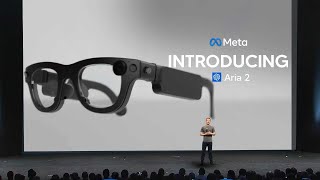
Meta's Aria Gen 2 glasses combine on-device AI with eye tracking, hand tracking, and heart-rate monitoring. The video demos how they help people with vision loss navigate stores and interact with their surroundings using voice commands, though the glasses aren't yet available to consumers.
Chapters
So most smart glasses usually sound cooler than they actually are. But Meta's new Arria Gen 2 glasses are genuinely a different ballgame. Let's actually take a look at what Mark Zuckerberg and the amazing people at Meta have done and why these glasses are a complete game changer. So Meta's Aria Gen 2 are glasses that apparently feel genuinely different. They're not just strapped to your face, they've actually got sensors that track your eyes, your hands and even your heartbeat. And the tech behind these things is absolutely insane. But what's impressive is that researchers are actually using them to shape the future of AI and robotics. And it feels like we've just jumped ahead five years by putting these glasses on. So one of the things that actually is really impressive about these glasses is that they're not AI in the traditional sense. They are essentially not really like ChatGPT or a virtual assistant, but they're actually a lot better than that. They're packed with advanced sensors and on device AI processing capabilities that gather tons of detailed information from, from your perspective, which is, you know, what you're seeing, what you're hearing, and even how you're moving. And the technologies inside them, like slam, which is simultaneous localization and mapping, you know, it's got eye tracking, speak recognition, all of that happens directly on the glasses themselves, which means that you don't need to actually connect to the Internet. And researchers actually take all of that detailed data and then create AI models or even train AI robots to react and interact with the world more naturally. So these glasses are basically like a portable AI research lab, which gives scientists and developers the tools to experiment with new ideas, improve robots and build smarter AI systems.
With product aria, we reimagined a wearable device with a sensor suite that could perceive as you perceive. And in doing so enables the development of a new generation of artificial intelligence that is a better understanding of who you are and makes possible new advancements in robotics. Project Harrier, from the outset was designed to begin a revolution around always on human centric computing. We're excited to announce the next step in our journey, the second generation of Aria glasses.
With Gen 2 glasses, we are building AI capabilities with a deeper understanding of the wear's context and the environment.
Aria Gen 2 is the perfect tool for researchers pushing the boundaries of AI and ar.
What you see here is the same as this. We have upgraded the sensor suite with additional computer vision camera for renounced location and embodied tracking. We have increased battery capacity by over 40% without a weight increase the device features A contact microphone and special microphones. It can distinguish between your voice and those of bystanders. Haria Gen 2 determines your location both indoors and outdoors. Advanced Eye Tracking Camera tracks your gaze to understand what you're looking at and tracks your hand to identify the object you interact with. All while monitoring your heart rate. For a comprehensive understanding of your well being.
We introduced the ability to process a lot of the signals on the device in real time.
As soon as you do that, you move away from the context of data collection and processing.
Later, then we can start to interact with the user. Not just research what might be possible, but actually experience it.
Help me pick up some red onions.
Taking you to red onions. Red onions are here.
Very important parts of Project Harrio has been building partnerships with companies and academic research labs that have reached far beyond our own.
We stay committed to research processes that safeguard personal information. The journey with second generic glasses is just the beginning.
Imagine what the research community can achieve with a device that closes the gap between machine and human perception. Together, we can unlock an understanding of what it is to experience reality as we do now.
One of the Things that Matter doesn't get enough credit for or simply isn't. Any company that is operating in the area where they are providing services to those who are disadvantaged is of course how these glasses are actually going to be used by people who have a certain disability. And this company, InVision, is actually taking the Aria 2 glasses and is actually basically making the glasses so that they can be super useful to someone with blindness. We've seen early examples of this with Be My Eyes with ChatGPT, but this demonstration, we actually get to see one of the major positive use cases for AI. This is something that I found super, super impressive, especially since the way how the centers and all those things were working together were able to essentially help this woman be able to walk through a store and essentially have a real sense of space. This isn't the first time companies have done this. I've also seen another company called Lumen that did something pretty similar to this. But this is something that I, I think is so important for the AI industry because while CS, ChatGPT and other things are interesting, this is where largely value creation comes for the everyday average person.
You know, it's one of those things that you don't know what you got until it's gone. And that was kind of the case with my vision when I lost it at 31. The challenges that we face, you know, just simply with visual navigation, you lose a level of independence with that for.
A lot of people who are blind and have a low vision independence, almost always access to information. ARIA enables us to combine technologies like artificial intelligence and spatial audio that make the visual world accessible for people who are blind or have low vision. It was amazing to see how a lot of our feedback was incorporated in building a Gen 2 device and also by keeping accessibility as one of the focus points.
This is a truly collaborative effort between Envision, Lighthouse San Francisco and Meta. We really want to go out and co design with the community and try to learn from their experience. They actually want to try out these technologies. They're really excited. Sharon has been testing these features, giving us early feedback. GPS just doesn't work indoors. We need a different mapping and navigation technology.
Usually when you listen to sounds over headphones, they'll sound like they're inside your head. Spatial Audio is a technology that lets you play sounds over headphones that seem like they're coming from a real location out in the world. And all you have to do is follow that sound.
You put the glasses on and you just talk to it like you talk to a friend.
Hey Meta, help me pick up some apples.
Certainly. Follow the sound to locate the apples in the store.
It'll start playing a beacon sound from the location within the store.
The glasses can actually map as they are being used.
We can allocate different points and label it with items that should be there in that space.
Apples are here.
You can ask any kind of a question.
What apples are here?
They have Granny Smith Cosmic Crisp and Honeycrisp apples.
I'll get Granny Smith apples. Help me pick up red onions.
Taking you to red onions. Red onions are here.
Is this a red onion?
Yes, this is a red onion in your hand.
Just to have the freedom to walk into a grocery store and navigate to what I wanted. It was efficient, it was fast, was just amazing. That's all I need today. Take me to the checkout counter.
Sure. Guiding you to the checkout.
This isn't ready to ship out the door this second, but what's exciting is for how many people, this appears to be working really well.
Without these partners, we would have not been able to do what we did today.
Thank you. Have a great day.
When we look at someone like Sharon pick the groceries that she wants on her own, that emotion is incredible.
Now, if you're a fan of Meta, you'll probably want to know about their recent glasses update. They've actually updated the Ray Ban ones. Actually do have a pair and they are super useful. So you may want to Take a look at how they've actually embedded AI into those ones. And the reason I'm talking about this is because this is something you can actually purchase. The ARIA Generation 2 aren't available for consumers just yet, but these ones currently are.
Hey, Meta, play some music. Hey, Meta, look and translate this.
Send a voice message to Laura on WhatsApp.
Hey, dad, what you doing?
Just checking on you. Just hurry back when you can.
You guys cooking? Say hi to Mom.
Hey, y', all.
Guess where we're at.
Festival.
Oh, hello to Azir.
He look amazing.
Hey, Meta, take a video.
Nice.
Hey, Meta, how many tablespoons are in a cup?
Hey, Meta, look and tell me what kind of butterfly that is.
Okay?
Yes, chef.
My turn.
Now. It wouldn't be fair, not to mention Meta's other glasses, the Orion glasses. And these ones aren't like the others. They're actually advanced AR glasses that were unveiled at meta connect 2024. So these ones are super interesting because they're a different platform, but I do think that they'll probably become mainstream once they're released. And they do have a price target release date for 2027, which is two years from now. But I do think the AR is pretty hard to get right, especially if you in such a thin pair of glasses.
About a decade ago, I started putting together a team of the best people in the world to build these glasses. And the requirements are actually pretty simple, but the technical challenges to make them are insane. They need to be glasses, not a headset, no wires, less than 100 grams. They need wide field of view, holographic displays, sharp enough to pick up details, bright enough to see in different lighting conditions, large enough to display a cinema screen or multiple monitors for working wherever you go, whether you're in a coffee shop or on a plane or wherever you are. And you need to be able to see through them. And people need to be able to see through them too, and make eye contact with you. Where this isn't pass through, this is the physical world with holograms overlaid on it. So if someone messages you, you will see that. And instead of having to pull out your phone, there will just be a little hologram. And with a few subtle gestures, you can reply without getting pulled away from the moment. Or if you want to be with someone who is far away, they're going to be able to teleport as a hologram into your living room as if they're right there with you. You're gonna be able to tap your fingers and bring up a game of cards or chess or holographic ping pong or whatever it is that you want to do together. You can work or play or whatever.
Now, for those of you who are wondering about the future of glasses in 2030, take a look at what Noam Shizer, Google's co lead on Gemini, says by 2030 that there actually will be AI assistants in glasses that provide advice and solve problems for you in real time. And I actually think that that probably will be the default form factor as well as like Alexa, because having your phone out every single time is just rather inconvenient and glasses already a staple thing that you already wear in 2030.
I think just more is always going to be better. If you just kind of think about, okay, what fraction of world GDP will be, will people decide to spend on AI at that point? And then like, okay, what do the AI systems look like? Well, maybe it's some sort of personal assistant like thing that is in your glasses and can see everything around you and has access to all your digital information and the world's digital information. And maybe it's like you're Joe Biden and you have the earpiece in the cabinet that can advise you about anything in real time and solve problems for you and give you helpful pointers or you could talk to it and you know, it wants to analyze like anything that it sees around you for any potential useful impact that it has on you. So I mean, I can imagine, okay, and then say it's like your personal assistant or your personal cabinet or something and that every time you spend 2x as much money on compute, the thing gets like 5, 10 IQ points smarter or something like that. And okay, would you rather spend like $10 a day and have an assist or $20 a day and have a smarter assistant? You know, and not only is it an assistant in life, but an assistant in getting your job done better because now it makes you from a 10x engineer to 100x or 10.
So let me know what you guys think about the integration for AI there. Hopefully you enjoyed this video and I will see you guys in the next one.










