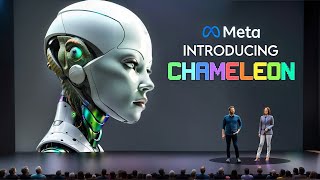
A LARRUZ YouTube video (May 24, 2024) describing Meta’s Chameleon model, which uses an early-fusion architecture to natively combine text, images and other modalities into a single token vocabulary. The narrator contrasts Chameleon with prior late-fusion multimodal models, summarizes Meta’s large-scale training (trillions of examples, millions of GPU hours), and claims state-of-the-art performance across visual and text benchmarks with strong human preference.
Chapters
We all know how language models like GPT3 revolutionized AI by understanding and generating human like text. It was a game changer, opening up new possibilities for AI assistants, creative writing, coding and so much more. But then they pushed further, creating multimodal AI models that handle not just text, but also images, audio, video and more. We've seen cool examples like Dall E making amazing images from descriptions and and GPT4 blending visuals into text outputs. It felt like AI models were finally breaking free from their text only limits. Now. Meta's upped the game with their Chameleon model. You see, up until now, most of these multimodal models relied on what's called a late fusion approach. They would process and encode each data type, like text or images separately, and only then try to bring those different representations together in some unified way. It worked okay, I guess, but it meant the models weren't truly integrating and understanding those multiple modalities in a cohesive end to end fashion. From the very start, there were always inefficiencies and limitations baked into that late stage unification process. Chameleon completely flips that script by employing an early fusion architecture that truly intermingles all data streams as one unified vocabulary from the ground up. It's designed to natively work with a mixed vocabulary of discrete tokens that could represent anything. Words, pixels, points, etc. Everything happens through transformers. Working their neural magic on these unified sequences of interleaving leave text, image and other tokens all together from the jump. There's no more separating or late stage merging required. Of course, this degree of deep multimodal integration from the very start presented its own massive challenges and complexities when it came to training these powerful AI models. But the brilliant minds at Meta were up for the task. They employed incredibly sophisticated techniques like two stage learning processes and stratospheric datasets containing over 4 trillion examples of text, images, interleaved sequences and so on. Essentially a training compute in the millions of GPU hours just to master this paradigm. But I guess it was worth the insane effort because the results of Chameleon are nothing short of extraordinary. This model displays state of the art performance across an incredibly diverse range of tasks and benchmarks. I mean world class scores on visual skills like captioning images, answering questions about visuals, and even generating wholly new composite documents with fluent sequences of intermingled text in imagery. The human evaluations showed people strongly preferred these multimodal chameleon outputs. And get this, despite being natively multimodal, this thing still goes toe to toe. With elite language models on text only tasks too, it matched or exceeded the likes of Gemini, Llama and others across challenges around reading comprehension, common sense reasoning and more. That's the true magic of Chameleon's unified end to end architecture shining through by mastering the shared representation of all modalities at a fundamental level, it doesn't sacrifice any single capability. If anything, it multiplies the model's overall effectiveness across any scenario. But perhaps even more valuable than achieving top scores on current benchmarks is the future potential this breakthrough represents. By pioneering this early fusion approach at a massive scale, Meta has unlocked an entirely new paradigm for advanced AI systems. We're talking about building multimodal assistants, question answerers, analysts and creators that can fluidly understand any combination of language, visuals, video and beyond in a truly unified common sense fashion. That's the kind of general intelligence and versatility we'll need for futuristic applications like robotics that combine seamless language and vision, immersive augmented and virtual reality interfaces, multimedia search generation and analysis at a degree we've never seen before. The Meta AI researchers themselves said Chameleon represents a significant step towards realizing the vision of unified foundation models capable of flexibly reasoning over and generating multimodal content. That's the North Star they're shooting for here, artificial general intelligence that masters all modalities together. Of course, the human level cognition is still a long ways away, but with each breakthrough like this early fusion approach, we we get one step closer to bridging that great divide separating narrow AI from the holy grail of advanced artificial general intelligence, or AGI. Now, Meta hasn't publicly released or open sourced their Chameleon model and weights just yet, but if they follow their standard playbook, we should expect to see it available for commercial and research use before too long. That could make Chameleon a powerful open alternative or counterweight to models like GPT4 or Google's Gemini that are currently locked behind closed doors. Having this caliber of multimodal AI available openly could massively accelerate breakthroughs across so many fields. Regardless of when the public release happens, it is certain that Meta's Chameleon has staked its claim as an absolute pioneer, blazing the trail for the next great frontier of generative AI. By achieving human level fluency across modalities in a single unified architecture, they've kicked open the door to realms of advanced intelligence we could only dream of just years ago. So what are your hopes and concerns around the implications of unified multimodal AI like this? I'm excited to hear all your takes. Alright, don't forget to hit that subscribe button for more updates. Thanks for tuning in and we'll catch you in the next one.