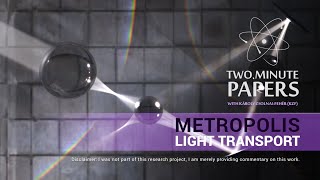
Path tracing renders photorealistic 3D scenes by randomly sampling light paths, but converges slowly and noisily. Metropolis Light Transport reuses good paths and explores variants nearby, converging much faster in difficult scenes like occluded or refractive setups. Eric Veach led the technique, which won a technical Oscar.
Chapters
Dear fellow scholars, this is two minute papers with if we would like to see how digitally modeled objects would look like in real life, we would create a 3D model of the desired scene, assign material models to the objects within, and use a photorealistic rendering algorithm to finish the job. It simulates rays of light that connect the camera to the light sources in the scene and compute the flow of energy between them. Initially, after a few rays, we'll only have a rough idea on how the image should look like. Therefore, our initial results will contain a substantial, substantial amount of noise. We can get rid of this by simulating the path of millions and millions of rays that will eventually clean up our image. This process, where a noisy image gets clearer and clearer, we call convergence. And the problem is that this can take excruciatingly long, even up to hours. To get a perfectly clear image with the simpler algorithms out there, we generate these light paths randomly. This technique we call path tracing. However, in the scene that you see here, most random paths can't connect the camera and the light source because this wall is in the way, obstructing many of them. Light paths like these don't contribute anything to our calculations and are ultimately a waste of time and precious resources. After generating hundreds of random light paths, we have found a path that finally connects the camera with the light source without any obstructions. When generating the next path, it would be a crime not to use this knowledge to our advantage. A technique called Metropolis Light Transport will make sure to use this valuable knowledge. And upon finding a bright light path, it will explore other paths that are nearby to have the best shot at creating valid, unobstructed connections. If we have a difficult scene at hand, Metropolis Light Transport gives us way better results than traditional completely random path sampling techniques, such as path tracing. Here are some equal time comparisons against path tracing to show how big of a difference this technique makes. An equal time comparison means that we saved the output of two algorithms that we ran for the same amount of time on the same scene and see which one performs better. This scene is extremely difficult in a sense that the only source of light is coming from the upper left. And after the light goes through multiple glass spheres, most of the light paths that we generate will be invalid. As you can see, the random path tracer yields really dreadful results. Well, if you can call a black image a result, that is. And as you can see, Metropolis Light Transport is extremely useful in these cases. And here's the beautiful, completely cleaned up, converged result. The lead author of this technique, Eric Veitch, won a technical Oscar award for his work, one of which was Metropolis Light Transport. If you like the series, please click on that subscribe button to become a fellow scholar. Thanks for watching. There are millions of videos out there and you decided to take your time with this one. That is amazing. Thank you and I'll see you next time.