Microsoft's New AI Genius - ORCA 2: Beyond GPT-4 in Complex Tasks!
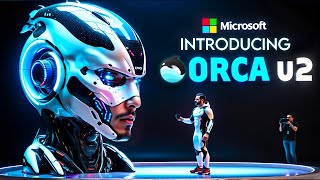
Microsoft's Orca 2 is a 7B and 13B parameter model that matches GPT-4 and Llama 2 Chat 70B on complex reasoning tasks like math and logic puzzles, despite being much smaller. It's open-source and available on Hugging Face and other platforms, trained on synthetic data from GPT-4 reasoning traces.
Chapters
So Microsoft has just released Orca 2, a new AI model that can perform complex reasoning tasks and communicate fluently in natural language. This is actually a huge breakthrough in AI and I'm going to tell you everything you need to know about it. Also, before we begin, remember to subscribe if you haven't done so yet. Alright so Orca 2 is the latest step in Microsoft's efforts to explore the capabilities of smaller language models, specifically those with about 13 billion parameters or fewer. Now if you wonder why there's interest in these smaller models, the reason is that they offer various benefits compared to larger models like GPT4, Palm or Llama 2, which have a massive number of parameters in the hundreds of billions. These smaller models are simpler to train, set up and operate. They also use less computer power and energy. This makes them more practical and cost effective for various organizations regardless of their size or field. However, smaller models do have their own set of hurdles. One of the main challenges is ensuring they perform well and accurately on complex tasks. These tasks can include answering questions, creating explanations, or tackling multi step problems that need advanced thinking skills. Now this new model's contribution is essential here. Orca 2 is a 7 billion or 13 billion parameter model that is created by fine tuning the corresponding Llama 2 base models on tailored high quality synthetic data. It is designed to overcome the limitations of smaller models by imitating the reasoning process of larger models such as GPT4. It can learn from rich signals from GPT4 such as explanation traces, step by step thought processes and other complex instructions guided by teacher assistants from ChatGPT. This way Orca 2 can learn various reasoning techniques such as step by step processing, recall, then generate, recall, reason, generate, extract, generate and direct answer methods while also learning to choose different solution strategies for different tasks. For example, while a large model like GPT4 can answer complex tasks directly, a smaller model like Orca2 may benefit from breaking the task into steps. Also, to clear up a common misunderstanding and the views of some individuals, it's important to know that Orca 2 is not simply a smaller version of GPT4. It it is a smarter and more efficient model that can achieve performance levels similar to or better than models five to ten times larger as assessed on complex tasks that test advanced reasoning abilities in zero shot settings. Zero shot settings are scenarios where the model has to perform a task without any prior training or examples. This is a very challenging and realistic test of the model's generalization and adaptation skills. Now let's see how Orca 2 does on these tasks. We can Start by checking out some of its performance results Orca 2 really shines when it comes to the GSM 8K dataset. This dataset is a collection of over 8.5 thousand high quality linguistically diverse grade school math word problems created by human problem writers. These problems require two to eight steps to solve, mostly involving basic arithmetic operations to find the final answer. They are designed such that a sharp middle school student should be able to solve each one. This makes the data set ideal for testing multi step mathematical reasoning. Orca 2 shows remarkable proficiency on this benchmark, surpassing models of a similar size, including the first ORCA model. Its performance is comparable to or even exceeds larger models like GPT4 and Llama 2 Chat 70B, which are five to ten times its size. This achievement is particularly noteworthy because Orca 2 was not exposed to any math problems during its training phase. It tackles these challenges using its reasoning abilities and understanding of natural language. Orca 2 also performs well on other benchmarks such as Big Bench Hard, which is a subset of the Big Bench data set that contains the most difficult tasks that require complex reasoning such as logic puzzles, word problems and IQ tests. It surpasses models of similar size and reaches parity with ChatGPT on this benchmark. It also shows competitive performance on professional and academic examinations such as the sat, lsat, GRE and gmat, both in zero shot settings without cot, which is a technique that allows the model to access external knowledge sources and it can answer these questions by using its reasoning skills and natural language understanding. These results show that Orca 2 is a powerful and versatile model that can handle a wide range of tasks and domains. Obviously, Microsoft has made Orca 2 open source as well, which allows everyone to access, utilize and enhance it. Microsoft's decision decision to do this is actually commendable. It promotes additional research and teamwork in developing, assessing and aligning smaller large language models. Now, how is Orca 2 different from the original ORCA model that was released in June this year? Both Orca models have 13 billion parameters, but Orca 2 uses a different base model, llama 2 instead of GPT4. The new model also improves its reasoning skills by using high quality synthetic data and can apply various methods to solve different types of tasks. It performs better than ORCA in several tests, particularly in the GSM8K dataset that measures multi step mathematical reasoning. Additionally, Orca2 matches ChatGPT in the big Bench Hard benchmark which evaluates complex reasoning in new situations. In terms of communication, Orca 2 is again more advanced in producing natural flowing texts, conversations and explanations. It uses a range of language features like rhetorical questions, casual expressions, and even emoticons. It can also adjust its speaking style and tone for different situations and audiences, whether it's formal, casual, friendly or even sarcastic. The new model is also more reliable and robust than the original orca. It can manage a broader variety of inputs and outputs and is better at dealing with mistakes and uncertainties. It is designed to recognize and avoid biases and ethical concerns in its data and results, ensuring its actions and decisions are transparent and responsible. Finally, Orca 2 is more versatile and adaptable. It can handle many tasks and fields, easily switching between them. It can work alongside other models and systems like GPT4, Palm or Llama2Chat7DB, benefiting from their strengths. It is also capable of tailoring its outputs and interactions based on user preferences and specific situations. Now, while impressive, the new model isn't without its flaws. It carries over some issues from its predecessors, Llama2 and GPT4. Like Databy biases, struggling with context and ethical concerns, there's a risk that Orca2 might produce responses that are discriminatory, spread misinformation, or go against societal values and ethics, especially in situations it's not well versed in. This is particularly troubling because LLMs like this can greatly influence society and people's lives. It's crucial for Orca 2 to align with human values and steer clear of causing harm. To improve Orca 2, one strategy could be using reinforcement learning from human feedback. This method trains the model using human input and feedback, helping it to learn what's beneficial and safe, and discouraging damaging or inappropriate content. Unfortunately, Orca 2 doesn't currently employ RLHF or similar safety measures. This absence is a shortcoming that should be addressed, as RLHF can greatly increase Orca2's alignment with human ethics and its overall reliability. Now, if you want to use this new AI model, you can run it on your computer using Python environments and interfaces like LM Studio, or access it online through platforms such as Hugging Face or Replicate. It is actually great for everyday tasks like answering questions, generating text, summarizing text, and creating code. You can also tailor it to your specific needs by training it with your own data and tasks. However, it's important to use Orca 2 responsibly. Be aware that it might produce inappropriate or harmful content, especially in areas it's not familiar with. Always check that the information Orca2 gives you is accurate and reliable. Make sure not to use it for bad purposes. You should also be mindful of other people's and entities privacy and rights and adhere to Orca2's licensing agreement and rules for proper use. As we've seen, Orca 2 is a major step forward in AI boasting impressive reasoning and language skills. So what's your take on this? How do you think Orca 2 might fit into your day to day tasks or future projects? Feel free to drop a comment and let us know your thoughts. I'm really curious to hear how you see Orca 2 making an impact. Thanks for watching and see you in the next one.










