Microsoft's New PHI-3 AI Turns Your iPhone Into an AI Superpower! (Game Changer!)
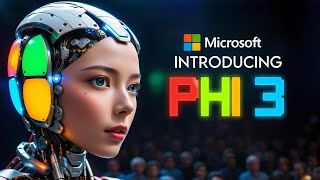
Microsoft's Phi 3 mini is a 3.8 billion-parameter model that runs on iPhone 14 offline, generating 12+ tokens per second at 1.8 GB when quantized to 4-bit. It matches the performance of much larger models like GPT-3.5 through better training data and architecture choices, bringing powerful AI to your phone without sending data to the cloud.
Questions this video answers
3.8 billion parameters.
Approximately 3.3 trillion tokens.
4,096 tokens (4K).
320,641 tokens/words.
Quantized to 4-bit and takes about 1.8 gigabytes.
Chapters
Microsoft just made a big move in the AI world by shrinking powerful AI down to fit right in your pocket with the Phi 3 mini. And I mean that literally. This little powerhouse can run on your iPhone 14, bringing advanced AI capabilities without compromising your privacy. It's a game changer for anyone looking to use advanced technology simply and securely. In the past, developing AI meant creating bigger and more complex systems, with some of the latest models having trillions of parameters. These large models are powerhouses of computing and have been able to perform complicated tasks that are similar to how humans understand and reason. But these big models need a lot of computing power and storage, usually requiring strong cloud based systems to work. Now, with Phi 3 mini, there's a change. This model fits an advanced AI right in your hand, literally. It has 3.8 billion parameters and was trained on 3.3 trillion tokens, making it as good as much larger models like Mixtral 8x7B and even GPT 3.5. What's even more impressive is that it can be used on regular smartphones without needing extra computing help. One of the major breakthroughs with this model is how carefully its training data has been upgraded. Instead of just making the model bigger, Microsoft put a lot of effort into improving the quality and usefulness of the data it learns from during the training. They understood that having better data, not just more of it, is key to making the model work better, especially when they have to use smaller computer systems. Phi 3 mini came about by making the data set it learns from bigger and better than the one its older version Phi 2 used. This new dataset includes carefully chosen web data and synthetic data created by other language models. This doesn't just ensure the data is top notch, but it also greatly improves the model's ability to understand and create text that sounds like it was written by a human. Now, the Phi 3 mini model is built using a transformer decoder which is a key part of many modern languages language models, and it has a default context length of 4K. This means that even though it's a smaller model, it is still able to handle a wide and deep range of information during discussions or when analyzing data. Additionally, the model is designed to be helpful to the open source community and to work well with other systems. It has a similar structure to the Llama 2 model and uses the same tokenizer which recognizes a vocabulary of 320,641 words. This makes it easy for developers who have experience with llama2 to use their existing skills and tools with Phi3 mini without having to Start from Scratch One of the coolest things about Phi 3 mini is that it can run right on your iPhone 14 thanks to the smart way it's built, it can be squeezed down to just four bits and still only take up about 1.8 gigabytes of space. And even with its small size, it works really well. It can create more than 12 tokens per second while running directly on the iPhone's A16 bionic chip without needing any Internet connection. What this means is pretty huge. You can use some really advanced AI features anytime you want without having to be online. This keeps your information private and everything runs super fast. When it comes to how well it performs, Phi 3 mini has really shown its strength in both in house and outside tests. It scores just as well as bigger models do on well known AI tests like MMLU and MTBench. This demonstrates not only the efficiency of its architecture, but also the effectiveness of its training regimen, which was meticulously crafted to maximize the model's learning from its enhanced data set. Now, when developing this, they also tried out larger versions of the model called Phi3 Small and Phi3 Medium, which have 7 billion and 14 billion parameters respectively. These bigger models were trained using the same high quality data but for a longer time, totaling 4.8 trillion tokens. The results from these models were actually really good, showing major improvements in their abilities as they got bigger. For instance, the Phi 3 Small and Phi 3 Medium scored even higher on the MMLU and MT bench tests, proving that making the models bigger can be very effective without using more data than necessary. But the way they trained the Phi 3 mini was different from the usual method of just making models bigger and using more computing power. The training process started with using web sources to teach the model general knowledge and and how to understand language. Then it moved to a stage where it combined even more carefully chosen web data with synthetic data focused on logical thinking and specialized skills. This careful step by step approach helped the model perform really well without just making it bigger. In training the model, they also made use of the latest AI research, including new ways of breaking down text into tokens and focusing the model's attention. For example, the Phi 3 small model uses a tokenizer called Tiktoken to handle multiple languages better, showing Microsoft's commitment to improving how the model works in different languages. After the model's development, the team did a lot of testing to make sure it wouldn't produce harmful content. This included thorough safety checks, red teaming where they tried to find weaknesses, and automated testing. These steps are very important as AI becomes a bigger part of everyday gadgets and handles more important tasks, and Phi 3 mini has been shown to produce harmful content less often than other models in conversations that have multiple turns. This lower risk of the model saying something inappropriate or harmful is key for its use in the real world. The creation of Phi 3 mini also focused on getting the community involved and supporting them by using a design similar to llama2 and making sure it works with Twitter tools developers already use. Plus, the model's design is flexible. It includes features like long rope, which lets the model handle much longer Texts, up to 128,000 characters. Using the Phi 3 Mini on your iPhone 14 really changes the game by making advanced AI technology easy to access right on your phone. And the best part is, in my opinion, that it ramps up our privacy. We don't have to worry about sending our personal info to far off servers to use AI apps anymore. And everything happens right on our phones, which keeps our data safe and private, just the way it should be now. Although Phi 3 mini has many benefits, like all technologies, it has its limits. One big issue is that it doesn't have as much capacity as larger models. Because of its smaller size. For example, it might struggle with tasks that need a lot of specific information, like answering complex questions in a trivia game. However, this problem might be lessened by connecting the model to search engines and that can pull up information when needed, as shown in tests using the Hugging Face Chat ui. Looking ahead, Microsoft's development team is excited about improving the model's ability to work in multiple languages. Early tests with a similar small model called Phi3small have been promising, especially when it includes data from many languages. This suggests that future versions of the Phi series could support more languages, making the technology useful to people all over the world. Moreover, by showing that a smaller data optimized model can perform as well as much bigger systems, Microsoft is encouraging the industry to think differently about how AI models are made and used. This could lead to new creative ways to use AI in areas where it was previously too demanding. In terms of computing power, Microsoft's Phi 3 mini marks an important advancement in bringing powerful AI tools into our daily lives in a practical way. As this technology keeps improving, it is set to broaden what we can do with our personal devices, enhancing our experiences and abilities in new and exciting ways. The ongoing development of such models will likely inspire more innovation throughout the tech industry, potentially transforming how we interact with technology at a basic level. And when you think about it, the Phi 3 Mini isn't just a data optimization breakthrough. It's actually a sign of where AI is headed. It balances power and size with efficiency and accessibility, setting the stage for smarter, more adaptive and personal technology in our everyday lives. Alright, don't forget to hit that subscribe button for more updates. Thanks for tuning in and we'll catch you in the next one.










