Mistral 7B Hype is Totally Justified + AutoGen by Microsoft
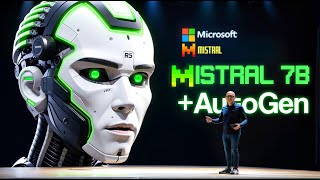
Mistral 7B, a 7 billion parameter open-source model, scores 86% on MTBench versus Llama 7B's 82%, using grouped query attention to run faster and cheaper. Microsoft's AutoGen framework lets you build multi-agent applications where language models, tools, and humans work together in conversation.
Questions this video answers
7.3 billion parameters
86%
82%
ChatGPT: 87%; PaLM 2 chat: 88%
90%
Chapters
Mistral AI recently launched Mistral 7B, an impressive open source model with 7 billion parameters that is available for everyone to use for free. I'm really excited about this as I'm a big fan of open Source models and Mistral 7B is surely among the top models available now. In the latter part of the video I'll discuss Autogen, which is referred to as the bridge to next gen LLM applications. It's important to watch the video till the end as Autogen is currently a very intriguing topic, but before that, let's focus on Mistral 7B. So Mistral 7B is small but powerful. It has only 7.3 billion parameters, which is much smaller than some of the other LLMs out there. Like llama213b has 13 billion parameters, but don't let the size fool you. Mistral7b outperforms many of them on numerous benchmarks and tasks. How is that possible? Well, it's because of its innovative architecture and design. It speeds up its performance and handles longer responses more cost effectively using two new methods, grouped query attention and sliding window attention. These methods help the model focus on crucial parts of the data, ignoring the unimportant bits. GQA lessens the data load by grouping similar queries together, while SWA manages more data by moving a set window across the input. As a result, Mistral7B processes information quicker and gives more thorough responses compared to other models. Now let's look at how Mistral 7B performs in various tasks compared to other models through some results from different benchmarks in understanding, writing and coding skills. In a benchmark called MTBench, which tests how well the model follows instructions and answers questions in a conversation, a specific version of Mistral 7B called Mistral 7B Instruct, gets an average score of 86%. This score is better than other 7B models like Code, Llama 7B instruction 82%, and Llama 2 chat. It also comes close to some of the 13B models like ChatGPT 87% and Palm 2 chat 88%. In another benchmark called Glue, which tests the model's understanding of language through tasks like sentiment analysis, textual entailment, and semantic similarity, Mistral 7B gets an average score of 90%, which is better than Llama 213B, 88%, and Llama 134B. In CodexGlu, a benchmark that tests the model's coding skills by checking its ability to generate code from descriptions or fill in missing parts of code snippets, Mistral 7B scores an average of 75%. And again, this is better than Llama 213B and Llama 134B, and almost as good as code Llama 7B, which is a model specialized for code generation. From these results it's clear that Mistral 7B, although smaller, outperforms many other models in different tasks. It has great features that make it stand out from the rest. So how can you use Mistral 7B for your own projects? It's actually straightforward. Download the raw model weights from Hugging Face or use the Hugging Face Inference API to run the model online without any downloads. You can opt for the base model or the fine tuned instruct model based on your needs. Additionally, you can fine tune the model with your own data using the Hugging Face Transformers library. There are many possibilities before you download Mistral 7B, it's important to know that it has its flaws. It might not always give accurate or suitable results, particularly on touchy or debated topics. There could also be biases or mistakes stemming from the data it was trained on, but it is just the starting point. The creators Mistral AI have ambitious plans to advance language learning models. They've gathered $113 million in initial funding with the goal to surpass OpenAI's models by 2024. They're working on developing bigger models that can do more. Plus they aim to make their models open source and community led, which is great. So what do you think of Mistral7B? Are you excited to try it out? Do you have any questions or comments about it? Let me know in the comments section below. Alright, now let's talk about this new framework that promises to revolutionize the way we use large language models for various applications. It's called Microsoft Autogen and it's the bridge to next gen LLM applications. So Autogen is a framework designed for creating LLM applications with the help of multiple agents that can talk to each other to complete tasks. These agents in Autogen are adjustable, easy to converse with and and let humans join in effortlessly. They work in different ways using mixes of LLMs, human responses and tools. With Autogen, you can easily create advanced LLM applications through conversations between agents. It makes managing automating and improving complex LLM workflows easier. It also boosts the effectiveness of LLM models and tackles their shortcomings while supporting a variety of conversation styles for intricate workflows. Autogen is actually the result of collaborative research studies from Microsoft, Penn State University and University of Washington. It's also supported by a vibrant community of contributors from academia and industry. Some of the notable contributors include Microsoft Fabric, which is a platform for building distributed systems using microservices, and ML. Net, which is a cross platform open source machine learning framework for. NET developers. Autogen is great for several reasons. Firstly, it lets you create flexible agents that can do specific tasks. These agents can be based on LLMs tools, humans or even a combination of them. For instance, an agent might use GPT4 for talking naturally. Another might use a tool like Bing for web searches. Or you could even have a mixed agent that does a bit of everything. Next, it simplifies creating conversations between multiple agents. You just define the agents and how they'll interact without needing to write much code or deal with complex setups. Plus, you can use these agents in different ways for various tasks, saving you time and effort. Also, it helps with decision making and working together through LLMs. It replaces OpenAI Completion or OpenAI Chat Completion to make using LLMs like GPT4 easy. You can include humans in conversations using proxy agents, making collaboration and overseeing your LLM applications smooth. Then Autogen supports automation and running code through LLMs. It can generate code snippets or even full programs based on your instructions and run the code using its own engine. Lastly, it has ready to use agents for chat automation which improve your conversational AI models. They can manage common chat situations like saying hello or goodbye without needing extra training. You can also tweak the automation level and change the agent behavior to fit your needs, letting you make personalized and adaptable conversational AI apps with little effort. Now Autogen can be used in different areas and tasks. One use is in improving supply chain processes by using a method called conversational Chess. Here several agents cooperate to answer code related questions in supply chain management using chess terms to communicate. The team has a commander for coordinating, a writer for coding, a safeguard for safety checks, and a human for extra help or feedback. This shows how Autogen can make complex tasks simpler with multi agent discussions. Another use is the actual conversational Chess where an agent uses ChatGPT to play chess with people using simple language. It can also explain chess rules, strategies, openings and notable players using ChatGPT and Bing, which shows its ability to merge different tools, AI models and human interaction to make interactive and helpful AI conversations. So what do you think of Microsoft Autogen? Do you think it's a game changer for LLM applications? Do you have any ideas or suggestions for using Autogen? Let me know in the comments below. And if you liked this video, please give it a thumbs up and subscribe to my channel for more AI related content. Thanks for watching and I'll see you in the next one.










