Károly Zsolnai-Fehér explains DeepMind's MuZero, an AI that mastered over 50 games by learning to predict the future without knowing the rules. It outperformed humans and previous AI systems across Atari, chess, and shogi.
Chapters
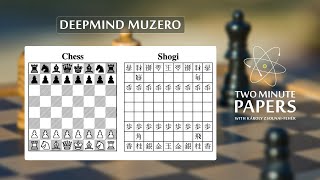
Dear fellow scholars, this is two minute papers with Some papers come with an intense media campaign and a lot of nice videos and some other amazing papers are at the risk of slipping under the radar because of the lack of such a media presence. This new work from DeepMind is indeed absolutely amazing. You'll see in a moment why and is not really talked about. So in this video, let's try to reward such a work. In many episodes you get ice cream for your eyes, but today you get ice cream for your mind. Buckle up. In the last few years we have seen DeepMind's AI defeat the best Go players in the world. And after OpenAI's venture in the game of Dota 2, DeepMind embarked on a journey to defeat pro players in Starcraft ii, a real time strategy game. This is a game that requires a great deal of mechanical skill, split second decision making, and we have imperfect information as we only see what our units can see. A nightmare situation for any AI. You see some footage of its previous games here on the screen and in my opinion, people seem to pay too much attention to how good a given algorithm performs and too little to how general it is. Let me explain. DeepMind has developed a new technique that tries to rely more on its predictions of the future and generalizes to many, many more games than previous techniques. This includes AlphaZero, a previous technique also from them that was able to play Go Chess and Japanese Chess or Shogi as well, and beat any human player at these games confidently. This new method is so general that it does as well as AlphaZero at these games. However, it can also play a wide variety of Atari games as well. And that is the key here. Writing an algorithm that plays chess well has been a possibility for decades. For instance, if you wish to know more, make sure to check out Stockfish, which is an incredible open source project and a very potent algorithm. However, Stockfish cannot play anything else. Whenever we look at a new game, we have to derive a new algorithm that solves it. Not so much with these learning methods that can generalize to a wide variety of games. This is why I would like to argue that the generalization capability of these AIs is just as important as as their performance. In other words, if there was a narrow algorithm that is the best possible chess algorithm that ever existed, or a somewhat below world champion level AI that can play any game we can possibly imagine, I would take the latter in a heartbeat. Now, speaking about generalization, let's see how well it does at these Atari games, shall we? After 30 minutes of time. On each game it significantly outperforms humans, and on nearly all of these games the percentages show you here what kind of outperformance we are talking about. In many cases the algorithm outperforms us several times and up to several hundred times. Absolutely incredible. As you see, it has a more than formidable score on almost all of these games and therefore it generalizes quite well. I'll tell you in a moment about the games it falters at, but for now let's compare it to three other competing algorithms. You see one bold number per row which always highlights the best performing algorithm. For your convenience, the new technique beats the others on about 66% of the games, including the recurrent experience replay technique. In short, R2D2. Yes, this is another one of those crazy paper names, and even when it falls short it is typically very close. As a reference, humans triumphed on less than 10% of the games. We still have a big fat zero on pitfall and the Montezuma's Revenge games. So why is that? Well, these games require long term planning, which is one of the most difficult cases for reinforcement learning algorithms. In an earlier episode we discussed how we can infuse an AI agent with curiosity to go out there and explore some more. With success. However, note that these algorithms are more narrow than the one we've been talking about today, so there is still plenty of work to be done, but I hope you see that this is incredibly nimble progress on AI research. Bravo DeepMind. What a time to be alive. This episode has been supported by Linode. Linode is the world's largest independent cloud computing provider. They offer affordable GPU instances featuring the Quadro RTX 6100 which is tailor made for AI, scientific computing and computer graphics projects. Exactly the kind of works you see here in this series. If you feel inspired by these works and you wish to run your own experiments, or deploy your already existing works through a simple and reliable hosting service, make sure to join over 800,000 other happy customers and choose Linode to spin up your own GPU instance and receive a $20 free credit, visit linode.com papers or or click the link in the description and use the promo code Papers20 during signup. Give it a try today. Our thanks to Linode for supporting the series and helping us make better videos for you. Thanks for watching and for your generous support and I'll see you next time.