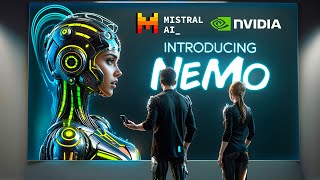
A LARRUZ YouTube video (July 21, 2024) summarizing recent AI news. Major items: Nvidia and Mistral AI launched Mistral Nemo, a 12B-parameter language model with a 128,000-token context window, released under the Apache 2.0 license and initially available as an Nvidia NIM Inference microservice; Google introduced an AI video tool called Vids (launched July 15 to a limited group) that can produce videos up to 10 minutes and integrates with Google Docs/Slides and stock assets; Google will also showcase AI features during the 2024 Paris Olympics. The video closes with a UCLA study reporting that Avenda Health’s Unfold AI detects prostate cancer with 84% accuracy versus 67% for doctors, illustrating practical medical benefits of AI.
Questions this video answers
12 billion
128,000 tokens
Apache 2.0 license
Available as an Nvidia NIM Inference microservice (downloadable version promised later).
July 15, 2024
Chapters
Nvidia and the French startup Mistral AI have just launched a new language model named Mistral Nemo, and their goal is to bring powerful AI capabilities directly to desktops. The model is designed to be efficient and accessible, making it possible to run advanced AI right on your local hardware. Alright now. Mistral Nemo has 12 billion parameters, which is relatively small compared to some of the massive models out there. But it boasts a 128,000 token context window so it can process and understand much larger chunks of text at once, which is a great thing for tasks involving lengthy documents, complex analyses or intricate coding. This extended context window could eliminate the need for frequent context refreshing, leading to more coherent and consistent outputs. Brian Catanzaro, Nvidia's VP of Applied Deep Learning Research, talked about the model's benefits in an interview with VentureBeat. He highlighted that Mistral Nemo is being launched under the Apache 2.0 license. This means businesses can use it for commercial purposes without any licensing fees, making it an attractive option for companies looking to implement AI without hefty cloud service costs. What's really exciting about this collaboration between Nvidia and Mistral AI is how it's aiming to democratize access to AI. Nvidia, a giant in GPU manufacturing and AI hardware, and Mistral AI, an emerging player in the European AI market, are focusing on creating a compact but powerful model. Their goal is to make advanced AI more accessible, even for smaller businesses. Catansaro explained that smaller models like Mistral Nemo are much more accessible and easier to run. Businesses can operate these models on their existing systems, including RTX GPUs that many people already have. This makes it possible to leverage powerful AI capabilities without needing extensive extensive and expensive setups. This launch comes at a crucial time in the AI industry. While much attention is given to massive models like OpenAI's, GPT4, Gemini 1.5 Pro, Claude 3 Opus, etc. Which has hundreds of billions of parameters. There's a growing interest in more efficient models that can run locally. This shift is driven by several factors, including data privacy concerns, the need for lower latency and the desire for more cost effective AI solutions. The Mistral Nemo model's long context capabilities are particularly valuable. Businesses dealing with lengthy documents or complex analyses will benefit from its ability to handle large chunks of text without needing frequent context refreshing, which naturally leads to more coherent and consistent outputs, making the model highly efficient for practical use. For businesses operating in environments with limited Internet connectivity or those with stringent data privacy requirements, Mistral Nemo could be a game changer. Catanzaro mentioned that the model is more suited for laptops and desktop PCs than smartphones, indicating that while it brings AI closer to individual business users, it's not quite ready for mobile deployment yet. Industry analysts suggest this release could disrupt the AI software market significantly by offering a model that can run efficiently on local hardware. Nvidia and Mistral AI address some of the main barriers to widespread AI adoption in business businesses such as data privacy latency and the high costs associated with cloud based solutions. However, the true impact of this development will depend on how well the model performs in real world applications and the ecosystem of tools and support that develop around it. The model is immediately available as a Nvidia NIM Inference microservice with a downloadable version promised in the near future. The fact that it's released under the Apache 2.0 license means businesses can use it commercially, potentially speeding up its adoption in various enterprise settings. Catanzaro wrapped up the interview by saying they believe this model represents a significant step toward making AI more accessible and practical for businesses of all sizes. It's not just about the power of the model, but about putting that power directly into the hands of the people who can use it to drive innovation and efficiency in their daily operations. Alright, now let's talk about some big news from Google AI Labs. Google has just introduced an exciting new AI video tool called Vids. Launched on July 15 to a select group of users, Vids promises to reduce video production costs and time significantly. Essentially, Vids is designed to streamline the entire video creation process, potentially revolutionizing content creation across various industries. It's powered by Google's Gemini AI and can produce videos up to 10 minutes long. It features AI generated storyboards, customizable templates and a royalty free stock content library. Plus it accepts various input formats including Google Docs, slides, videos and audio recordings. This versatility is what actually sets it apart from standard AI video generators. Souk Sohal, a senior consultant at Glue Affinity Reply, shared some insights with Pimtz. He believes Google Vids can transform business communication by leveraging Google's vast ecosystem. This integration lowers the barrier to entry for creating professional quality videos, making it more accessible for users already familiar with Google's suite of products. The AI driven capabilities of Google Vids enable users to produce visually engaging presentations promoting storytelling excellence regardless of technical proficiency. As video becomes the preferred medium for strategic communication, Google Vids could significantly boost engagement and comprehension in business contexts. Google hasn't announced a date for Vids global launch yet, leaving the industry to speculate on its broader impact. As the business world anticipates more comprehensive access to this tool, it's clear that Google's vids signifies an advancement in integrating AI into business operations and content creation. Alright, moving on, let's talk a bit about Google's involvement in the upcoming 2024 Paris Olympics. Google has secured the title of a Fear Official AI sponsor for Team USA and starting on July 26th, we'll see Google's AI powered features prominently during the event. NBCUniversal's partnership with Google will highlight many of the company's AI tools throughout the Olympics. Broadcast viewers can expect to See Google Maps 3D views of venues like Versailles, Stade, Roland Garros and the Aquatic Center. These immersive views, developed over the past few years, offer photorealistic models of certain landmarks and areas of interest, providing detailed information about the events occurring at each location. In addition to the 3D views, announcers and commentators will integrate Google Search AI overviews into broadcast segments Answering Olympic and Paralympic Questions this promotion aims to showcase the capabilities of Google's AI tools, but it also brings to mind past AI mishaps like the infamous Pizza Glue suggestion. Hopefully this time everything will go smoothly. Comedian Leslie Jones will also get in on the action using Gemini to learn new sports and engage in other scripted activities. Moreover, five Olympic and Paralympic athletes will appear in social videos and late night promos utilizing Gemini Google Lens Circle to Search and Google Maps Immersive View to explore Paris. These initiatives are part of Google's broader strategy to promote its AI technologies during the Olympics, reinforcing its brand presence and demonstrating the practical applications of its AI tools in real world scenarios. Alright, now finally some good news about AI's real world impact. A UCLA study found that Unfold AI developed by Avenda Health can detect prostate cancer with 84% accuracy, beating doctors 67%. This tool creates 3D cancer maps from patient data, helping physicians better understand and treat prostate cancer. It's a promising step forward in using AI to improve cancer diagnosis and care. Dr. Ali Khazrayan uses Unfold AI to determine the best treatment options for his patients, potentially reducing the need for invasive surgeries. Joshua Trachtenberg, a UCLA professor and prostate cancer patient, benefited from this technology, avoiding a major surgery and becoming cancer free with a targeted treatment. While promising, experts like Dr. Harvey Castro caution that AI should complement, not replace the doctor's expertise, privacy and cost are also concerns. However, this technology offers hope for more accurate diagnoses and personalized treatments, potentially improving patients quality of life. Alright, if you liked this video. Please give it a thumbs up and subscribe for more AI updates. Share your thoughts in the comments below. Thanks for watching and I'll catch you in the next one.