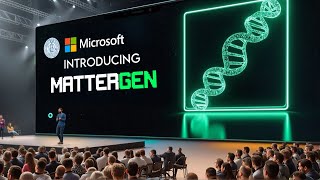
A short YouTube explainer (LARRUZ, Jan 18, 2025) reporting recent AI advances that push biology and materials science toward predictive discovery. It highlights a Columbia University "foundation model of transcription" trained on over 1.3 million human cells (published Jan 8, 2025 in Nature) that predicts gene expression across cell types and helped explain an inherited pediatric leukemia mutation; and Microsoft Research projects (Mattergen for generative materials design and Rad Dyno for radiology, in partnership with Mayo Clinic) published in Nature/Nature Machine Intelligence aiming to accelerate materials discovery and X‑ray interpretation.
Chapters
An AI system can now decode the genetic dark matter that fuels diseases, while another AI is fine tuning materials for everything from batteries to quantum computers. You'll also hear how doctors might soon diagnose patients far more quickly with AI driven x ray analysis. Alright, first let's talk about the project from Columbia University Vegalos College of Physicians and Surgeons, where researchers built a new AI method that predicts gene activity in any human cell. Just imagine that, a system that can look at any cell type, normal or diseased, and predict exactly which genes are switched on. This is not your standard guesswork. It's taking massive amounts of data from millions of cells and using advanced AI to spot patterns way more accurately than our traditional experimental methods. And yes, this isn't purely hypothetical. We're talking about real data from over 1.3 million human cells that the researchers used to train their model. But why does predicting gene expression matter so much? Well, if we can reliably say how a cell behaves based on which genes are active, we can also tell how it'll respond to say, a cancer causing mutation. Think of it like being able to read the cell's internal instruction manual. Traditional biology has been great at describing what happens after the fact. Like this is how the cell looks when it's unhealthy, but it's never been great at predicting it. And that's the huge step forward. We're turning biology into a predictive science rather than just a descriptive one. A key figure in this research is Raoul Rabadon, a professor of systems biology at Columbia. He points out that typical experiments show us how cells react in a specific environment. But they don't necessarily forecast how cells might behave in brand new situations. By using AI, we aim to learn the grammar of gene regulation. It's a bit like ChatGPT, which learns the grammar of human language. Here the AI learns the grammar of the genome, how different pieces of DNA interact, how accessible they are and how that influences gene expression. Here's the mind blowing part. Once this AI has that grammar down, it can be presented with a completely unfamiliar cell type, even a type of diseased cell it's never been trained on, and predict which genes will be active in tests. These predictions agreed closely with actual experimental data. So we're not just in the realm of speculation. The model's performance is validated. One of the first real world applications has been looking into a specific inherited form of pediatric leukemia. Children who inherit a certain mutated gene end up at risk. But it was unclear exactly how the mutation was causing these abnormal blood cells. The AI predicted that the mutation disrupts the interaction between two crucial transcription factors. These are proteins that tell the cell which genes to turn on or off, effectively rerouting how the leukemia cells grow. Lab experiments then confirmed the AI's prediction. This could pave the way for future targeted therapies, because once you know which interactions are broken, you can try to fix them. But the real game changer might be how model can explore what researchers often call the genome's dark matter. This term has been borrowed from cosmology to describe the vast stretches of DNA that don't directly code for proteins. Turns out most cancer mutations lie in those dark regions. So even though these mutations don't necessarily break a protein, they might alter how genes get switched on or off, contributing to disease in ways we're only beginning to understand. Rabadan's team believes their model can illuminate those unexplored areas by predicting how changes there might affect gene expression. This research was published on January 8, 2025 in Nature under the title A Foundation model of transcription across Human Cell Types. It's by an entire team. Zifu, Shentong Mo, Alejandro Buendia, Anouchka, P. Laurent and many others. They're basically telling us, welcome to a new era of biology, one where we can harness AI for major leaps, not just baby steps. If that doesn't already blow your mind, there's more happening in the AI world. Two new papers, one in Nature and another in Nature Machine Intelligence, detail breakthroughs that could radically speed up scientific discovery. Microsoft Research has been collaborating with various academic and private sector partners to develop generative AI foundation models on Microsoft Azure. And they're applying this tech to two big materials discovery and radiology. Let's start with materials science. We all know how crucial new materials have been to human progress, from the steel that makes up skyscraper frames to the silicon chips powering our laptops. But it's a painfully slow and expensive process. Typically, you'd have to sift through or test millions of potential substances before landing on a winner. If you ever do, enter Mattergen, a generative AI model that's like a text to image AI except for materials. Rather than scanning an enormous universe of possibilities, researchers just tell the AI what properties they want. Like make a battery material that holds a charge for x hours and is stable at Y temperature, and Mattergen comes up with a blueprint. According to the research, the first time they synthesized a Mattergen generated material, its properties were within 20% of of the targeted values. That's extremely promising. For a first attempt, imagine cutting years of trial and error down to a fraction of the time. Whether we're talking about better batteries for sustainable energy, superconductors for quantum computing, or specialized polymers for biomedical devices, this approach could transform entire industries faster than we ever thought possible. Tian Xie from Microsoft's AI for Science group in Cambridge points out that human history is driven by material innovation. If we can harness this AI to fine tune materials discovery, we might see a ripple effect across energy, healthcare, and beyond. Just think how new battery technology could drastically shift the electric vehicle landscape. Or how advanced superconductors could open up next level medical imaging. Now for the second big breakthrough from Microsoft Research, a system called Rad Dyno, created in partnership with Mayo Clinic, aiming to enhance radiology. Specifically, they're starting with X ray data. These foundation models can interpret both text and images, so they're not just training on pictures. They're also reading radiology reports, identifying patterns, and even generating new text that describes what they see in an X ray. One thing doctors spend a lot of time on is reviewing images to figure out, for instance, if a chest X ray shows improvement or deterioration compared to the last scan. By automating some of that process, the AI frees up clinicians to focus on more nuanced or complex decisions. The model might be able to generate a comprehensive report highlighting subtle changes or misplacements of tubes and lines faster than a human might catch them. That means doctors could arrive at a diagnosis or or a treatment plan more quickly, which can be critical in emergency situations. Imagine how this could look in a hospital workflow. A new patient comes in, gets an X ray, the image is fed into radio, and within minutes the system flags potential issues, such as a catheter that's incorrectly positioned or an unnoticed anomaly from a previous scan. Physicians get a concise summary and can decide on the best course of action without hours of manual analysis. Mayo Clinic is among the world's best hospitals, and their collaboration with Microsoft is a testament to how serious they are about making sure any implementation meets high standards of quality and safety. The ultimate goal is faster, more accurate care, according to Chris Bishop, Microsoft's research AI for science director. These models can learn the languages of molecules, proteins, and more, opening paths to faster drug discovery and disease diagnosis. Microsoft's new projects, Mattergen for materials and Rad Dyno for Radiology, were just published in Nature and Nature Machine Intelligence. Both are shared openly, aiming to speed up innovation and tackle big scientific challenges. Still, training, data quality, and ethical concerns are major hurdles, especially in healthcare. But as these AI tools improve, so do the potential benefits. Safer treatments, stronger materials, and quicker breakthroughs. So if you're into AI and tech, keep an eye on these breakthroughs and share your thoughts on where they'll lead next. Thanks for watching and I'll see you in the next one.