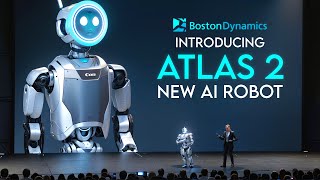
Boston Dynamics unveiled an all-electric Atlas robot with a redesigned body, three-finger hands, and a screen head. CEO Robert Plater told TechCrunch the company is running pilot tests at Hyundai and planning to move into manufacturing. The robot is built for industrial work and designed to handle physical interaction.
Questions this video answers
April 18, 2024
Three fingers on each hand.
Hyundai (pilot testing at Hyundai facilities early next year).
Robert Plater.
Chapters
Just one day after retiring its older hydraulic model, Boston Dynamics has introduced a new electric version of its Atlas robot. This marks a significant shift away from the noisy hydraulic mechanisms that characterize previous models. Now, Atlas is powered by an electric motor, which, although not silent, offers a quieter operation that contrasts sharply with the hydraulic system's distinctive sounds. The unveiling of this new version was captured in a compelling video. It opens with Atlas lying prone on a set of interlocking gym mats, accompanied only by the soft whirring of its new electric motor. As the camera pans around, the robot begins a seemingly natural motion of bending its legs at the knees. This movement, initially reminiscent of human action, soon crosses into an uncanny valley, evoking a feeling similar to a scene from a Sam Raimi film. This clever maneuver allows Atlas to shift from lying on its back to standing upright facing away from the camera. It then performs an eerie rotation of its head, followed by its Torso, completing a 180 degree turn to face the camera directly. The robot's face, featuring a ring light around a perfectly round screen, then rotates back as Atlas strides off the mats and out of the frame. This new electric Atlas is not just a technological evolution, but also a symbolic one, mirroring the transformative moment when Bob Dylan famously switched from acoustic to electric guitar. The motion of the new Atlas, while still showing some jerky movements, is notably smoother and more fluid compared to many of the commercial humanoids introduced in recent years. This progress illustrates a level of mechanical sophistication that brings to mind the confident and fluid movements of Spot, another robot from Boston Dynamics, suggesting a familial resemblance in their design philosophies. The physical appearance of Atlas has undergone a radical transformation. Gone are the bulky torso and awkward bowed legs covered in protective plating, replaced by a streamlined, cable free frame that bears more resemblance to contemporary robots like Agility's Digit and Apptronics Apollo. This redesign leans towards a softer, more approachable aesthetic, eschewing the intimidating utilitarian look of past models for a friendlier, cartoonish appearance. Despite these substantial changes, Boston Dynamics has chosen to retain the Atlas name, continuing the legacy of its well known brand into this new commercial phase. This decision contrasts with previous practices with where research names were changed upon commercial release, such as Spot Mini becoming Spot and Handle becoming Stretch. In an interview with TechCrunch, Boston Dynamics CEO Robert Plater discussed the company's strategy and future plans for Atlas. He highlighted that while the branding remains unchanged for now, it might be revisited as the project progresses toward mass production. The CEO also outlined the company's timeline, which includes starting pilot testing of the Electric Atlas at Hyundai facilities early next year, with broader manufacturing goals set for the subsequent years. Plater emphasized the importance of understanding specific use cases to ensure that the investment in robotics is justified by sufficient productivity gains. He revealed that experiments with Hyundai are already underway, indicating a collaborative effort in refining the robot's design and functionality. The flexibility and range of motion in the new Atlas are particularly noteworthy. According to Plater, the robot incorporates custom high powered actuators at most joints and which afford it the power and agility of an elite athlete. This capability is not just for show. It has practical implications in industrial applications where robots must perform complex, dynamic tasks reliably. Boston Dynamics is known for its viral videos that often highlight the agility and dexterity of its robots in dramatic, even theatrical ways. While these demonstrations are visually impressive and entertaining, they also serve a practical purpose by showcasing the robot's capabilities in scenarios that might occur in real world settings. For example, the video's depiction of Atlas starting from a prone position and then standing up underscores its ability to recover from falls, an essential feature for maintaining productivity without human intervention in industrial environments. The design choices extend to the robot's hands, which now feature three fingers instead of the more human like four or five. This simplification reduces mechanical complexity and enhances durability crucial for repetitive industrial tasks. The robot's head has also been redesigned, now featuring a large round screen that adds a touch of friendliness and enhances interaction capabilities, which Plater notes will be critical as robots increasingly work alongside humans. Overall, the new Electric Atlas is a big step forward in the world of humanoid robots, combining high tech features with smart designs to meet the growing needs of businesses and factories. As Boston Dynamics keeps improving this robot, everyone in the industry will be watching closely. They're eager to see how these new features will actually help improve efficiency and productivity in the real world. Alright, don't forget to hit that subscribe button for more updates. Thanks for tuning in and we'll catch you in the next one.