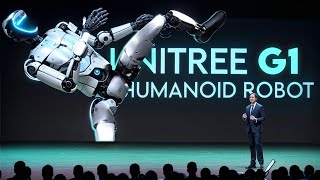
YouTube commentary (LARRUZ) describing Unitree’s newly released G1 humanoid robot—its design, range of motion, impact resistance, internal wiring, dexterous hands, learning via simulation, and a base price positioned at $16,000—arguing the platform is a game changer for research and competition with firms like Boston Dynamics and Tesla. The video also reports Abu Dhabi’s Technology Innovation Institute (TII) releasing the Falcon 2 series (Falcon 211B and Falcon 211B VLM) and summarizes UAE moves in AI industry geopolitics, including Microsoft’s reported $1.5 billion investment tied to G42.
Questions this video answers
$16,000
Up to 3.3 meters per second
Around $150,000
Falcon 211B and Falcon 211B VLM
Technology Innovation Institute (TII)
Chapters
So Unitree just dropped the trailer for their new Unitree G1 humanoid robot, and this thing is mind blowing. The flexibility, proficiency and overall capabilities of this robot are really something else. I'm going to explain and show you exactly why this robot is such a game changer. Alright, so there's a lot to unpack here, and this robot is genuinely revolutionary. First off, you might have noticed that it looks kind of similar to Boston Dynamics recently unveiled Atlas robot. Now, I don't think Unitree managed to create this robot in just the three weeks since that trailer came out. Something like this takes a long time to develop, but what it does show is that Unitree is evolving faster than a lot of people expected. And they're delivering some seriously impressive tech at a relatively affordable price point. The G1 starts at just $16,000, which is cheaper than any other humanoid robot with these kinds of capabilities. One of the things that really stood out to me in this demo was the insane flexibility and range of motion. As you can see here, this robot can swivel around in ways that humans simply can't, and its legs have a much greater range of motion. They've also managed to internalize the wiring using hollow joint technology, which allows for more efficient movement and a more compact design. This trailer really hammers home the fact that the robot race is on. I don't think anyone predicted that Unitree would release something like this so soon. I would have expected it to come from a company like Boston Dynamics First. And while Boston Dynamics might be using hydraulic actuators or fully electric systems, the G1's movement capabilities suggest that it's going to be able to handle a huge range of tasks that we might not have even considered yet. Another thing that really impressed me was the robot's stability when taking impacts. Now, I'm not saying we should go around punching robots that might not end well if they decide to rebel against us down the line. But in all seriousness, the fact that this robot can take a solid hit to the chest and remain completely stable is a remarkable feat of engineering. In real world applications, robots might encounter things like wind, debris or unexpected collisions, and being able to stay upright and keep functioning in those situations is hugely important. Most humans would probably hit the ground if they took a punch like that. So this is a really exciting development. We've seen similar demonstrations of stability from Unitree before with their H1 robot, but the G1 takes it to a whole new level. If you tried this with most other humanoid robots on the market, they'd topple over in an instant. The fact that Unitree has achieved this level of stability without even using external support cables is mind blowing. Usually in these kinds of robotics demos, you'll see the robot tethered to the ceiling or something to prevent falls, because balance is one of the biggest challenges in the early stages of development. But Unitree has created a robot that can take a beating and stay on its feet with all the wiring hidden internally. That's a massive accomplishment. The speed of the G1 is also really impressive. It can reach speeds of up to 3.3 meters per second, which is just shy of the world record set by Unitree's previous robot. For context, that's about 2 meters per second, which is almost a running pace. We haven't seen anything close to that from other humanoid robotics companies. The Tesla bot, for example, can walk pretty smoothly, but it's not moving nearly as fast as this. And I can't imagine they'd be too eager to have someone kick it around to test its stability. So, in terms of overall performance, I'd argue that the unitree G1 is probably one of the best humanoid robots out there right now. One of the things that absolutely blew me away was the robot's ability to learn tasks through simulation and then apply them in the real world. Using imitation and reinforcement learning, they can train the robot to perform complex actions and in a simulated environment, like Nvidia's Isaac Sim, and then transfer those skills to the physical robot. Watching it move, you can see how precise and subtle the joint movements are, and the fact that it can maintain its balance while performing these tasks autonomously is staggering. This has huge implications for robotics research, because until now, most humanoid platforms have been really expensive, which makes them hard to access for a lot of labs and universities. The Unitree H1, for example, was a great research platform, but its high cost was a big barrier. With the G1 coming in at a lower price point, we're going to see a lot more people getting their hands on this tech and pushing the boundaries of what's possible. And then there are the hands. Previous Unitree robots were criticized for their lack of dexterous manipulators, but the G1 has hands that can grasp and manipulate objects with incredible precision. It can crush a walnut, flip a piece of bread, and even pop open a soda can like it's nothing. The level of control and fine motor skills on display here is just insane. They also mention something called the Unitree Robot Unified Large Model, which seems to be some kind of AI system that allows the robot to perform these Tasks autonomously. There aren't a lot of details available yet, but I'm guessing it's a machine learning model that's been trained on a huge data set of simulated and real world interactions. As more information comes out, I'll be sure to update you all. One of the other key things they demonstrate is the robot's ability to perform very precise movements like soldering electronic components. This opens up a whole new range of potential applications in fields like manufacturing and assembly. But perhaps the most exciting thing about the G1 is its price. At just $16,000 for the base model, it's nearly 10 times cheaper than Unitree's previous humanoid robot, which was listed at around 150,000 dol. That's a massive leap in affordability and it's going to make this technology accessible to a much wider range of researchers and developers. We've already seen some of the incredible things that people have been doing with Unitree's H1 platform. For example, researchers at Shanghai Tech and Mars Lab recently presented a framework for humanoid parkour learning which allows the robot to navigate rough terrain, jump onto high platforms, leap over hurdles and more, all using only vision and proprioception. It's a fully end to end system with which is a huge accomplishment in the field of robotics. The problem is that a lot of academic labs struggle to get funding for this kind of research because they simply can't afford the expensive hardware. But with the G1, we're going to see an explosion of new projects and discoveries. I mean, the H1 could do a full backflip which is just mind boggling for a robot with such basic actuators. Imagine what people are going to do with the G1's advanced capabilities. So to sum up, the Unitree G1 is an absolute game changer. Its combination of flexibility, stability, Dexter and affordability is unparalleled. And it's going to open up a whole new world of possibilities in the field of robotics. I cannot wait to see what researchers and developers do with this platform once it starts shipping in the next few months. The robotics race is heating up and Unitree has just shown that China is a serious contender on the global stage. They are innovating at an incredible pace and they're making this technology accessible in a way that no one else has done before. So keep an eye on Unitree. I have a feeling we're going to be seeing a lot more groundbreaking developments from them in the very near future. Now here's some interesting news from the United Arab Emirates. This announcement comes from Abu Dhabi's Technology Innovation Institute, also known as TII. They've launched the Falcon 2 series featuring two impressive models, Falcon 211B and Falcon 211B VLM. So Falcon 211B is, as they say, a super powerful text based AI designed to understand and generate human like text. Meanwhile, Falcon 211B VLM is a vision to language model. This means it can take an image and generate a detailed text description of it. Let's talk about why the UAE is making such big moves in AI Known for its vast oil reserves, the UAE is now pouring massive investments into artificial intelligence. This shift hasn't gone unnoticed. In fact, US officials took note last year, issuing a strong ultimatum for the UAE to choose between American and Chinese tech. In response, EMIRATI AI firm G42 cut ties with Chinese companies, paving the way for a whopping $1.5 billion investment from Microsoft. This strategic pivot was carefully coordinated with Washington, showcasing the UAE's serious commitment to advancing in the AI space. The release of Falcon 2 comes as countries and companies worldwide are racing to develop their own large language models. And while some companies keep their AI tech proprietary, others like the UAE's Falcon and Meta's Llama, are going open source. Looking ahead, the UAE's substantial investments in AI are positioning the country as a significant player on the global tech stage. The Falcon 2 series is just the beginning, with the anticipated Falcon 3 already in the works. Alright, don't forget to hit that subscribe button for more updates. Thanks for tuning in and we'll catch you in the next one.