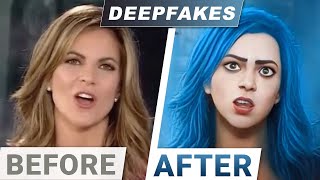
Dr. Zsolnai reviews a new AI that transforms video in real time, turning faces into cartoon styles with a slider to control how strong the effect is. It runs at 5 to 10 frames per second on high-resolution video, handles hair well, but still struggles with teeth and some artifacts. Source code and a web demo are available.
Chapters
Dear fellow scholars, this is Two Minute Papers with Dr. Zsolnai. Today we are going to transform ourselves into cartoon characters. And it is going to be amazing. But how? Well, for instance, let's start out from style transfer. Style transfer means mixing two images together, one for content, reimagined with the other one for style. This also works for video. What's more, there are also computer graphics techniques that can update these virtual worlds in real time. As we mark up these examples on a piece of paper. How cool is that? Now that is all well and good, but that's nothing compared to what you are going to see today. Because now we are going to run style transfer on ourselves. That sounds great, but wait, that's not exactly a new idea. Previous techniques have already tried that. So our question, have they done it? Well, let's have a look. Oh my. These are not so good. And even the better ones are not ready for prime time. However, hold on to your papers because we now have a new technique where again, in goes a video of us and a target style and we get this. Whoa, these are so much better. So cool. And if only we could try it ourselves right now, maybe that is possible. I tell you in a moment. And it doesn't stop there. This paper has a ton more in the tank. For instance, this slider is incredible. By using it, we can tell the AI how much should the style influence the video. These results are going by quick, so I'll stop the process here and there so we can have a little more time to have a look together. I particularly like the fact that we have a ton of control over the jawline and the eyes. And of course, if we wish, these features can get exaggerated a great deal or we can be a little more subtle with them and everything in between. These two are also possible. And have a look at this one too. This is one of my favorite parts of the paper. Are you seeing it? Well, look here. Our input person has long hair, but the style reference has short hair. And I love how the technique reimagines the input person's hair as well. In. In the style of the reference. It doesn't even break a sweat. This is such an amazing usability feature and it supports a variety of different styles. Just choose the movie and the character of your liking and there we go. Loving it. And just think about the fact that a couple papers before this one, in 2020 this was possible. Even inpainting real images of human faces was quite challenging. And today, just a couple more papers down the line and we can do so much better with so much more artistic control. And all this for video. So let's pop the question, how long do we have to wait for such a result? And this is where I fell off the chair when reading this paper. And don't blink. Why? Because that's exactly how long it takes for each image. We are talking high resolution images and we get 5 to 10 of those every second. 5 to 10. Wow. I would absolutely love to see what the amazing artists among you fellow scholars will be able to do with this. This could make the job of virtual actors for animation movies easier and I bet it will be a super fun tool for video conferencing with our friends and beloved ones and even putting our copies into virtual worlds. What a time to be alive. Now wait. All that is well and good, but when do we get to use it? Well, I have two good news for you. Good news number one, the source code of this project is available free of charge for everyone. And good news number two, as of the making of this video, you can also try it yourself online. The links are available in the video description and make sure to read the instructions carefully. Also note that the web app is a bit slower than running it locally, but of course it is so much more convenient for most people now. Not even this technique is perfect. As for almost all deepfake related techniques, teeth are usually a problem. And oh yes, sure enough it is a problem here too. But just think about how far we have come in just a couple papers and imagine what we will be able to do a couple more papers down the line. My goodness. So this was a paper from the amazing Siggraph Asia Conference, which is one of the most prestigious venues in computer graphics research. Having a paper published there is perhaps the equivalent of the Olympic gold medal for a computer graphics researcher. Huge congratulations to the authors. So what do you think? What would you use this for? Let me know in the comments below. If you're looking for inexpensive cloud GPUs for AI, Lambda now offers the best prices in the world for GPU Cloud computer. No commitments or negotiation required. Just sign up and launch an instance and hold on to your papers. Because with Lambda GPU Cloud you can get on demand a 100 instances for $1.10per hour versus $4.10 per hour with AWS. That's 73% savings. Did I mention they also offer persistent storage? So join researchers at organizations like Apple, MIT and Caltech in using Lambda Cloud instances, workstations or servers. Make sure to go to lambdalabs.compapers to sign up for one of their amazing GPU instances today. Thanks for watching and for your generous support, and I'll see you next time.