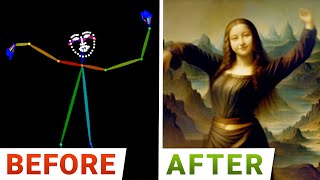
A short YouTube video (Two Minute Papers / Dr. Zsolnai style) surveying recent AI demos and papers. The speaker highlights advances in text-to-video and motion-transfer that can synthesize dancing characters from a stick figure plus a text prompt (no user video required), a NVIDIA-related approach to extreme video compression plus AI super-resolution for streaming and gaming (artifact reduction, available on RTX cards), and a paper that predicts human odor labels from molecular structure (a tech report claiming human-level discrimination). The video notes the motion/visual results are impressive but imperfect, that one paper is a tech report not yet peer reviewed, and includes a sponsor mention for Lambda Labs GPU cloud (on-demand H100 for $1.99/hr).
Questions this video answers
New AI Makes Everybody Dance!
Dr. Zsolnai / Two Minute Papers (SPEAKER A)
2024-01-07
$1.99 per hour
Described as a tech report and not peer reviewed at the time of the video.
Chapters
Today we are going to create imaginary characters and make them dance. And we'll use an AI to greatly improve the details in low quality streamed gaming videos. And we will see if it is possible for a robot to learn to smell. Spoiler alert. There is a new AI that has no nose and yet it can still smell kind of. Now this is an AI paper from 2016. This is what was possible eight years ago. You could take a source video of an amazing dancer and take a video of yourself moving about and then it would transfer these amazing dance moves to you. But today, not only text to image, but text to video is also getting more and more available. This means that you can enter a piece of text and out comes a video of exactly that. What's more, today you can do this with free and open source techniques. But if that is possible, does that mean that. Yes, yes it does. So now hold on to your papers fellow scholars, because today we have come so far, you don't even need a video of yourself, just a little stick figure moving about and one text prompt to synthesize the video. And then a character of you will start dancing. Wow, look at how far we have come in the last few years. These new results are still not perfect, but they are leaps and bounds beyond the everybody dance now paper. And this is not only better, but it also solves a significantly more difficult problem. You see here, with your text prompt you can choose your background and your attire as you wish. No video of you is needed, but it gets better. If you can use a text prompt, you can write whatever you want there. Even the Mona Lisa or any other character you can think about. A couple years ago we were happy if we got a text to image result with this. And now we can just make them up and make them move exactly the way we want it to. Absolutely incredible. Dear fellow scholars, this is two minute papers with Dr. Zsolnai. Now I will quickly note that this paper is a tech report and as of the making of this video, it was not peer reviewed yet. It just came out a few days ago and supposedly the source code and the datasets for creating all this will also be available. Now we talked about a brilliant little paper earlier where scientists at Nvidia wanted to create high quality video conferencing videos by compressing them down far more than previously thought possible. I would tell you what it does, but I will tell you what it does not. It does not compress the entirety of the video information, but it only takes the first image from the video and then throws away the entire video afterwards. What? Why? Well, it is able to do it because it learns about your head movement and gestures and, and is able to synthesize that in a way that is super close to reality. That is fantastic. However, look, compression artifacts still remain. The lower we go with the bandwidth, the worse it gets. And now you can use their newer technique to eliminate those. Look, when streaming games or video, unless you have a really fast connection, you get some of these artifacts along these lines and something perhaps even worse, blocky artifacts. But now with these new super resolution AI techniques, Ha. No more. Look at that flag. If you wanted to get this kind of quality, you would either need a significantly more powerful Internet connection to stream it, or an expensive computer to render it yourself. Once again, no more. Love it. Now, not even. This technique is perfect. Its earlier version was widely tested and testers typically found it to be working really well on static and slow moving content. However, when used on fast moving footage, it might introduce its own artifacts. Now, to the best of my knowledge, it is already available on the RTX 2000 series Graphics cards and app, which is fantastic news. These are from an age when these cards were a little more affordable. More longevity for us. I like it. Note that we do not have any business ties with Nvidia. And now the ultimate question. Fellow scholars, we know that these modern AI techniques learn to listen, see, and even talk. But here is a crazy. Is it possible for an AI to learn to smell? Well, this crazy paper attempts to give this a try. First, they give it a bunch of molecule structures as an input and they get information on what humans think this smells like. For instance, this molecule smells like a musty research paper with a hint of caramel. And then the goal is that we give it new compounds that it hasn't seen yet. Excuse me, hasn't smelled yet. So what did it learn? Well, it learned how we label these smells. And now hold on to your papers, fellow scholars, because when given these new molecule structures, it can tell them apart at least as well as a human can. That is mind blowing. Now, just to avoid any misunderstanding here, this is a piece of software and it does not have a nose. Actual smelling in a way that humans smell something does not happen here. It is given a molecule structure and it makes a prediction based on that. Hmm, an AI that has no nose and yet it can still smell. Kind of. What a time to be alive. When I first heard this, I was a little skeptical, but I had a look at the incredibly thorough evaluation in the paper and I found that it really knows which smells typically appear together and can also put these smells on a map. I think this is an absolutely amazing concept and with a wonderful execution as always. The link to the paper is available in the video. Description if you're looking for inexpensive cloud GPUs for AI, Lambda now offers the best prices in the world for GPU cloud computer. No commitments or negotiation required. Just sign up and launch an instance and hold on to your papers. Because with the Lambda GPU cloud you can now get on demand H100 instances for just 1.99per hour. Yes, 1.99and they are one of the first cloud providers to offer publicly available on demand H100 access. Did I mention they also offer persistent storage? So join researchers at organizations like Apple, MIT and Caltech in using Lambda Cloud instances, workstations or servers. Make sure to go to lambdalabs.compapers to sign up for one of their amazing GPU instances today.