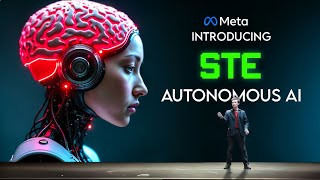
YouTube explainer describing Meta’s Self Taught Evaluator, a method that lets large models generate synthetic tasks and use chain-of-thought reasoning and LLM-based judging to self-improve without human labels. The video reports that starting from Llama 370B instruct, accuracy on the RewardBench benchmark rose from 75.4% to 88.3% (and to 88.7% with majority voting), and argues this approach reduces cost, speeds deployment, and can mitigate some human-label bias. It also briefly covers Meta updates to SAM 2.1 (image/video segmentation) and the open-source metaspirit language model (joint text+speech).
Chapters
Meta's latest breakthrough is shaking up the AI world in a big way. Their research team has developed the Self Taught Evaluator, a model that is making it possible for AI to improve itself without human feedback. This technology pushes the boundaries of autonomy in AI and the implications are massive. It doesn't just simplify the process of training AI, it rewrites how the entire development cycle operates. Typically, training an AI model involves massive amounts of human intervention. Whether it's coding assistance, complex reasoning tasks, or even understanding language nuances. AI developers often rely on reinforcement learning from human feedback. This is where humans step in to evaluate the AI's responses and guide it toward better answers. However, this method is not only expensive and slow, but can become less effective as models improve. The older training data becomes stale and humans need to re annotate everything, constantly, making scaling up an even bigger challenge. That's where the self taught Evaluator comes in. Meta's approach eliminates the need for human annotations by allowing AI to learn from its own synthetic data. Think of it as a closed loop system where the AI creates its own tasks, evaluates its performance and then adjusts its strategies based on those evaluations. Over time, this self reinforcing process results in more accurate, smarter models without requiring a human to step in. The technical process behind this involves what's known as the chain of thought reasoning technique. Meta's self taught Evaluator uses this to break down complex tasks into smaller, more manageable steps. It's particularly effective in areas like mathematics, scientific analysis and coding. The AI generates a set of possible answers or approaches and then judges them based on specific criteria such as accuracy, efficiency and creativity. From there, it identifies the best path forward and fine tunes its internal models accordingly. A key advantage here is the use of fully AI generated data. Meta's team has trained the evaluator entirely without human labeled data, a major leap forward in autonomous learning. The model first creates a range of responses to a given task, then uses what's called LLM as a judge a a large language model acting as an evaluator to rank those responses based on reasoning and logic. Through this iterative process, the AI becomes better at not only performing tasks, but also judging the quality of its outputs. Numbers speak volumes about how far Meta has pushed this. Starting with the Llama 370B instruct model, the self taught Evaluator improved its accuracy on the reward bench benchmark from 75.4% to 88.3% after several iterations. That's a jump of almost 13 percentage points. Purely from self learning. This model even competes with and in some cases surpasses reward models that rely on human labeled data. In fact, with a majority vote system, the accuracy can climb as high as 88.7%. This isn't just theoretical progress. Meta's models are already being used to evaluate and improve on real world tasks. For example, Reward Bench, a benchmark specifically designed to test how well models align with human preferences, has seen significant advancements thanks to this approach. Reward models play a crucial role in tasks where precise human like reasoning is needed, such as safety, ethical decision making and multi step reasoning problems. The shift to synthetic data has other advantages too. Human feedback models can be slow to adapt as new AI models are rolled out. There's always a lag between when new data is generated and when humans can annotate it, which can slow down the training process. With the self taught evaluator, however, this lag disappears. The AI generates, evaluates and learns in real time, accelerating the pace of innovation. Meta's researchers predict that this could drastically cut costs and speed up the time it takes to bring new models to market. Another fascinating aspect is how this method bypasses traditional issues with human bias. When humans evaluate AI, there's always some level of subjectivity involved, whether it's in understanding, tone, context or cultural nuance. By automating the evaluation process, Meta's self taught evaluator can maintain consistent standards across the board. This makes it particularly useful for global applications where language models must adapt to different languages, dialects and cultural contexts without introducing bias. Now they've also released updates to the Segment Anything Model SAM 2.1, another major tool in their AI arsenal. SAM 2.1 improves image and video segmentation, making it easier to isolate objects within complex visual environments. This tool has already been downloaded more than 700,000 times since its initial release and is used across fields like medical imaging and meteorology. In fact, with this update, SAM 2.1 handles small and visually similar objects much more effectively, making it a valuable resource for researchers who need high levels of precision in visual AI tasks. Let's talk numbers again. SAM 2.1 now features data augmentation techniques that simulate objects in different scenarios, improving the model's ability to handle occlusions and objects hidden behind other elements in a scene. This is crucial for applications like autonomous driving, where every pixel matters. Meta also launched a developer suite allowing users to find fine tune SAM with their own data sets, opening the door for even more customization and innovation. On the language side, Meta has been pushing the boundaries with its metaspirit lm, an open source language model designed for seamless integration between text and speech. This model is unique in that it can handle both text and speech data at the same time, making it possible for AI to generate more natural sounding speech that reflects different emotions. Excitement, anger, surprise, you name it. And they've made this model open source, which means developers can take it, customize it and use it in their own projects, driving forward innovation in speech to text and text to speech technologies. Meta's approach with the self taught Evaluator could very well set a new standard for AI training. By focusing on AI feedback rather than human input, Meta opens up possibilities for more scalable, efficient and accurate models. This leap is significant not just for AI researchers, but also for businesses and industries that rely on high performing AI systems. As AI becomes increasingly integrated into industries like healthcare, finance and education, models that can autonomously improve will be crucial for staying ahead of the curve. In practical terms, the self taught evaluator reduces the dependency on specialized human annotators. Traditionally, these annotators had to verify AI outputs manually, especially for tasks like coding, scientific research and technical problem solving. This verification process could take weeks or even months, depending on the complexity of the task. With Meta's new model, however, the verification process becomes instantaneous. The AI checks itself, identifies areas for improvement, and adapts on the fly. What's more, Meta has integrated this self evaluation method into a broader AI ecosystem. Their mission is to achieve advanced machine intelligence, a level of AI that's not just smart, but capable of reasoning, learning and adapting at a level close to or beyond human intelligence. The self taught evaluator is a foundational step toward that goal. By empowering AI to evaluate and improve itself, Meta is bringing us closer to a future where digital agents can take on more complex tasks without constant human supervision. So where does this leave us? Well, for one, this new era of autonomous AI systems could drastically change how we interact with technology. We're looking at a future where AI assistants can handle everything from complex scientific research to everyday tasks like writing code or diagnosing medical conditions, all without needing to be checked by a human. It's a self sustaining cycle of learning and improving, powered by the AI itself. Alright, that's it for today's video. If you found this helpful, hit that like button and subscribe. If you haven't already. We've got more AI updates coming your way soon. Thanks for watching and I'll catch you in the next one.