New ATLAS AI Robot is Now Fully AUTONOMOUS (Shocked the Experts)
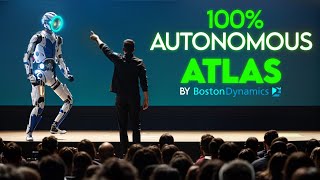
Boston Dynamics' new Atlas robot can now sort and place engine parts without remote control, using electric actuators instead of hydraulics. The demo shows true autonomy with vision and force sensors, unlike Tesla's Optimus which still relies on teleoperation. Atlas is built for automotive manufacturing under Hyundai ownership and Toyota Research Institute collaboration.
Questions this video answers
October 31, 2024
Vision, force, and proprioceptive sensors
All-electric design (no hydraulics) with advanced actuators
1.7 meters tall; 65 kilograms (about 143 pounds)
Top speed 3.3 meters per second; sold over 100 units; price cited at $90,000 each
Chapters
So Boston Dynamics just released a video showing their Atlas robot doing what they call fully autonomous work. And this one's nothing like the usual pre programmed demos. This time it's not Atlas doing parkour or showing off agility. It's focused on handling real world factory tasks. A robot that works entirely on its own. Managing the fast paced environment of a car assembly line, a adjusting to shifting parts and changes without human input. This is the kind of breakthrough we're seeing now. So let's talk about it. By now, most of us know Atlas, the humanoid robot from Boston Dynamics that's already famous for doing crazy physical stuff. Remember the viral videos of it doing push ups? Well, it's gone from showing off its physical capabilities to handling actual industrial work. And that's a huge step forward. In this latest demo, Atlas is seen moving engine parts between containers and a mobile sequencing dolly. And which basically means it's sorting parts, adjusting to different heights and moving them precisely where they're supposed to go. Now the wild part. It's all completely autonomous. No human stepping in to tell it what to do next. Boston Dynamics really stepped up the game with Atlas's sensor technology. The robot uses a mix of vision, force and proprioceptive sensors. That's how it feels its body's position to adapt and react instantly, so say a part. Its handling is a bit out of place. Instead of fumbling around, Atlas will adjust its grip or position, making real time decisions to get the task done right. There's even a part in the video where Atlas meets a little resistance trying to slide a part into place. The robot literally stops, recalibrates and then tries again. And we're talking about this happening all in a split second, which is just mind blowing. Now let's talk hardware. This latest version of Atlas is all electric, no hydraulics like in the older models. That makes it lighter, quieter and gives it a greater range of motion, which is super important when it's working in a complex environment. And thanks to advanced actuators. Think of them like robotic muscles. It moves smoothly and quickly. Imagine the speed and precision it brings to a fast paced factory floor. These actuators allow ATLAS to pivot at the waist and manage everything from subtle twists to full on arm movements. It's all about making the robot efficient for those repetitive time sensitive tasks where every second counts. And it makes perfect sense that Boston Dynamics is steering Atlas toward automotive applications. Especially with Hyundai now owning the company and pushing automation in car manufacturing. In such a demanding field, a robot like Atlas could significantly enhance efficiency. Which is why they're testing it in these settings. Their recent collaboration with the Toyota Research Institute could also mean we'll see ATLAS equipped with even more advanced machine learning and helping it adapt and learn directly on the job. In terms of design, the video shows Atlas's point of view with a slightly fisheye field of vision where objects it handles are highlighted. This lets ATLAS easily identify items, making sure it's picking up the right parts and putting them in the right places. The new machine learning models running behind the scenes make this even better. By letting ATLAS understand its surroundings and make quick decisions, Boston Dynamics is also making it clear that this is a genuinely independent machine. We're not talking about a robot with pre scripted moves. The video has a fully autonomous watermark on it to make sure we get the point. No remote control, no teleoperation. Just atlas, its sensors and its programming figuring things out on its own. And this autonomy is what really sets ATLAS apart from other robots. In fact, this level of independence is something you don't see often in robots today, especially those designed for industrial use. To give you some perspective, the think of Tesla's Optimus robots. They made headlines when they served drinks and mingled with guests at Tesla's Cyber Cab event. But here's the thing. Most of their moves were actually controlled by humans remotely. So while the Optimus robots were cool to look at, they weren't as autonomous as Boston Dynamics. ATLAS is proving to be. Social media has been buzzing about Atlas, with people calling it creepy, but undeniably impressive. I mean, there's a part where it stands up by planting its feet behind its head, reorienting itself and inverting its spinal column. Yeah, that's a bit of a what just happened moment. But all of this just shows how versatile and advanced ATLAS is becoming. Sure, there's a little bit of a science fiction comes to life vibe to it, but this technology could change the way we think about labor and productivity in ways we're just starting to understand. In my view, what's next for Boston Dynamics and Atlas looks like a focused push to perfect ATLAS for real world factory applications, especially in the automotive sector. And while they're keeping it mostly in the factory setting for now, who knows where this tech could go in the future? Alright, now, as Boston Dynamics explores the future of robotics Autonomy in the US, some equally exciting AI advancements are unfolding in China. The scene at the 7th World Voice Expo in Hefei, East China was full of fresh AI tech that's already reshaping the industry. Standing at 1.7 meters about 5ft 7 inches and weighing 65 kilograms, around 143 pounds. A black humanoid robot demonstrated its perceptual skills. When a visitor mentioned they were thirsty, the robot accurately identified and handed them a bottle of coffee from a set of objects. Showing the precision of its latest generation large language model, this second gen AI developed by Iflytech reflects advances that allow for nuanced tasks like pouring drinks, marking a leap in human like Dexterity for robotics. IFlytech's Superbrain robotic platform supports more than 450 robotics companies and connects a community of 15,000 developers across China. Demonstrating the scale of China's AI integration, this Superbrain isn't just for industrial robots. It's part of a wider push into consumer and daily use products showcased at the expo, which featured over 200 AI solutions and including advanced humanoid robots, human machine interaction systems and enhanced language models. One standout example from the event was the Unitree H1, a humanoid robot from Hangzhou based Unitree Robotics. It's built to move at a brisk 3.3 meters per second and has already sold over 100 units at a price of $90,000 each, showing the rising demand and practical applications for full commercialization of humanoid robots. The government's AI initiative, designed to drive the digital economy and modernize manufacturing, fuels much of this rapid development. At the Expo, an automatic voice interaction testing system for new energy vehicles garnered substantial interest. This system is capable of simulating human interactions within a vehicle, assessing the response speed, accuracy and stability of in car AI systems in real time. According to Wu Jiangzhou, general manager of the National Intelligent Voice Innovation center, this tech has reduced testing time from weeks to just a couple of days, delivering a significant boost for automotive R&D. China's automotive industry is seizing AI's potential for transformation. Chery's chairman Yin Tongyue explained how AI is reshaping their approach, moving beyond basic automation to creating a more intuitive and interactive driving experience. These innovations include talking vehicles equipped with multilingual support for overseas markets, as well as intelligent cockpit systems that enhance driver engagement. AI is also finding its way into everyday household items. Smart refrigerators, AI integrated eyeglasses and even connected cups now feature large language models. Mmous, an Onhui based company, presented their smart mouse and a newly launched AI powered keyboard at the Expo. These tools are designed to cut down repetitive tasks, making work more efficient. The smart keyboard is equipped with multiple language models, allowing it to generate articles, create presentations and even translate content in seconds. Mi Mouse's General manager Feng Haihong noted that their Smart Mouse sold 10,000 units in under a month, underlining the high demand for AI driven office tools. China's AI sector continues to grow rapidly, with more than 4,500 companies contributing to an industry now valued at over 578 billion won, or approximately $81.3 billion, a 13.9% increase from last year alone. Liu Chingfeng, chairman of iFlytech, spoke at the expo, emphasizing that AI's impact goes beyond industrial applications and is beginning to influence every part of daily life and industry. AI's next wave in China promises transformations across sectors and even research fields, driving a more efficient and connected world. With the latest advancements and the government's strategic support, China's AI ecosystem is not only expanding in size, but also pushing the boundaries of what's possible in both personal and industrial tech applications. So what do you guys think? Are we ready for robots like Atlas working side by side with us? Let me know in the comments. And as always, if you enjoyed this breakdown, don't forget to like and subscribe for more on the latest in AI and robotics. Thanks for watching and I'll see you in the next one.










