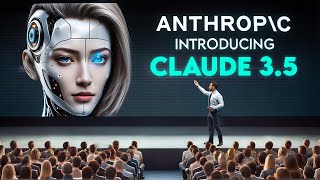
YouTube review by LARRUZ covering Anthropic's Claude 3.5 Sonnet (mid-tier in Anthropic's Haiku/Sonnet/Opus naming). The video summarizes benchmark claims that Sonnet outscored GPT-4o, Gemini 1.5 Pro, and Meta's Llama 3400B across several tests (graduate/undergraduate reasoning, coding), emphasizes a claimed ~2x speed improvement over Claude 3 Opus, and lists practical improvements: better code writing/agentic coding (64% fix rate vs 38% prior), improved humor and human-like writing, image-to-text transcription, chart/graph interpretation, and a 200k token context window. Availability: free on Claude AI and iOS app (higher limits for Pro/team), plus API access via Anthropic, Amazon Bedrock, and Google Cloud Vertex AI. Pricing (Anthropic API) stated as $3 per million input tokens and $15 per million output tokens. New product feature "Artifacts" enables in-app inspection/editing of model outputs. Safety claims include external expert reviews (e.g., UK AI Safety Institute) and opt-in-only use of user data for training. Roadmap: Claude 3.5 Haiku and Opus, Memory feature, and enterprise integrations planned.
Chapters
Anthropic has just launched Claude 3.5 Sonnet, a new AI model that's being compared to OpenAI's GPT4O in terms of performance. They've also introduced some exciting new features, making Claude 3.5 Sonnet more skilled at understanding humor, handling complex workflows, and interpreting charts and graphs. Alright, so what's the deal with Claude 3.5 Sonnet? Well, it's Anthropic's newest AI model and it's already generating some pretty big hype in the AI world. But let's start with the basics. Claude 3.5 Sonnet is part of Anthropic's AI model lineup. They've got this whole naming system going on. Haiku for the smallest model, Sonnet for the middle one, and Opus for the top tier. It's a bit quirky, but hey, every AI company seems to have their own weird naming conventions these days. Now Anthropic is claiming that Claude 3.5 Sonic can go toe to toe with or even outperform some of the heavy hitters in the AI world. We're talking about models like OpenAI's GPT4O and Google's Gemini 1.5. That's a pretty bold statement, right? Anthropic says that 3.5 Sonnet is actually better than their previous top model, Claude 3 Opus, and get this, it's apparently twice as fast. That's a huge deal when it comes to AI performance. Now Anthropic has released some benchmark scores and I've got to say they look pretty impressive. Claude 3.5 Sonnet outscored GPT4O, Gemini 1.5 Pro, and even Meta's Llama 3400B in most of the benchmarks they tested. And this includes areas like graduate level reasoning, undergraduate level knowledge and coding skills. But here's the thing, we always need to take these benchmark scores with a grain of salt. The AI world moves so fast that today's top performer could be old news tomorrow. Plus, companies can cherry pick the benchmarks that make them look good. So while these scores are definitely promising, we'll have to see how the Claude 3.5 Sonnet performs in real world applications. Speaking of real world applications, let's talk about what this new model can actually do. According to anthropic, Claude 3.5 sonnet is much better at writing and translating code. It can handle complex multi step workflows more efficiently. And here's a cool one. It's apparently way better at interpreting charts and graphs, but there's one improvement that I find particularly interesting. Anthropic says that this new Claude is better at understanding humor and and can write in a more human like way. Now that's something I'd love to see in action. An AI assistant that can actually get your jokes and make you laugh. Oh, and here's a neat little tidbit. Claude 3.5 sonnet can apparently transcribe text from images more accurately. That could be super useful for all sorts of applications, from digitizing old documents to helping with visual accessibility. Now, let's talk about availability. If you're itching to try out Claude 3.5 Sonnet, you're in luck. It's already available for free on Claude AI and the Claude iOS app. If you're a subscriber to Claude Pro or their team plans, you'll get higher usage limits. And for the developers out there, you can access it through Anthropic's API, Amazon Bedrock, and Google Cloud's Vertex AI. Also, Anthropic has set up a pretty affordable pricing model for this AI through Anthropic's API. It costs $3 per million input tokens and $15 per million output tokens. This basically means every time you feed information to the AI or get results back, you're using tokens. And these prices are quite competitive in the AI market. Another cool thing is the 200k token context window. This might sound technical, but it's actually really important. It means Claude can handle much larger chunks of information at once. So if you're working on a big project that involves a lot of data, Claude can process it all without getting overwhelmed. But Anthropic isn't just improving their AI model. The they're also rolling out a new feature called Artifacts. And this is pretty cool, folks. Basically, it lets you see and interact with the results of your request to Claude right in the app. So if you ask Claude to design something for you, you can now see what it looks like and even edit it right there. Think about it. If Claude writes an email for you, you can edit it directly in the Claude app instead of having to copy it to a text editor. It might seem like a small thing, but it's actually a really smart move. These AI tools need to evolve beyond just being chatbots, and features like Artifacts are a step in that direction. This Artifacts feature might be giving us a glimpse into Anthropic's long term vision for Claude. They've always said they're mainly focused on businesses, even though they've been hiring some big names from the consumer tech world. In their press release they talked about turning Claude into a tool for companies to securely centralize their knowledge, documents and ongoing work in one shared space. That sounds less like a chatbot and more like a full fledged productivity platform, doesn't it? We might be looking at something that could compete with tools like Notion or Slack, but with Anthropic's powerful AI models at the core, that's a pretty exciting prospect. If you ask me. The pace of improvement in AI is just mind blowing. Anthropic launched Claude 3 Opus in March, saying it was as good as GPT4 and Gemini 1.0. Then OpenAI and Google released better versions of their models. And now, just a few months later, Anthropic is back with Claud Claude 3.5 Sonnet Now, I know Claude doesn't get as much attention as Gemini or Chat GPT, but make no mistake, it's very much in the race and with improvements like these, it's definitely a contender to watch. Let's talk a bit more about some of the specific improvements in Claude 3.5 sonnet. Anthropic did an internal evaluation of what they call agentic coding. Basically, they tested how well the AI could fix bugs or add new features to an open source code base when given a description of what needed to be done.
Here you're going to see Claude edit the function file to fix the bug. And now Claude's going to rerun those tests. And the tests are passing. So now if we rerun the function look, our image no longer has that white background. Thanks Claude.
Claude 3.5 Sonnet solved 64% of these problems, compared to only 38% for the previous model. That's a huge jump. Now let's address safety and privacy because these are huge concerns when it comes to AI. Anthropic says they've put Claude 3.5 sonnet through rigorous testing and trained it to reduce misuse. They've even brought in external experts to evaluate the model's safety, including the UK's Artificial Intelligence Safety Institute. They've also incorporated feedback from outside experts to make sure their safety evaluations are robust and up to date. For example, they worked with child safety experts from an organization called Thorn TO to update their classifiers and fine tune their models. And here's some reassuring news for those concerned about data privacy. Anthropic says they don't train their generative models on user submitted data unless the user explicitly gives them permission to do so. That's a pretty strong stance on privacy in a world where data is often seen as the new gold. So what's on the horizon for Anthropic? They're not taking a break anytime soon. Later this year they plan to roll out Claude 3.5 Haiku and Claude 3.5 Opus, completing the Claude 3.5 model family. They're also developing exciting new features like one called Memory, which will enable Claude to remember user preferences and interaction history, making the AI experience more personalized and efficient. They're also exploring new modalities and features to support more use cases for businesses, including integrations with enterprise applications. It's clear that Anthropic is gunning for the business market in a big way. Now, I know we've covered a lot of ground here, but there's one more thing I want to mention. Anthropic is really emphasizing their commitment to improving the trade off between intelligence, speed and cost. They're aiming to make substantial improvements in this area every few months. That's an ambitious goal, but if they can pull it off, it could really shake up the AI industry. It's an exciting time to be following these developments and I can't wait to see what comes next. What do you think about Claude 3.5 sonnet? Are you excited to try it and see how it compares to other AI models? Let me know in the comments below. And don't forget to like and subscribe for more AI updates. Thanks for watching and I'll see you in the next one.