New 'High IQ' AI Model From China Just Shocked The World - ERNIE 4.5
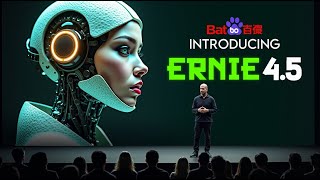
Baidu released Ernie 4.5 and Ernie X1, free AI models that score higher than GPT-4O on multimodal benchmarks and cost roughly 1% as much. Ernie X1 reportedly matches Deepseek R1 on math reasoning, while Ernie 4.5 hits 90+ on document analysis tasks.
Questions this video answers
March 16, 2025
Over 90
Ernie 4.5: 77.77; GPT4O: 73.92
Input: 0.004 yuan per 1,000 tokens; Output: 0.016 yuan per 1,000 tokens
June 30 (year given in video context: implied 2025)
Chapters
So Baidu just dropped two new AI models, Ernie 4.5 and Ernie X1, and they went ahead and made them free on their Ernie Bot platform ahead of schedule. Seriously free. This move has got the entire tech scene going wild, with Baidu openly challenging big names like OpenAI, Google, Deepseek and Tencent by offering advanced AI tools to everyone, not just major players. Now, Baidu's not new to the AI conversation. They were one of China's first big players to roll out a generative AI platform back in 2023. But they struggled to catch fire the same way ChatGPT did. When OpenAI launched, that competition was fierce from companies like ByteDance. They have their own AI chatbot that got a ton of user attention, and from this startup, deepsea, which basically rattled the entire industry by claiming it had a reasoning model on par with the best US based models yet, delivered at a fraction of the cost. Imagine telling all these established giants, we can do what you do and cheaper. That absolutely set off alarms everywhere. So let's talk about these new Baidu models. First up is Ernie 4.5, which Baidu calls their latest foundation model, meaning it can tackle a bunch of different tasks because it's trained on massive heaps of data. It's what they call multimodal. So it doesn't just do text, it can handle images, maybe audio, maybe video, the works. They say it has better language abilities, logic generation and memory. They even claim it has a high eq, meaning it gets all those satirical cartoons and memes we toss around online. The company put a lot of emphasis on how well Ernie 4.5 does on tasks like Doc VQA, which is about understanding complex documents. Apparently it scored over 90 there, which is a big deal for anyone handling loads of text like contracts or research reports. Baidu compares Ernie 4.5's overall multimodal performance with GPT4O, quoting this super precise number 77.77 for Ernie 4.5 versus 73.92 for GPT4O. Now if you're asking, well, what do those points actually mean in real life, they basically come from a bunch of benchmarks like ocr, Bench chartqa, Math, Vista, docvqa, and more. The gist is if you're a researcher or a developer who deals with images, text, or a combo of both, you're probably going to be excited about the prospect of a model like Ernie 4.5 that might outperform some big name counterparts. Now let's check out Ernie X1, which Baidu dubs their reasoning focused or Deep Thinking model. They're bragging that it rivals Deepseek's R1 model at half the cost. They specifically highlight that Ernie X1 does well in benchmarks like CM MLU, which tests knowledge in Chinese and in Chinese simple QA, as well as something called Math 500. Allegedly, X1 even beat GPT 4.5 in that math test. Think about that for a second. Overshadowing GPT 4.5 in math tasks is huge in a world where math and logic capabilities can be the difference between a so so AI assistant and a truly powerful one. Some are already finding huge value in Baidu's free AI models. Like Siri, A researcher in Indonesia struggled to analyze satellite images and scientific data until Ernie 4.5 became free, allowing her to finally manage her work in Jakarta. A dev named Arty wanted to build a homework assistant but couldn't afford the powerful AI tools he needed until Ernie X1 was released for free. Baidu calls this move a democratization of AI, a opening doors for developers and researchers who couldn't afford these tools before. But now the question is why are they making all this free if advanced AI is so expensive to develop? Essentially, it's a bold strategy that could give them a massive user base in the AI world. Once people start using your model, you get tons of real world data. More data means better improvements, which can make your models more attractive for enterprise deals, more advanced research, more or even licensing partnerships. And if the AI is free but built on Baidu's cloud or integrated into Baidu Search, that might still generate indirect revenue. They also mentioned that they'll be open sourcing some of their ernie models starting June 30, which follows Deepseek's example of open sourcing. So it's like an arms race of let's see who can get more devs and users on board now. Tencent released a model in February that it claims answers faster than Deepseek, yet also integrated some of Deepseek's technology into its apps. Alibaba partnered with Apple for AI on Apple's devices in China and committed something like 380 billion yuan. That's about $52 billion to AI in the next three years. Alibaba also rolled out a new version of its AI assistant, powered by an open source reasoning model called Quen. ByteDance, the company behind TikTok, is in on the generative AI game too, with a chatbot that soared in popularity. Everyone's essentially jostling for attention, user adoption, and maybe even trying to see who can offer these powerful services at the lowest cost. And it's not just companies. The Chinese government has poured resources into AI, with local governments in places like Beijing, Shanghai, Guangdong and Zhejiang building AI industry hubs. Shanghai is talking about an open and collaborative innovation structure aiming to expand open source development and data sharing. Meanwhile, Guangdong is rolling out new AI and robotics policies, offering subsidies of up to 8 million yuan a project. The I research guys say China's AI sector could be worth 811 billion yuan by 2028. That's insane growth, and it really sets the stage for these big moves from Baidu and its rivals. Another angle to this story is that Baidu itself integrated DeepSeek's R1 reasoning model into its search engine earlier, so they're obviously aware of Deepseek's strength. Yet from Baidu's perspective, they want to be the go to platform for AI at scale, from consumer chatbots to enterprise solutions, they want to stand out in the global AI race, claiming things like Ernie X1 is the first deep thinking model that uses tools autonomously. It's also telling that they highlight the cost advantage, but for instance, there's mention of how earny 4.5 might only be 1% the price of GPT 4.5. Another detail is that the actual input and output costs for Ernie 4.5 can be as low as 0.004 yuan per thousand tokens for input and 0.016 yuan per thousand tokens for output. That kind of pricing can be a game changer for small startups and individuals. Now, of course, the big question is whether Baidu can keep up this pace. Training and maintaining advanced AI models is expensive. Sure, making the models free is great for publicity and user adoption, but the company still needs to cover the cost of cloud servers, research, data centers and everything else that goes into top tier AI development. They had decent financial growth in 2024 with a 26% jump in cloud income, but there was also a 6% drop in non GAAP net income. So that points to possible challenges if they're going to keep giving these AI models away for zero fees. Still, the early results have people stoked. Baidu says millions of users rushed in to try out Ernie Bot right after they announced it was free. Developers started testing Ernie 4.5's multimodal powers, hooking it up to do things like analyze X rays combined with a patient's medical history or to interpret charts for financial analysis. The potential is enormous if Baidu can maintain their servers and keep pushing improvements. Some folks are even calling March 16, 2025 the day that shifted the trajectory of AI development, at least in China, because it's when a major player openly challenged the standard that you have to pay big bucks for advanced AI. There's also this angle of how Western companies might respond. DeepSeek's success in offering cost affluence models has already prompted a flurry of new releases. OpenAI might feel like it needs to accelerate its rumored GPT5 release or figure out more competitive pricing. Baidu also claims that Ernie X1 has a strong advantage in Chinese language tasks, especially in logic and reasoning, so that could give them a regional edge. And in China's market, ByteDance and Tencent aren't going to let Baidu hog the spotlight. Tencent introduced Hunyuan Turbo s earlier in the year, saying it can pump out text twice as fast as before. ByteDance's consumer adoption soared when they launched Dubao. Meanwhile, Alibaba joined forces with Apple to develop AI solutions for iPhones in China and set aside those billions for AI investment. People are noticing that the whole AI scene right now is kind of in the midst of a giant evolution. In the past, advanced AI was the playground of well funded labs or big corporations. But with Baidu and Deep Seq pushing out free or low cost models, you suddenly have folks like that researcher in Indonesia and the developer in Jakarta stepping up their game. Teachers in remote regions might start using models like this to craft better lessons, local hospitals might leverage it to read X rays, etc. So it's not just hype, it's real daily impact. Of course, there's a healthy dose of skepticism. Some industry insiders wonder if Baidu will eventually introduce premium tiers. Maybe basic usage remains free, but advanced features, higher token limits, or specialized toolkits cost money. That sort of freemium approach is pretty common, especially if you look at how, say, certain web services operate. But for now, Baidu is clearly leaning into the narrative of AI for all, which resonates strongly with governments and businesses alike, especially in a country with so many small and medium sized enterprises eager to digitize and automate. So yeah, that's the whole story. Let me know what you think down below. Thanks for watching and I'll see you in the next one. Sa.










