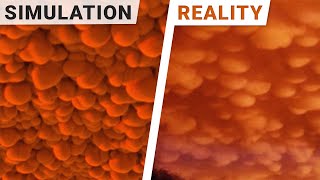
A new weather simulator models water's physics to create realistic clouds and rain across different landscapes. It handles buoyancy, evaporation, and condensation properly, runs at 10 frames per second, and can reproduce rare phenomena like mammatus and hole-punch clouds.
Questions this video answers
2022-01-15
Approximately 10 frames per second
Approximately 500 views
Perceptilabs
Chapters
Dear fellow scholars, this is two minute papers with Dr. You can immediately start holding on to your papers because today we are going to take a journey around the globe and simulate the weather over the mountainous coast of Yucatan, a beautiful day in the Swiss Alps, and a searing day in the Sahara Desert. Yes, from now on, all of this is possible through the power of this new paper. Just to showcase how quickly things are improving in the wondrous land of computer graphics. First we were able to simulate a tree, and then researchers learned to simulate an entire forest. But that's not all. Then more recent papers explore simulating an entire ecosystem for thousands of years. Now that's something. So are we done here? What else is there to do? Well, this new work finally helps us simulating weatherscapes. And it can go from a light rain to a huge snowstorm. Now, previous methods were also able to do something like this, but something was missing. For instance, this looks great, but the buoyancy part is just not there. Why? Well, let's look at the new method and find out together. Yes, the new work simulates the microphysics of water, which helps modeling phase changes and buoyancy properly. You are seeing the buoyancy part here. That makes a great difference. So what about phase changes? Well, look at this simulation. This is also missing something. What is missing? Well, the simulation of the phone effect. What this means is a phenomenon where condensed warm air approaches one side of the mountain and something happens. Or to be more exact, something doesn't happen in reality. This should not get through. So let's see the new simulation. Oh yes, it is indeed stuck. Now that's what I call a proper simulation of heat transfer and phase changes. Bravo. And here you also see another example of a proper phase change simulation where the rainwater flows down the mountain to the ground and the no system simulates how it evaporates. Wait for it. Yes, it starts to form. No clouds. So good. And it can simulate many more amazing natural phenomena beyond these in a way that resembles reality quite well. My favorites here are the Mammatus clouds, a phenomenon where the air descends and warms, creating differences in temperature in the cloud. And this is what the instability it creates looks like. And oh my. The hole punch. This can emerge due to air cooling rapidly, often due to a passing aircraft. All of these phenomena require the simulations of the microphysics of water. So. Microphysics, huh? That sounds computationally expensive. So let's pop the question. How long do we have to wait for a simulation like this? Whoa. Are you seeing what I am seeing? How is that even possible. This runs easily interactively with approximately 10 frames per second. It simulates this and this and all of these variables and it can do all this ten times every second. That is insanity. Sign me up now. One more thing. Views are not everything. Not even close. However, I couldn't ignore the fact that as of the making of this video, only approximately 500 people watched the original paper video. I think this is such a beautiful work, everyone has to see it before 2 minute papers. I was just running around at the university with these papers in my hand trying to show them to the people I know. And today this is why 2 Minute Papers exists. And it can only exist with such an amazing and receptive audience as you are. So thank you so much for coming with us on this glorious journey and make sure to subscribe and hit the bell icon if you wish to see more outstanding works like this. We have a great deal more coming up for you. Perceptilabs is a Visual API for TensorFlow, carefully designed to make machine learning as intuitive as possible. This gives you a faster way to build out models with more transparency into how your model is architected, how it performs, and how to debug it. And it even generates visualizations for all the model variables and gives you recommendations both during modeling and training, and does all this automatically. I only wish I had a tool like this when I was working on my neural networks during my PhD years. Visit perceptilabs.com papers and start using their system for free today. Our thanks to Perceptilabs for their support and for helping us make better videos for you. Thanks for watching and for your generous support and I'll see you next time.