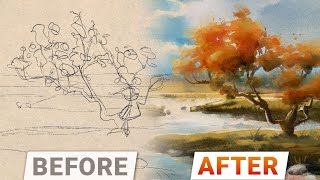
Dr. Hmm reviews a new paint-mixing simulation that tracks pigment concentration and subsurface scattering in real time. Previous digital painting mixed colors wrong, turning blue and yellow into cream instead of green. This runs at 60+ FPS and is already built into Rebelle 5.
Chapters
Dear fellow scholars, this is two minute papers with Dr. Hmm. As you see, this is not our usual intro. Why is that? Because today we are going to simulate the process of real painting on a computer. And we'll find out that all previous techniques mix paint incorrectly and finally create this beautiful image. Now, there are plenty of previous techniques that help us paint digitally. So why do we need a new paper for this? Well, believe it or not, these previous methods think differently about the shape that the paint has to take. The more sophisticated ones even simulate the diffusion of paint, which is fantastic. They all do these things a little differently, but they agree on one thing. And here comes the problem. The only thing they agree on is that blue plus yellow equals a creamy color. But wait a second, let's actually try this. Many of you already know what is coming, of course. In real life, blue plus yellow is not a creamy color. It is green. And does the new method know this? Yes, it does, but only this one. And we can try similar experiments over and over again. The results are the same. So how is this even possible? Does no one know that blue plus yellow equals green? Well, of course they know. But a proper simulation of pigment mixing is very challenging. For instance, it requires keeping track of pigment concentrations. And we also have to simulate subsurface scattering, which is the absorption and scattering of light of these pigments. In some critical applications. Just this part can take several hours to days to compute for a challenging case. And now hold on to your papers, because this new technique can do all this correctly and in real time. I love this visualization as it is really dense in information, super easy to read at the same time. That is quite a challenge. And in my opinion, just this one figure could win an award by itself. As you see, most of the time it runs easily with 60 or higher frames per second. And even in the craziest cases, it can compute all this about 30 times per second. That is insanity. So what do we get for all this effort? A more realistic digital painting experience. For instance, with the new method, color mixing now feels absolutely amazing. And if we feel like applying a ton of paint and let it stain the paper, we get something much more lifelike too. Artists who try this will appreciate these a great deal. I am sure, especially that the authors of also made this paint color mixing technique available for everyone free of charge. As we noted, computing this kind of paint mixing simulation is not easy. However, using the final technique is, on the other hand, extremely easy. As easy as it gets. If you feel like coding up a simulation and include this method in it. This is all you need to do. Very few paper implementations are this simple to use. It conceals all the mathematical difficulties away from you. Extra points for elegance and huge congratulations to the authors. Now, after nearly every Two Minute Papers episode where we showcase such an amazing paper, I get a question saying something like okay, but when do I get to see or use this in the real world? And of course rightfully so. That is a good question. For instance, this previous Gauguan paper was published in 2019 and here we are just a bit more than two years later and it has been transferred into a real product. Some machine learning papers also made it to Tesla's self driving cars in one or two years. So tech transfer from research to real products is real. But is it real? With this technique? Yes it is. So much so that it is already available in an app named Rebelle 5 which offers a next level digital painting experience. It even simulates different kinds of papers and how they absorb paint. Hmm, a paper simulation you say? Yes, here at 2 Minute Papers we appreciate that a great deal. If you use this to paint something, please make sure to leave a comment or tweet at me. I would love to see your scholarly paintings. What a time to be alive. This video has been supported by Weights and Biases. They have an amazing podcast by the name Gradient Descent where they interview machine learning experts who discuss how they use learning based algorithms to solve real world problems. They've discussed biology, teaching robots, machine learning in outer space, and a whole lot more. Perfect for a fellow scholar with an open mind. Make sure to visit them through WNB MEGD or just click the link in the video description. Our thanks to WeightsAndBiases for their long standing support and for helping us make better videos for you. Thanks for watching and for your generous support and I'll see you next time.