Nvidia AI Foundations - Bigger Than You Think
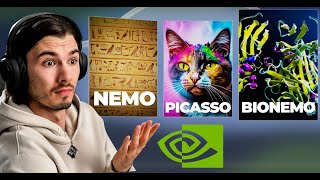
Nvidia launched AI Foundations, offering pre-trained customizable models for text, images, and drug discovery. Amazon Robotics used Nvidia's Omniverse to boost marker detection from 88.6% to 98% with synthetic data. The company also released the H100 GPU and positioned DGX Cloud as an AI factory to let small businesses build custom models.
Questions this video answers
Nemo (text), Picasso (text→image/video/3D), and BioNemo (drug discovery).
Improved marker-detection success rate from 88.6% to 98% (using synthetic data).
PCI Express H100 with dual GPU MVLink and 94 gigabytes of HBM3 memory.
Chapters
Welcome ladies and gentlemen to today's news flash. So much to talk about here. Honestly, Getting into it in about two, three minutes. All right. Hello everyone. Welcome to today's stream. We'll give it a minute and we'll talk about Nvidia yesterday. Honestly, I've ever created. I am not even kidding. This is massive. This is copyright free music. I take from.
Hell.
Yeah.
Okay. How are you guys doing today? How are you guys doing? How's been your day? Let me know in the chat. Yeah, I know, I know it's instrument. I'm not saying anything. Don't worry. You guys relax. We're about to talk business here.
Okay? And video.
That's conferencing. Oh wow. Studio €85 under impress. Okay, I can't wait to. Ladies and gentlemen. You guys, you guys are a little feisty today. What's up with that? Listen up. So there's like some serious news happening here. Okay. Usually I only cover things on this channel that you can put to work right away. Tangible things, tangible tutorials that you can watch and put it to work. I tend to shy away from all the newsworthy AI topics just because there's so many. Okay. But there's no way, there's no way for me to skip this one. This is. I want to talk about the implications of this. All right? This is serious stuff. This is serious stuff because we didn't just experience massive leap forwards on the hardware front. We also just experienced the one thing I've been waiting for here since months. Okay. We are experiencing a platform for companies to build their own custom models without the high barrier of entry that we are seeing right now with ChatGPT. Okay. And with. I know you can fine tune models, sure. But it's not something that you know, your typical small to medium sized company would be doing within video. This is different. Let's talk about all the details here. Okay, I want to go through this step by step. I want to look at the trailers here together and I want to talk some of the implications. This is not going to be a very long live stream. Okay, I have a bunch of talking points that I want to go through here. And essentially what you can expect here is a summary of the 1/2 20 long Nvidia conference, their opening keynote. Okay, so here's the juice they. Nvidia is one of the main manufacturers for chips and concretely GPUs in the world. You probably already know that. But what many people don't know is that they're extremely active in working with all these AI infrastructure with, with all these AI companies, they're essentially the infrastructure beneath a lot of it. Okay. As they go into, in the keynote, they helped OpenAI get off the ground, the co founders get off the ground back in 2013. All that was done on Nvidia GPU's beautiful backstory. But the point here is, the point here is they're the infrastructure providers in this new era that we're entering. Okay? And for anybody interested in these topics, the stuff we're about to discuss here is super relevant because he said one phrase I counted four times in the stream, okay? And it was all pre written so they knew what they were doing there. He said this is the iPhone moment for AI. Okay, iPhone moment for AI. He said that multiple times in the beginning, in the middle, in the ending. And I think it's a beautiful comparison and we'll get into an accurate comparison too, and we'll get into that soon. But concretely, I want to talk and show you guys what was unveiled here today and why I think it's a big deal. Okay, so first of all, developer conference happening over the next three days, this entire thing, if you're not a very technical person, most of it is about hardware and data centers and talks about the improvements in, you know, computing capabilities and it's just not going to be very interesting to the typical consumer. But what is very interesting is the tidbits in between. Omniverse is interesting, we're going to summarize that. Okay, what else is interesting is the partnership with Adobe. To me, very interesting. And the most interesting thing is their cloud service for generative AI. They call it AI Foundations. And this is what I really want to talk about because this is the big deal, in my opinion. But first, let's have a look at what we get here. Very simple. If you're into generative AI, well, if you're watching this, chances are you're into generative AI, right midjourney. ChatGPT. And if you're into generative AI, there's a bunch of speeches here and talks here over the next three days that you should probably check out. Concretely, they stated there's over 70 talks concretely on generative AI. There's many other topics covered with this, but definitely something worth checking out. Now they had a little trailer in the beginning and I want to watch this together with you guys because I thought it was really cool. It was sort of a trailer that advertised generative AI to the world and it was all narrated by ChatGPT. So I thought this was pretty cool. And I just want to watch this together and yeah, get what you guys are thinking of this. Have a look if you haven't seen this yet.
I am a translator, Transforming text into creative discovery.
There you go.
Movement into animation. And direction into action. I am a healer, exploring the building blocks that make us unique. Modeling new threats before they happen. In searching for the cures to keep them at bay. I am a visionary, generating new medical miracles. And giving us a new perspective on our son to keep us safe here on Earth. I am a navigator, discovering a unique moment in a sea of content.
We are announcing the next generation and.
The perfect setting for any story. I am a creator, building 3D experiences from snapshots and adding new levels of reality to our virtual selves. I am a helper bringing brainstorms to life.
Okay, so here I just want to quickly point out, while I switch this to 1080p, might improve it. You can always see the apps in the bottom left. And if you've been looking for use cases and different apps to explore the capabilities of generative AI, honestly, there's no better source than this trailer. If you just check out, there's examples and there's the names of the apps. A bunch of rabbit holes to go down. Let's see.
Sharing the wisdom of a million programme and turning ideas into virtual worlds.
Build Northern Forest.
I even helped write the script, Breathed life into the words and composed the melody. AI brought to life by Nvidia. Deep learning and brilliant minds everywhere.
And then, and then the key keynote continues. So look, personally I just wanted to check that out because I thought it was a fantastic trailer that showed off a bunch of the generative AI use cases that you. That we don't talk about on a daily basis. So feel free to check that out. Go down some of those rabbit holes. Some of those apps are freely available and you can just experiment with them. At the very least, good to know they exist. All right, so that is that. So let's get into the first main topic of the day here and that is AI foundations. Okay, what is AI foundations? It's a cloud service for generative AI. Okay, let's break that down. So generative AI is the category that ChatGPT falls into midjourney. Falls into, right? You type something into a text box and it generates output for you. And this is really the first time that we're getting. And okay, maybe this is the first time we're getting an accessible version of this because most medium small to medium sized companies right now are not able to, you know, fine tune their own model to superpower their agency or something like that. Essentially what they're doing here is they're providing pre trained models that you can customize yourself, okay, quite easily in the cloud. They have a partnership with Microsoft, we're going to talk about that too briefly. But essentially it's hosted at the Azure cloud and companies can go in and train their own models. Now what's different about this? It's their approach that is different, okay? Because with OpenAI they started as this like open, open company, right? But right now if you want, if you want a fine tuned model for your, let's say agency, I think that's a fantastic example because they're usually, you know, like small to medium sized companies if you want a fine tuned model. It's a lot of technical work and it costs quite a bit of money. What they're going to do is, and this is the big news to me, they're going to make this accessible, okay? There's going to be models that are quite small and that are going to be cheap to run and this just made it accessible to the masses. That's what I'm trying to say business wise, okay? This is really going to be, yes, they have a enterprise facing part two, but it's also going to be consumer facing. People are going to be able to train their own model. Okay? And that is the revolutionary thing here. That is why I'm saying that this is like the least clickbaity title I have probably ever done. This is to me this is bigger news than GPT4. And guys, I couldn't be more excited about GPT4. I'm using exploring it daily. I'm about to share a lot of the findings here on the channel via videos that we're already creating one on jailbreaks coming very soon, wink wink. But the point is this really democratizes generative AI and it puts it into the hands of normal people and that's why I'm so excited about this. So let's talk about this in more detail. Okay? So I have a bunch of things lined up here that are interesting but let's talk about the free models. Okay, I'll just have to. Everything else I set up in advance. I just have to find this little visualization. Okay, so it's really about the DGX cloud. Okay, so let's jump hop on over to the screen share here and it's really about the DGX clouds. Now what is the, what is dgx? This is the new Term, I had to learn. And you'll have to learn now too. Okay. DGX is what they call their supercomputer. It's essentially where this runs on. Okay. The DGX cloud is going to be the service you tap into when you interact with their AI Foundations service. Okay, and why is that? Why is the AI? So as we said, you're going to be able to train your pre, pre trained your generative models and there's going to be customer support too. So they're going to assign you one of their experts or assistants to help you out in setting everything up. So again, this is really the beginning of a new era. A lot of these companies are going to have their custom generative models implemented into their workflows. And this is what it looks like up until now. We kind of got a taste. We got ChatGPT, a really simple interface. You know, we got the API, but you know, it got quite expensive. GPT3 got quite expensive now it got cheaper. But it's still not easy to interact with. It's not really usable for smaller businesses, not at scale. A lot of people are experimenting it, but it takes a very high level of technical understanding for you to do it with this service. It really changes. Okay, so DGX is their supercomputer. DGX cloud is something. They refer to this as the AI factory. They say every company is going to have their own AI factory. What that means is that they're going to generate text, they're going to generate images, 3D models and so much more with their very own custom model. And in here you had a beautiful overview of the three models. And this is what I really want to dive into now. Okay, you have these three models. So this is what they call Nvidia foundations. Okay, you have Nemo, you have Picasso, and you have bionemo. Briefly and simply explained, Nemo is all about text to text, right? ChatGPT, like Picasso, is all about text to image, text to video and text to 3D. I'm going to talk about, talk more about those three soon. And BioNemo is all about drug discovery. A very specific use case, not relevant to 99.9% of us, but it's all about drug discovery. They partnered, they've partnered well. They have a bunch of data that they pre trained their models with that is, you know, not openly available, closed databases of previous research data. And on that data they trained their bionemo model. And now various pharmaceutical companies or startups are going to be able to tap into it and For a feed, they're going to be able to use this for drug discovery. So that's the one we're going to talk the least about. But I really want to talk about Picasso and Nemo here. Okay, so some notes here because there's just a lot to talk about. Okay, so as we said, Nemo is going to be the classic text text. You can think of this as training your own custom chatgpt. Once it's going to be out, once companies are going to be able to use this. Okay. Yes. This is really like Microsoft Copilot. Yes. But a custom one. Yeah. Investment's about to pay off. Yes, I agree, Andrew. Yes. It's really compounding now. So Nemo, you can think of as your custom ChatGPT. This is my very primitive explanation for it. There's going to be different models, some of them with a limited amount of parameters and some of them almost at the complexity of ChatGPT. And I'm sure they're going to be adding to this over time. But essentially you can have your custom ChatGPT at a fraction of the price. Okay. Even at a fraction of the price of ChatGPT 3.5, which is really cheap already. They said there's going to be like tiny models for certain use cases. That's all you need. Okay, so Nemo is going to be that Picasso. This is the interesting one and this is where they brought up a bunch of examples which I want to show you in which I want to talk about. So Picasso is going to be all about text to photo, text to video, and text to 3D. Okay. And they brought up three examples which got me personally with my photo video background really excited because. And listen up, buckle up, because this is like, this is exciting. They have a collaboration with first of all Adobe, secondly Shutterstock, and third of all, Getty Images. So all three platforms have myriad of stock footage or stock images that are licensed. Right. So what this means is we're going to get the first text to image model that is ethical, essentially, that is not trained on other artists work that has been illegally, you know, copied. There's no copyright issues with it. Essentially it's commercially viable and corporations will be able to, ethically and without worry, use this and all of their presentations and all of their work and all of their marketing, whatever it might be. This is going to be the first step in that direction. Because up until now, you know, stable diffusion and all the little experiments we've seen all the custom models and midjourney and Dall E, well, they're not exactly trained on copyright free images, that's no secret. So, Remy, Bionimo was something that amazed you. Interesting. So, yeah, that's. You need a little bit of interest in those topics. But I think Bionimo, they expanded on it intensely. Where was it? I think it was in here, right? Yes, they talked. Yeah, Baunimo was super interested. Andrew, you were not impressed with Bart? Yeah, that's a good point. Bart came out today, it launched and apparently it's just like it's meh. I don't have access yet. So I'm just quoting people I trust here. Anyway, continuing with our little presentation here. So we're talking about Picasso on the Nvidia Foundation's cloud service for custom generative AI language models. Jesus Christ, that is a mouthful. Right. But essentially you're going to have your own AI within your company. That's what this means. Okay. And Picasso, again, the partnering with Adobe. And I want to show you some of the things that Adobe is going to provide with this. Okay. Because they released this today, they call it Adobe Firefly. Okay. This is their own AI. And okay, that's kind of cute right there. But let's look at what we get. So first of all, in the presentation we got to look at their text to image engine where you're going to be, you know, the good old. You type your text to get a result. Then this one is really interesting. And here as a creator, let me tell you, this is something I've been waiting for. Overall, this controlled approach, this approach that really integrates into workflows. So for example, you can just select different parts and I'm sure they're going to bring this to Photoshop, right? I hope. And you can just generate variations. Look, just pick different lighthouses and it matches the style and you can just do that. So this we knew before, right, you could just like auto fill this, but now you can like select it. And instead of auto filling it, wait, what is it called? Content Aware fill. Right. Instead of Content Aware filling it, you can say City of Atlantis and it fills that in. I think this is really from a creative perspective, this is such a massive leap once this comes out. Because photoshopping this, let me tell you, that's a 20 to 30 minute task right there. And he just did that in two clicks. Okay. And that's if you're advanced, if you know, you wouldn't even know how to do that, I suppose. Okay, next up, creative building blocks. So this is all about vectors and shapes and this is really going to be a massive upgrade in terms of logo design. I know the videos on YouTube that talk about midjourney for logo design are quite popular, but the fact of the matter is it's weak for logo design at best. Yes, it's good for inspiration. It can maybe get you some interesting shapes, but it never gets the text right. And there's like just, there's like big limitations on it. It definitely cannot do everything. And what's the case here is you're going to be able to, just by inputting text, you're going to be able to generate vectors that you can use for your designs. I think that's quite fascinating. Okay. It will become a part of the Adobe suite. Yes, I think so too. Do you think that they're using Getty without permission? No, no, no, Eileen. It's a partnership. So Getty themselves is partnering with Nvidia and feeding all of their stock imagery and stock footage into the AI models. And they're just using the ones that they have the copyrights for. Right. So if you have a non exclusive license, I believe they wouldn't be allowed to use that. Also, quick side note, there was a big issue with Adobe and people complaining that, hey, you guys will surely be using all the images that people upload to your cloud. Right. And then the CEO had to make a big statement that, no, only the copyright free stuff is going to be used to train our custom AI models. So. All right. And this is a step in an interesting direction. Okay, so AI video editing. Now it's not video editing as in, you know, cutting it up and putting it in the right place and getting the timing right and inserting memes or whatever. It's more a video filter. This is more, this is more of a Instagram filter for your videos, but a really advanced one. Right? So you get the snow on top, you get the color grade. And the interesting thing here is I think the color grade is local change scenes. Winter today. Right. So as you can see, it created like a custom mask around this barrel. You can see that a little on the fringes here, on the fringes of that barrel. Sauna. That's what this is. I believe if we zoom in here a little bit, it's going to be a little messy. But is that better? I'm not sure. But you can see it creates a mask here that is almost perfect. So that means it doesn't tint this thing blue, which is incredible in my opinion. So it's quite smart. You know, it's not just putting like an Instagram filter Over the whole thing. So I just thought that was interesting. And then, yeah, you can, you know, make template from mood board and you pick the mood board and you get templates. So this is, you know, it's quite amazing, actually. And then you can put the pull, drag and drop. It's going to get better. This is really a creative. So. And here for 3D objects, you can just drag and drop textures. This wasn't possible up until now. And it kind of analyzes the image in depth. So. Okay, some quick demos there. I just thought that was really cool, so I wanted to show it off as a creator. And this. I found this on Twitter. I just wanted to share this. And then we're going to move on with the other nose here. But I've never been able to test out Adobe Firefly. I've been able to test out Adobe Firefly for a few days now. Thanks again. This is a very good start. Let's see where the road takes us from here. And then she shared a few images. And this is just a basic text to image. Text to image function of Adobe Firefly. So, you know, in typical AI fashion, you can see these little anomalies down here with the carpet. You see a funky pillow over here. I'm not sure what's going on with this curtain, but the first impression of this is very good. Quite good. The photorealism is, I would say it's on par with midjourney. Just the details, you know, it's still very rough around the edges in these examples here. This one is quite good. This doesn't look realistic. The carpet is a little weird, but otherwise, honestly, like the couch, you know, if you start looking closer, these fall apart. They do, they do. But I think this, this is probably the best one. This is probably the best one. If you would Photoshop this, then I think you would. You could kind of get away with using this as is. This is really good. Anyway, Photorealism is really good in them. So this is gonna. As it's trained on pictures, it's gonna be something realistic. That's what you can expect here. All right, now, that being said, what else do we have here? So we talked about the Picasso model here, right? It's going to be the second model on their. I want to use the exact terminology they use. So it's a cloud service for generative AI, right? Picasso is going to be the second model. And the Bionemo if. Yeah, it's just going to be used for drug development. If you care about the details of that. They're all in here. Okay. Also, another topic I want to touch on, but only brush over is the hardware improvements that happened here. Okay? And guys, for the first time in like, in like a long time, I heard the term 1,000,000X. You know, those like clickbaity YouTube titles that promise you, you know, 100X returns on this stock or whatever. And I say clickbaity because they, you know, because they don't usually deliver. They just give like some stock tips and it never pans out that way. But here they used the term 1 million x improvements. Now in what context was that? Right? Is that, is he a crazy man or what's going on? No, he was talking about computational improvement over the last 20 years, particularly in the deep learning sphere. And if, if you're a technical person and you decide to venture into the depths of this part of the video. Well, first of all, you know, good luck to you. Understand everything. Good luck to you. I listened to the entire presentation two times. But I think the most important, the most important part, the most important takeaways here are the following. Okay, they're now making ASICs for AI. What that means is they're making custom GPUs that are developed for running AI and they're making these at scale. And not just that, they're building data centers or they already have set up data centers all around the world and building more that are going to provide these cloud computing, these cloud computing services. They're partnering with Azure, but they're also doing a lot of custom work. They're introducing a whole new line of GPUs and they're introducing new CPUs too. Okay. And the interesting part is the CPUs are custom created, so they work together with the GPUs really well. Basically custom AI hardware is here and it's better than ever. That's the punchline. Okay, so we saw a lot of the improvements on the software side, right? Because when they train these large language models with new data and you get improvements or more parameters and you get improvements like GPT 3.5 to GPT 4, you get like these 70, 80% increases in creativity or reasoning. Right? We all know that already. But with this, it's another multiplier on top. So all of a sudden if you have like a 2x multiplier in speed here and you have a 80% increase in reasoning, all of a sudden it's 160% increase. See where I'm going with this? So this really amplifies all the development that we've Been seeing from the software side. Okay. I wish I had a powerful gpu. I'm only asking for one. Andrew, I feel you. That brings me to the next point. Well, it's a money thing, but you're going to be able to buy one. They're going to be selling custom machines that are consumer facing too. And this is what I wanted to talk about. There's going to be new computers, okay, so from Dell, Lenovo, HP and Box, I believe. Is that a brand? Okay. They're going to be selling custom computers for generative AI and 3D work. So if you want to train your own stable diffusion models or if you want to run or you know, play around with TensorFlow or PyTorch and you want to push it, you want to really push it, there's going to be custom computers for your home. Now maybe you're just a really passionate gamer and you want to, you know, turn on the ray tracing would be good there too. Or maybe you work in 3D or in the creative sphere and you want a machine that can handle all that. Well, that machine will be there for you too. So I thought that was, they just. Okay, so upgrades on all sides, right? Big announcements. But again, I think really the biggest one is the cloud service, the one where most people are going to be able to afford and be able to train their own model because the implications of that are infinite. You guys. If you, honestly, if you could feed that all your data, all your, a lot of your experiences, it would become so damn useful. It would be like ChatGPT if you train it with like 10 to 15 prompts. But that is like one very specific use case. If you do that right, this is just going to have a knowledge base of you, your life, your approaches. And the most important part, I forgot to say this, it's also going to include human reinforcement learning. What that means is that it's going to learn from your interactions with it. That means if, you know, you ask it for email to your boss 20 times and it gets it wrong three out of those times and you say, no, no, no, that's not what I need. It's going to learn from those three times and in the future it's going to adjust to you. Okay, super powerful stuff. This is really the beginning. This is really. March 2023 is kind of a, you know, it's, it's like a flag. It's a, it's a chapter. It's a new, it's a new chapter. Truly with GPT4 for me, crossed the threshold of a little too good for comfort, sometimes a little too creative gpa. Chat GPT was fascinating, but this is like, wait a minute. This, this, this is just, it's just too good, in my opinion. And then every, anything that comes beyond this is like midjourney, same thing, mid journey v5. It crossed that threshold of realism for me where I'm like, yeah, I couldn't, I couldn't tell. If you put up like four images and two of them are midjourney, two of them are iPhone images. There's. You're not able to tell. Right. So again, I think this is another one of those moments. We're going to have models that people can train for themselves and for their businesses. That's why I'm saying this is, in my opinion, this is the biggest news because these custom models, ChatGPT is fantastic, but ChatGPT, that is tailored to your life. That's the real deal, in my opinion. That's going to be the big game changer. Yeah. So, all right, and that's going to be the thing that endangers all these jobs. Right. Let's be real. We have to touch on that. That's going to be the thing. It's not ChatGPT. It's not people, you know, prompt engineering, like three paragraphs and a five message sequence that gets a specific get gets you, you know, superior customer support. It's not that, that's not what's going to, you know, replace a lot of customer support agents. It's the fact that you're going to be able to go in here, you're going to get a support, support from an agent and at a very realistic cost. You're going to be able to train your own model, feed it all the data you want. You're going to have a human assisting you. I'm sure they're going to make it intuitive. And yeah, that's what's going to be the real game changer here. But talking about game changers, we need to talk about Omniverse. And I just wanted to. Okay, let's switch gears really fast because this presentation was excellent. It was full of technical details, as I said. If you're looking to watch a part, I would say watch the intro and then watch the DGX cloud and generative AI part. This is what we are interested in here on this channel. But. And I don't know how else to put it, but there was this part in there. I am sorry, but I haven't cringed this. I haven't cringed this much in a Minute. Cover your eyes. If your kids are watching, cover their eyes. Most definitely. This is just. This is just a cringe fest. Look at this. Look at the way they present a super cool thing in a very lame way. I'm sorry, but this is. This is not great. Let's check this out together. So this is all about how Nvidia is using Omniverse, what we're going to talk about next for BMW to improve their factory design. Right. And this is out of. With all the money in the world, this is what they decided to do. Really? Listen, our virtual factories from everywhere. I'm about to join a virtual planning session for Debrecen in Hungary. Our new EV factory opening in 2025. Okay, let's jump in. Ah, Milan is joining. Hello everyone. Hi Milan. Great to see you. We are in the middle of an optimization loop for the body shop. Would you like to see? Thanks, I'm highly interested and I'd like to invite a friend. Sure. Please don't.
Hey, Milan. Good to see you.
Jensen. Welcome to our virtual planning session.
It's great to be here. What are we looking at?
This is our global planning team who are working on a robot cell in Debrecen's digital twin. Matthias, tell us what's happening. So we've just learned.
Production.
This part is cool. Changes. We are now reconfiguring the layout to add a new robot into the cell. Okay, but if we add a new robot, on the logistics side, we'll need to move our storage container. All right, let's get this new robot in. I mean this part of the demo is amazing. That's perfect. But let's double check. Can we run the cell? Excellent. Demo it right away.
Just incredible. Virtual factory integration is essential for every industry. I'm so proud to see what our teams did together. Congratulations.
We are working globally to optimize locally after planning operations is king. And we've already started to celebrate the launch of our virtual product. Okay, so look, the demo was amazing. But just, I don't know, the way they introduced that call did not sit well with me and I. I don't know, I had to share that cringy feeling with you guys. And also if you check it out, this is what I rewatched it. I could tell this, this lady over here, okay, I think she might be feeling the cringe too. Maybe I'm stretching it a little bit here, but like, look at her facial expression when he like introduces himself. When they like introduce him. Hello everyone. Hi Milan. Great to see you. We are in the Middle of an optimization loop for the body shop. Would you like to see? Thanks, I'm highly interested and I'd like to invite a friend. Did you see that? Because like, look what. Obviously what happened here is. And we'll continue with the presentation here. But they're boomers. We get it. Okay, yeah, I guess, I guess, I guess, I guess that's fair. But they obviously like edited him in, right? Like this is. He was not a part of the call. So they recorded this thing without him. News like, hey, would you like to see? And then it was just silence. This lady just couldn't. She was like, see what? Anyway, anyway, okay, that's just like a random funny thing that, you know, entertained me. Hopefully, you know, you, you got a good cringe out of that. Either way, the rest of the presentation was pretty amazing. I want to talk about Omniverse here next because Omniverse is something a lot of people don't know about. And okay, so here what they say, it's the fabric connecting creative tools. Okay. And they also. And what it essentially is, is a, it's a real time graphics collaboration platform. Okay. So it plugs into most 3D tools and all kinds of animation and creative tools and it allows people to collaborate on things. So just how you saw them working together remotely in the software and placing the robot and testing everything that's made possible by Omniverse. And this thing essentially plugs into everything. And this is the second trailer I wanted to watch with you guys. But before we watch the trailer that shows all the use cases, I want to show you this part, which I thought was absolutely fascinating on how they collaborate with Amazon to automate, to fully automate the warehouses.
Amazon Robotics has manufactured and deployed the largest fleet of mobile industrial robots in the world. The newest member of this robotic fleet is Proteus, Amazon's first fully autonomous warehouse robot. Proteus is built to move through our facilities using advanced safety perception and navigation technology. Lets see how Nvidia Isaac SIM built on Omniverse is creating physically accurate photo real simulations to help accelerate Proteus deployments. Proteus features multiple sensors that include cameras, lidars and ultrasonic sensors to power its Autonomy software systems. The Proteus team needed to improve the performance of a neural network that read fiducial markers and helped the robot determine its location on the map. It takes a lot of data and the right kind to train the ML models that are driven by the robot sensor input. With Omniverse replicator in Isaac sim, Amazon Robotics was able to generate large photoreal synthetic data sets that improve the marker detection success rate from 88.6% to 98%. The use of synthetic data generated by Omniverse Replicate also sped up development times from months to days as we were able to iteratively test and train our models much faster than when only using real data. To enable new autonomous capabilities for the expanding fleet of Proteus robots, Amazon Robotics is working towards closing the gap from simulation to reality, building large scale multi sensor, multi robot simulations. With Omniverse, Amazon Robotics will optimize optimize operations with full fidelity Warehouse digital twins. Whether we're generating synthetic data or developing new levels of autonomy.
Okay, so look, the point here is they're able to model the entire Warehouse digitally and they don't even have to test these things in the real world. They just create the model, run it, test all kinds of scenarios, and then, you know, they set up the factory and there's minimal testing involved after that, as opposed to before where it all kind of happened. A lot of it happened physically. So. And people can collaborate on this all over the world. So the Omniverse technology is super cool and super convenient. But I don't think that that does it justice. I don't think what I just said and what I just showed does it justice. And that's why I want to show you a part of the trailer here showing off all the different types of apps that use this Omniverse tech. Okay. Okay. Okay. So you're saying the cam is a little choppy. Let me see. I can actually have a look into that while we look at this video. Check this out. This is just fascinating. This is all types of Flex software. It works with. Yeah, I can see what you're saying. It's a little choppy. You're right. Thank you so much for that note. I wonder if that's due to the fact that I tried that. I'm streaming this in 4K. It's probably a little overkill and it might be. Yeah, yeah. So the. Okay, the audio levels I figured out already. All right, all right. Minor technical stuff. I think I'm going to be streaming in full HD in the future. It's not the Internet. Yeah, it's not the Internet. That is working perfectly. I just checked that. It's probably. It's probably the 4k decision I went with here. Anyway, who cares about high resolution if it's choppy? So anyway, it's a bit choppy. I still want to show you.
Nearly three.
Okay. And that was essentially it. So again, you saw A bunch of different apps, bunch of different use cases. They use this to collaborate together. This also is hosted on Azure and they partnered with Microsoft365. Okay, so all of this is merging together, right? OpenAI working with Microsoft on Nvidia software Partnership left and right. Yeah. Look, we know that Google has a lot of aces up their sleeve, but with the news of today's bard not really performing at the level people would hope for. I don't know. I don't know. I know they can afford to be late because they're the leaders in the search category, but how late can they be? I don't know. I guess only time will show. But yeah, we looked at the cringe planning session. That was a. That was a big priority for today's stream. So I'm glad we got that done. And I think that covers most of the important points here. Except this one. Except we're not going to do that again. No, no, no, no, no, no, no, no. Play the video in 1080p. Ah, my man, you make a good point. Huh? No, it was actually in 1080p. It was actually in 1080p. AI switches. This one is in 4K. I would love to show you guys. Okay, so the stream is almost over, but I still want to show you this little demo, new demo of Runway. They were featured in the stream too. And yeah, they just had a bunch of new demos and I always like to look at Runway demos. They came out with Gen 2, by the way, if you're not familiar. They're probably one of the leading text to video companies in the space. And they came out with a Gen1 product. About a month ago we covered it on the channel and now they came out with gen 2. So that's another thing to check out. And here's a demo from that. Okay.
Styles to video using just an input image or change the background or the foreground of a video. What used to take hours using conventional tools can now be completed with professional broadcast quality results in just a few minutes. Runway does this by utilizing CV cuda, an open source project that enables developers to build highly efficient.
Okay, so that was an image, right? Just to be clear. Okay.
CPU accelerated pre and post processing pipelines for computer vision workloads and scale them into the cloud. With Nvidia technology, Runway is able to make impossible things to give the best experience to content creators. What previously limited pro.
Okay, so this is, this is again, this is the features that Adobe has now too, right? Where it inserts elements into the image.
Can now be done by you. In fact, Runway is used in Oscar nominated Hollywood films. And we are placing this technology in the hands of the world's creators.
I'm. I'm so excited for this. In particular, look at that. A basketball hoop. A basketball net made out of water. Are you kidding? This is going to be so cool. Because this is. You have to remember, this is like day zero. Okay?
Large language models like ChatGPT are a significant new inference workload. GPT models are memory and computationally intensive.
This is relevant. Listen.
Furthermore, inference is a high volume scale out workload and requires standard commodity servers. For large language model inference like ChatGPT, we are announcing a new Hopper GPU, the PCI Express H100 with dual GPU MVLink. The new H100 has 94 gigabytes of HBM3 memory.
For anybody that missed it, this is new hardware for large language models.
H100 can process the 175 billion parameter GPT3, aka ChatGPT.
Right? Large language model equals ChatGPT.
And supporting commodity PCI Express servers make it easy to scale out. The only GPU in the cloud today that can practically process ChatGPT is HGX A100 compared to HGX A100 for GPT3 processing. A standard server with 4 pairs of H100 with dual GPU MV link is up to 10 times faster. H100 can reduce large language model processing costs by an order of magnitude.
That's what I want to end on. That's what I wanted to end on. Okay, guys, this is. That's why I think straight up, this is the news of the year. Okay? We just got a 10x improvement. Remy, could you confirm. Could you confirm this? Currently, currently we have the GPUs that he showed first. I. I don't know these models by heart. I'm sorry. Currently he had the model that he showed and with the new release, it's going to be 10 times faster. That is correct. Right? Did I understand that correctly? We're going to get a 10x improvement in performance. Do you realize what that. That's insane. And this stuff is coming out at like a bi monthly pace. I mean.










