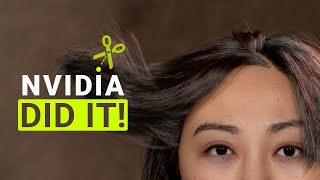
NVIDIA's new hair-physics simulation runs 120,000 hair points in real time, processing each frame in 17 milliseconds. Collision detection is the bottleneck, though some frames render in under a millisecond. The results match real-world measurements.
Questions this video answers
May 17, 2023.
Approximately 120,000 points (from thousands of hair strands).
17 milliseconds per frame.
Most of the time it runs in a couple of milliseconds, sometimes under 1 millisecond; execution time varies substantially depending on hair state.
$2.40 per hour for H100 instances.
Chapters
Dear fellow scholars, this is Two Minute Papers with Dr. Zsolnai. Dr. Papers. Today we are going to have a look at what is new in the physics of hair in virtual worlds. You see, this is a challenging problem where these virtual characters are given fur or other kinds of hair and we have to simulate their interactions via Coulomb friction. This is dry friction when two surfaces come into contact, which typically arises when we have lots of hair and, and thus lots of strand, strand interactions. And that happens a great deal whenever a wolf is jumping or running around. And when things start moving, these simulations can get very, very messy. This previous paper that we talked about earlier can resolve such conflicts and create beautiful realistic hair simulations. However, this class of algorithms typically takes forever to compute. They are typically not even close to real time. However, Nvidia has also done some research on this, and their algorithms typically run on your graphics card and are fast enough to be deployed in real video games and other virtual worlds. But wait, these cannot resolve scenes that are as detailed as the ones in the previous paper. With this, we have to resort to much simpler models and fewer hashtrands more. Many of which typically move together. To the best of my knowledge, they also haven't seen a lot of improvements over the last few years. So are we done? Is there no hope for quick and detailed hair simulations? Well, sometimes all it takes is just one person, one scientist. Yes, you are seeing correctly. This is a one author siggraph paper from Nvidia on this exact topic. So. So I am itching to look at it together and. Whoa. Now that is a next generation hair simulation right there. It looks like almost every single hair strand is simulated independently. My goodness. And as I am a light transport researcher by trade, I have to note that I love how the specular highlights are computed here. And what you see here is the favorite pastime of the computer graphics researcher. And here, now this time I hope it will not get as painful as with some of the previous papers. And yes, it looks like this character is getting away by just getting its hair cut. Very fun experiment indeed. And now comes the bombshell. These models have thousands of hair strands that are made up of 120,000 points. That is incredible. So now I feel that it's appropriate to pop the question. So it does all this how quickly exactly? Well, hold on to your papers, fellow scholars, because it does all this in 17 milliseconds. Yes, all this is happening in real time. And these are not some run of the mill simulations that we saw earlier? No sir, these are super detailed. And if we pop the hood and look at the internal workings of the algorithm. We see that that most of the time is spent with detecting and resolving these collisions and. Oh my goodness. Are you seeing what I am seeing? Oh, yes. Depending on the current state of the hair, there is substantial variation between the execution times of the algorithm. That is big trouble. Why? Well, because if we are in any kind of virtual world or we are playing a video game, we have to make sure that every individual picture is computed quickly and on time. If one moment we get 10 frames per second and the next moment we have 60, what we get is a jarring experience. So are we done? Is this not going to make it? Well, do not despair for a second because most of the time it runs so quickly, it only takes a couple of milliseconds. And look, sometimes not even a millisecond. So I think this one is going to do just fine and hopefully will be implemented in the video games of the future. What a time to be alive. But just one more quick question. Is this actually accurate? Well, let's have a closer look at these two lines. And there we have our answer. Now, I Hear you asking, Dr. Papers, why are you saying that there are two lines here? I only see one. And that is exactly the point. The simulated results are so close to reality that the measurements essentially overlap. And all that in real time. That is incredible. And now you can see that the papers that we discuss here are real. They get out there in the real world to be used in real products by millions of people. And sometimes all this comes from the ingenuity of one fellow scholar, one scientist is all it takes to change everything. Huge congratulations. If you're looking for inexpensive cloud GPUs for AI, Lambda now offers the best prices in the world for GPU cloud compute. No commitments or negotiation required. Just sign up and launch an instance and hold on to your papers. Because with Lambda GPU Cloud, you can now get on demand H100 instances for just $2.40 per hour. They are one of the first cloud providers to offer publicly available on demand H100 access. Did I mention they also offer persistent storage? So join researchers at organizations like Apple, MIT and Caltech in using Lambda Cloud instances. Workstations or servers, make sure to go to lambdalabs.compapers to sign up for one of their amazing GPU instances today. Thanks for watching and for your generous support and I'll see you next time.