Nvidias Just Revealed Stunning New AI Upgrades! (Nvidia Computex)
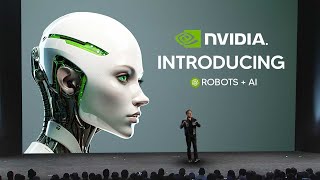
A YouTube explainer by LARRUZ (uploaded June 2, 2024) covering highlights from Nvidia's Computex 2024 keynote. Central announcements covered: Digital Twins and robotics advances (Omniverse/Isaac Sim, reinforcement learning in simulation, Jetson/Jetson Thor, HGX/GPU clusters), digital humans (Nvidia ACE microservices, Nemotron/LLMs, Riva speech, neural rendering in Omniverse RTX), robot factories and a Foxconn case study using Omniverse for factory planning and robot training, and a gaming assistant (Project G Assist) demoed in Ark: Survival Ascended that provides game-specific advice and system optimization guidance. The video emphasizes industry applications (customer service, healthcare, marketing, manufacturing, and gaming) and Nvidia's stack that connects simulation, edge devices, and data-center training.
Questions this video answers
LARRUZ
June 2, 2024
Chapters
So Nvidia CEO Jensen Huang recently did a keynote speech at Computex 2024, and it was genuinely fascinating to see all of the updates that Nvidia is going to be delivering over the years to come. Now, this video is going to show you guys only the key AI updates that you need to be aware of because they are rather important and also quite fascinating. So. So coming in at number one is of course, the Digital Twins and advancing the capabilities of robots in AI with a lot more developments that we're going to see in the future.
The era of robotics has arrived. One day, everything that moves will be autonomous. Researchers and companies around the world are developing robots powered by physical AI. Physical AIs are models that can understand instructions and autonomously perform complex tasks in the real world. Multimodal LLMs are breakthroughs that enable robots to learn, perceive and understand the world around them and plan how they'll act. And from human demonstration, robots can now learn the skills required to interact with the world using gross and fine motor skills. One of the integral technologies for advancing robotics is reinforcement learning. Just as LLMs need RLHF or reinforcement learning from human feedback to learn particular skills, generative physical AI can learn skills using reinforcement learning from physics feedback in a simulated world. These simulation environments are where robots learn to make decisions by performing actions in a virtual world that opens them where physical AIs can be created. Omniverse is a development by Technologies. In Omniverse, robots can learn how to be robots. They learn how to autonomously manipulate objects with precision precision such as grasping and handling objects, or navigate environments autonomously, finding optimal paths while avoiding obstacles and hazards. Learning in Omniverse minimizes the SIM to real gap and maximizes the transfer of learned behavior. Building robots with generative physical AI requires three computers. Nvidia AI supercomputers to train the models. Nvidia Jetson Orin and next generation Jetson Thor Robotics supercomputer to run the models and Nvidia Omniverse where robots can learn and refine their skills in simulated worlds. We build the platforms, acceleration libraries and AI models needed by developers and companies and allow them to use any or all of the stacks that suit them best. The next wave of AI is here. Robotics powered by physical AI will revolutionize industries.
So this recent demo did go ahead and show us that, you know, for the first part of this, you know, video that the robots in the Digital Twins that have been trained in the simulation really do speed up the time that we can get feedback in order to get these robots out into the physical world to be able to do tasks that are very, very effective. And we can see that these digital twins have been used. There was even a robot demo that I was looking at Yesterday where the GR1 robot, in fact the Unitree G1 robot, was actually showcasing it being trained in the digital twin. So it's basically, as you can see right here, the demonstrations in the simulation environment which we have in Nvidia's Digital Omniverse, you can see that the demonstration, the Isaac Sim in Omniverse Digital Twin. And then, of course, it's mapped onto the real robot, which is very, very effective. Now, some of the robots that you are seeing do have partnerships with Nvidia, and it seems that not only are there humanoid robots, but the entire robotics industry is taking this upgrade and is all getting evolved at the same time. Which means that, like we saw in the start, we could see this entire different evolution where not only humanoid robotics, but these kind of robots too, where we can see robots in surgery, robots, you know, autonomous robots. Just a huge different range of applications for these robots being used in our everyday lives. Now, another thing that was really, really fascinating from Nvidia's demo was of course, the Nvidia's digital humans. This was something that was, you know, caught me a little bit by surprise, but not too much because I predicted this in a video where I spoke about what one of the things that I thought about that was gonna come in AI for 2024. But this is digital humans. Slash AI agent avatars, or I guess, you know, however you want to describe it. I'll let Nvidia take it away and then I'll further describe exactly what's going on here.
Market, let's dive. Before I head out to the night market, let's dive into some exciting frontiers of digital humans.
Imagine a future where computers interact with us just like humans can.
Hi, my name is Sophie and I am a digital human brand ambassador for unique.
This is the incredible reality of digital humans. Digital humans will revolutionize industries from customer service to advertising and gaming. The possibilities for digital humans are endless. Endless.
Using the scans you took of your current kitchen with your phone, they will.
Be AI interior designers, helping generate beautiful photorealistic suggestions and sourcing the materials and furniture.
We have generated several design options for you to choose from.
They'll also be AI customer service agents, making the interaction more engaging and personalized. Or digital healthcare workers who will check on patients, providing time timely, personalized care.
I did forget to mention to the doctor that I am allergic to Penicillin. Is it still okay to take the medications? The antibiotics you've been prescribed, Ciprofloxacin and metronidazole don't contain penicillin, so it's perfectly safe for you to take them.
And they'll even be AI brand ambassadors setting the next marketing and advertising trends.
Hi, I'm Ima.
Japan's first virtual model.
New breakthroughs in generative AI and computer graphics let digital humans see, understand and interact with us in human like ways.
From what I can see, it looks like you're in some kind of recording or production setup.
The foundation of digital humans are AI models built on multilingual speech recognition and synthesis and LLMs that understand and generate conversation. The AIs connect to another generative AI to dynamically animate a lifelike 3D mesh of a face. And finally, AI models that reproduce lifelike appearance appearances, enabling real time path traced subsurface scattering to simulate the way light penetrates the skin, scatters and exits at various points, giving skin its soft and translucent appearance. Nvidia ACE is a suite of digital human technologies packaged as easy to deploy fully optimized microservices or NIMs. Developers can integrate ACE NIMs into their existing frameworks, engines and digital human experiences. Nemotron SLM and LLM NIMS to understand our intent and orchestrate other models. Riva Speech NIMS for interactive speech and translation, audio to face and gesture, NIMS for facial and body animation and Omniverse RTX with DLSS for neural rendering of skin and hair. ACE nims run on Nvidia gdn, a global network of Nvidia Excel accelerated infrastructure that delivers low latency digital human processing to over 100 regions.
So Nvidia's digital humans are going to be a very fascinating concept to deal with in the future as humans get more and more accustomed to dealing with AI in, I guess you could say, your everyday environment. I think that this is a perfect, perfect segue and a perfect demo within to what the future holds because there are a lot of interactions in which AI actually improves it. And I know that a lot of people might think that this is, I guess you could say, too hypey or too much AI integration. But trust me when I tell you that there are just some interactions that are just far better to have an AI guide you through in terms of just the overall experience because humans always do want to talk to another human being, but sometimes deciphering that kind of information is just much easier to do if you can talk to someone who is patient and who can explain things to you in a way that you may not previously have understood. And a lot of the times these AI systems will genuinely speak other languages fluently, meaning that the cross border barrier that many used to suffer from is no longer going to be an issue. So I think this is, you know, real progress across the bounds for all. I'm not entirely sure about how AI influencers are going to be perceived, as I've seen them do. Some of them do pretty well so far. But I do think that this entire digital human thing is truly the next step in AI. The next part that we do have to talk about is of course Nvidia's robot factories. And this one is so, so crazy. So take a look.
Demand for Nvidia accelerated computing is skyrocketing as the world modernizes traditional data centers into generative AI factories. Foxconn, the world's largest electronics manufacturer, is gearing up to meet this demand by building robotic factories with Nvidia Omniverse and AI. Factory planners use Omniverse to integrate facility and equipment data from leading industry applications like Siemens TeamCenter X and Autodesk Revit. In the Digital twin, they optimize floor layout and line configurations and locate optimal camera placements to monitor future operations. With Nvidia Metropolis powered Vision AI virtual integration saves planners on the enormous cost of physical change orders during construction. The Foxconn teams use the Digital Twin as the source of truth to communicate and validate accurate equipment layout. The Omniverse digital twin is also the robot gym where Foxconn developers train and test Nvidia Isaac AI applications for robotic perception and manipulation and Metropolis AI applications for sensor fusion. In OMniverse, Foxconn simulates two robot AIs before deploying runtimes to Jetson computers on the assembly line, they simulate Isaac manipulator libraries and AI models for automated optical inspection for object identification, defect detection and trajectory planning. To transfer HGX systems to the test pods, they simulate Isaac perceptor powered Farobot AMRs as they perceive and move about their environment with 3D mapping and reconstruction. With Omniverse, Foxconn builds their robotic factories that orchestrate robots running on Nvidia Isaac to build Nvidia AI supercomputers which in turn train Foxconn's robots.
Now that was not surprising to me at all. I know that Nvidia is truly, truly working hard on these robot factories with all of the Omniverse Digital Twin stuff that they are doing. But another thing that I did find completely interesting from this announcement was the gaming assistant that Nvidia did announce. So this one is pretty fascinating because we recently did see some kind of gaming assistant released by Microsoft recently. But here is Nvidia's new gaming assistant and I'll let them take it away and then I'll update you guys on my thoughts and theories.
A demo showcasing how developers can enhance games and apps with AI Assistant Many games offer vast universes and rich gameplay systems to explore, each with its own intricacies and mechanics. Depth has become the cornerstone of some of the most captivating gaming experiences. Whether it's a new player trying a game for the first time, overwhelmed by massive skill trees, or a seasoned veteran looking for that perfect weapon to min max that DPS build, many of us spend hours researching, scouring the Internet to learn to dig deeper and ultimately enjoy more of what the game has to offer. To show you what's possible, we've partnered with Studio Wildcard for Attack Demonstration using Ark Survival Ascended. The assistant is your conduit for game specific knowledge. You can ask it questions you often find yourself looking up online, like what's the best early game weapon and where do I find the crafting materials for it?
The best early game weapon is the spear. It provides knockback and is essential for survival.
Not only does it know about the game, it can understand what's happening on the screen. Maybe you're staring at a dinosaur you're not familiar with and you want to know what it is or how to tame it. And because the assistant is context aware, it can tailor its recommendations to your playthrough. Say you've racked up enough points to level up or to unlock a crafting recipe, but you're just not sure what to go for next. But gamers often need help outside the game too. The AI assistant that understands your system and can help tune and optimize it for you. It can provide insights into performance metrics like FPS and PC latency, for example, and chart these for you as you tweak your PC for more responsiveness. It can scan your system to see if there's anything out of order, like not taking full advantage of your display's capabilities. You can ask it for recommendations to increase performance or efficiency. It may suggest optimal graphics settings for your particular setup, or even overclocking or finding ways to consume less power while maintaining a target of 60fps.
For example, your system has been optimized for performance per watt with a minimum maintained frame rate of 60fps.
AI assistants will transform the way we engage with our favorite games and apps, and Project G Assist is a glimpse into that future.
So, yeah, I think this is kind of interesting because one increasing trend that we're currently seeing is that gaming AIs are increasingly getting, you know, some kind of, I guess you could say, merging with the current gaming landscape. I mean, these AI systems are going to be in there, it seems. And it seems that, you know, these AI systems are going to be acting as guides for players in these games in the future. And I wonder if this trend will continue, if they can actually pull this off, because certain gaming trends do really, really well, and other gaming trends just really don't do well at all. So it will be interesting to see how the AI evolution does impact gaming as well as the digital humans and, of course, this gaming assistant. But with that being said, what is your favorite announcement from Nvidia? There were some announcements regards to, you know, the kind of chips that they're going to be making. Nothing too crazy. But of course, Nvidia is right now one of the biggest companies in terms of AI development, because their architecture, their chips are needed to power the next big training runs. So with everything that Nvidia is doing, from the Omniverse to Isaac Sim to the Isaac Gym to their GPU clusters and whatever it is that they might be building. Hopefully you enjoyed this video and I'll see you in the next one. How is that 30 minutes?










