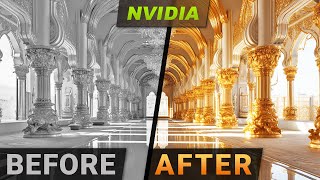
A short narrated YouTube transcript describing NVIDIA’s Neuralangelo, a phone-based photogrammetric neural surface reconstruction system that creates high-detail 3D geometry from video, and pairing it with Magic Avatar (text↔motion and motion↔video). The speaker emphasizes Neuralangelo’s ability to recover high-frequency detail without holes (notably on a ‘barn’ scene), and highlights applications: virtual worlds, game assets, avatar animation, and physics simulation. The tone is enthusiastic and optimistic about near-future possibilities.
Chapters
Finally, Nvidia's Neural Angelo paper is out. And this one is a different paper. We will talk about this one too. Now, Neural Angelo. This is Nvidia's photogrammetric neural surface reconstruction tool. What does that mean? It means that you can scan your environment with your phone camera and out comes 3D geometry that you can use to create a virtual world for video games. Or have a video conference that actually takes place place in this environment. Not just a 2D image, but actually being there. Unfortunately, this is almost impossible. Why is that? Well, with previous techniques, we can choose from two different problems. One, we get intricate details in the virtual version of the scene. But with that, we also get holes and other troubles. Or if the holes are not acceptable, because that is also fine. However, then the fine details are gone. Now, hold on to your papers, fellow scholars, and have a look at the new technique. Whoa. We can get all the high frequency details and no holes and no major issues appear in the results. That is fantastic. I did not expect the results to be this much better. Just one more paper down the line. Stunning results. The numerical comparisons here also reveal how much ahead of its time this technique is. Don't forget, these previous methods are from just one and two years ago. That is a huge improvement across the board, especially on the barn scene. Why is that? Presumably because here, the high frequency details in the trees and the roof were completely gone with the previous technique and with the new one, so much better. Now, all this pairs incredibly well with our second paper for today. Magic Avatar. Here we can perform text to motion and then motion to video. That is great. But wait a second. I hear you asking, Doctor, this is a video, not 3D geometry, so why showcase it here? Well, that is exactly the point. Now, if we use Neural Angelo on this video, we can have a real piece of 3D geometry in our virtual worlds. How cool is that? This way, we can spice up an otherwise ordinary Judo video and even play with these characters in a video game world. And the magic of Magic Avatar does not end there. You can really unleash your creativity by using Video two Motion. We get a little stick figure showing how the AI understood our motion. Hmm. Is that valuable? Oh, yes. Yes, it is. Now we can use this motion to create a completely new video with a new actor, but with our own motions. I have a feeling that with all of these amazing new AI papers, we are entering a world where anything to anything will be possible. We will be able to place ourselves in virtual worlds. And these virtual worlds can be highly detailed copies of the real world or we will be able to create new worlds from scratch, not just by text to image, but by text to geometry. And these AI based techniques can also learn to animate these characters, simulate how they can interact with new kinds of objects and furniture, and they can even learn how to simulate physics itself. This includes fluids, fire, smoke and all kinds of physics systems. And we will be able to meet in a virtual version of any place on planet Earth.
Wow.
I can only imagine what kind of world we'll be living in. Just two more papers down the line. I hope you are excited too. What a time to be alive.
This video has been supported by Weights and Biases. Check out their recent offering Fully Connected, a place where they bring machine learning practitioners together to share and discuss their ideas, learn from industry leaders and even collaborate on projects together. You see, I get messages from you fellow scholars telling me that you have been inspired by the series but don't really know where to start. And here it is. Fully Connected is a great way to learn about the fundamentals, how to reproduce experiments, get your papers accepted to a conference and more. Make sure to visit them through WNB Me papers or just click the link in the video description. Our thanks to WeightsAndBiases for their long standing support and for helping us make better videos for you.