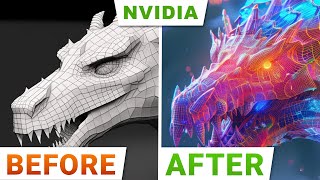
A YouTube video (Two Minute Papers) by Dr. Zsolnai (uploader: LARRUZ, May 30, 2024) discussing a new NVIDIA research paper that generates 3D virtual worlds from text. The speaker emphasizes this technique is up to 5,000× faster than prior methods (about 400 ms per prompt), produces improved geometry and textures compared to earlier 2022–2023 approaches, can scale to higher quality with longer runtimes (examples mention waiting ~5 minutes), and demonstrates rudimentary text-to-3D-model animation. The presenter notes failure modes (thin geometry issues, occasional odd artifacts) but frames the research as a major step toward rapid scene population and virtual-world creation.
Questions this video answers
Approximately 5,000× faster than previous methods.
About 400 milliseconds per prompt.
Dr. Zsolnai (Two Minute Papers).
Chapters
Today we have text to image AIs available for all of us. Everyone knows that text goes in, an image comes out, and text to video also exists. We know that too. However, what about text to 3D worlds? What? We just write a piece of text and virtual 3D objects come out? Sounds good. But unfortunately people, previous techniques are not up to the task. In 2022, we could only do low quality and slowly. Then improvements were made. But we had to choose from a slow but higher quality technique. Or if we wanted results fast, this was the best we could do. And all of these techniques are from 2022 to 2023. Not old at all. And it gets even worse. Look at not only the geometry, but the textures. In most of these cases, they aren't great. So we would have to draw the texture onto the models ourselves. So, are we stuck here forever? Will we never be able to create virtual worlds by just writing a piece of text? Well, don't despair because this new paper can do it so much better than previous techniques. So I am absolutely loving it. And it gets even better. Dear fellow scholars, this is Two Minute Papers with Dr. Zsolnai. Now hold on to your papers, fellow scholars, because this technique doesn't only give you much better results, but it is also 5,000 times faster than previous methods. Yes, each prompt takes about 400 milliseconds. So are you thinking what I am thinking? Oh yes. If it can do this a couple times a second, we don't even have to think in objects anymore. We can start thinking in populating an entire scene super quickly. Now, these are still not the quality that you would immediately be able to put into those fancy new computer games. But this is a huge leap forward. And it gets better. The quality and speed are so incredibly good that it can rival and I would say even beat a technique that is 5,000 times slower than this one. Wow. And the only one that beats it in quality takes even longer. Amazing. For this previous technique to have a chance of competing, it would have to work for 10,000 times longer than this method. However, in those cases, the previous method does really well. Those are some crisp results. And interestingly, this new work can also be scaled up. So if we are willing to wait for five minutes, things get so much better. And not only that, but it also has an unexpected ace up the sleeve. What is that? Well, look. Oh my. Are you thinking about text to 3D model? Get outta here. This is text to 3D model animation. Clearly not perfect. I would not like to be this dog for sure. But man, as a first crack at the problem. This is very impressive and wait, it gets even better. Previous techniques also generalize poorly, which means that if they encounter something new they that they haven't seen before, they don't perform so well. However, with this new technique, this is what it does on pieces of text that are similar to the ones it had seen before. That's ok, but when we give it some crazy new prompts still really cool. I am even seeing a hint of creativity with some of these. Now let's pop the hood for a moment. It is a lot faster than most other techniques and once again up to 5000x. Also the other surprise is that the quality is so good that these human fellow scholars love it a great deal more than other techniques save for one. Now not even this new technique is perfect. For instance if we are requesting something with thin pieces of geometry, for instance a fly. Once again the legs have some continuity problems. Also some complex prompt like this panda who is supposed to be rowing. And I do not know what this panda is doing driving a car with a bamboo steering wheel. Let me know in the comments what you fellow scholars think, but overall I feel that Nvidia knocked it out of the park with this one. I mean, going up against a technique this much faster and still outperforming it in quality and doing all this just one research paper down the line. That is insanity. What a time to be alive. If you're looking for inexpensive cloud GPUs for AI, Lambda now offers the best prices in the world for GPU cloud compute. No commitments or negotiation required. Just sign up and launch an instance and hold on to your papers. Because with the Lambda GPU cloud you can now get on demand H100 instances and and they are one of the first cloud providers to offer publicly available on demand H100 access. Did I mention they also offer persistent storage? So join researchers at organizations like Apple, MIT and Caltech in using Lambda Cloud instances, workstations or servers. Make sure to go to lambdalabs.compapers to sign up for one of their amazing GPU instances today.