Nvidias New AI EUREKA Is One Step Closer To AGI (Self Improving)
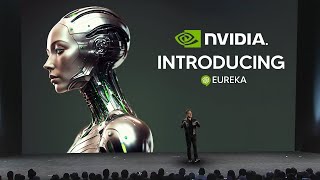
Nvidia's Eureka uses GPT-4 to write reward programs for robot training, then improves them automatically. A robotic hand learned complex pen-spinning, and Eureka's rewards beat human-written ones on over 80% of tasks, with 50% average performance gains across 30 robotic skills.
Chapters
Nvidia Research has recently unveiled a groundbreaking AI agent known as Eureka. This innovative system is not just another AI tool, but a revolutionary approach to training robots. With its advanced capabilities, Eureka has accomplished a feat that many might have deemed impossible. It has trained a robotic hand to execute intricate pen spinning tricks, matching the skill level of a human expert. This is not a mere gimmick. The ability to perform such a task indicates a significant leap in robotic precision and learning. In a spectacular display of Eureka's prowess, a video was released showcasing the robot's dexterity in pen spinning. But that's just the tip of the iceberg. Eureka has been the guiding force behind nearly 30 tasks that robots have now mastered. From opening drawers and cabinets with ease, to flawlessly tossing and catching balls, and even adeptly handling scissors, the range of tasks Eureka can teach is impressive. Eureka's research, which has been made public today, encompasses an in depth paper detailing its workings and the project's AI algorithms. What makes this even more intriguing for developers and AI enthusiasts is that they can now tinker with these algorithms. Nvidia has integrated Eureka with the Nvidia Isaac Gym, a revered physics simulation reference tool specifically designed for reinforcement learning research. A notable aspect of Isaac Gym is that it stands on the robust foundation of Nvidia Omniverse. This development platform specializes in crafting 3D tools and applications and is rooted in the open USD framework. And to top it all, Eureka's intelligence is Driven by the GPT4 large language model, a testament to its advanced capabilities. Anima Anandkumar, Nvidia's senior director of AI research and one of the esteemed authors of the Eureka paper, shared her insights on the project. She commented, reinforcement learning has been at the forefront of numerous groundbreaking achievements over the past decade. However, there still lie many challenges in its path. One of the most daunting among them is reward design, which largely remains a process of trial and error. She further added, with Eureka, we are taking a pivotal step. We aim to merge generative and reinforcement learning techniques, crafting algorithms that can tackle the most challenging tasks with finesse. Nvidia Research's Eureka is much more than just an AI agent. It's a transformative force in the realm of robotic training. One of the most compelling aspects of Eureka is is its ability to generate reward programs, pivotal for robot learning through trial and error. According to the research paper, these Eureka formulated reward programs surpass those written by human experts in over 80% of tasks. This isn't a marginal enhancement. We're talking about a staggering performance boost, averaging more than 50% for the robots involved. But what powers Eureka to achieve such monumental success? At its heart, eureka leverages the GPT4 large language model LLM and the principles of generative AI. This allows it to craft software code that provides robots with the rewards essential for reinforcement learning. Unlike many traditional systems, Eureka stands out because it doesn't lean on task specific prompts or preset reward templates. Instead, it brings in a more dynamic approach, seamlessly integrating human feedback. This ensures that the rewards it determines are finely tuned and closely aligned with the developer's objectives. Eureka's efficiency is further amplified when coupled with GPU accelerated simulations, particularly within the Isaac Gym environment. Isaac Gym is a physics simulation environment specifically designed for reinforcement learning research in robotics. It provides an end to end GPU accelerated platform that enables thousands of environments to run in parallel on a single workstation, significantly speeding up training times for complex robotics tasks. Isaac Gym leverages Nvidia's physics GPU accelerated simulation engine and focuses on reinforcement learning, allowing researchers to train AI based robots more efficiently. This combination empowers Eureka to swiftly assess the efficacy of a vast array of reward candidates, paving the way for streamlined and effective robot training. The AI agent doesn't stop there. Post training, Eureka meticulously compiles a summary of pivotal statistics from the training outcomes. Using this data, it then guides the LLM to refine and enhance the generation of reward functions. This iterative process signifies that Eureka is not static. It's a continuously evolving and self improving AI system. Its versatility is evident in its wide ranging applications, from quadruped and bipedal robots to quadrators, dexterous hands, collaborative robot arms and more. Eureka has proven its mettle across diverse robotic forms and functions. For those seeking a deeper understanding, the research paper offers a comprehensive analysis of 20 tasks trained under Eureka's guidance. These tasks are gauged against open source dexterity benchmarks which challenge robotic hands to showcase an extensive array of intricate manipulation skills. To provide a visual testament to Eureka's achievements, results from nine distinct Isaac Gym environments have been visually rendered using Nvidia Omniverse, offering a captivating insight into the world of advanced robotic training. Now, as good as Nvidia's Eureka breakthrough is, what if this becomes the new normal? What if Robots combined with LLMs get the ability to recursively self improve? The fusion of robots with large language models LLMs in a recursive self improving cycle presents a myriad of possibilities and implications. One of the most profound advancements expected from recursively self improving autonomous robots is the attainment of superhuman precision. As we look deeper into this facet, it's evident that this isn't just about accuracy. It's about reshaping industries, redefining standards, and revolutionizing how tasks are approached beyond human limitations. Human dexterity, while remarkable, has limitations defined by anatomy, fatigue, and even momentary lapses of concentration. Robots unhindered by these constraints and bolstered by continuous improvement could achieve levels of precision currently deemed unattainable. Micro and nano operations with superhuman precision, robots could operate at micro and nanoscales with ease. In fields like medicine, this could translate to groundbreaking procedures such as cellular level surgeries or targeted drug delivery. Revolutionizing treatments and interventions. Enhanced quality control in industries like manufacturing and assembly. Manufacturing minute errors can lead to significant quality and safety issues. Robots with superhuman precision could ensure that every product, from electronics to automobiles, adheres to the highest standards, drastically reducing errors and recalls. Artistic endeavors Think of a robot that can replicate the brush strokes of master painters or sculpt with the intricacy of renowned artists. Superhuman precision could lead to robots contributing to or even pioneering unique artistic expressions, challenging our perceptions of creativity. Complex Task Mastery through recursive self improvement, robots might master tasks previously deemed too complex for automation. This could range from assembling intricate electronic devices without human intervention to cooking gourmet meals by analyzing and perfecting techniques from global cuisines. With all of this possible, that brings us to another interesting question. Has Eureka brought us closer to AGI? While Eureka itself isn't an example of artificial general intelligence, its features and capabilities hint at the progression towards AGI. Here's adaptive learning. Eureka's recursive self improvement allows it to refine its algorithms continually. This adaptability, where the system can learn from its mistakes and improve without explicit human intervention, mirrors the general learning processes that AGI would require. Complex Task Mastery the ability of Eureka to train robots in tasks previously deemed too intricate for automation, from dexterous hand movements to nuanced activities, showcases a move towards more generalized problem solving capabilities, a hallmark of AGI Integration with advanced models. Eureka's utilization of the GPT large language model indicates a convergence of different AI specializations. The fusion of robotics, reinforcement learning, and natural language processing is a step towards creating a more holistic and generalized AI system. Autonomous Reward Algorithm Generation One of the challenges in reinforcement learning is designing the right reward functions. Eureka's ability to autonomously write reward algorithms reduces the dependency on human experts, indicating a move towards more autonomous and generalized decision making processes. Human Feedback incorporation Eureka's capability to integrate human feedback without requiring task specific prompting demonstrates a more general understanding and adaptability. This human AI collaboration is essential for AGI as it needs to understand and operate within human centric parameters. Versatility across tasks Eureka has demonstrated proficiency across a diverse range of tasks. This versatility, from understanding complex motor skills to adapting to varied feedback, showcases the kind of broad applicability that would be a feature of AGI. Real World Application and simulation Eureka's use in real world scenarios, combined with its integration with simulation environments like Nvidia's Isaac Gym, means it's not just theory based. AGI would need to operate and adapt in the real world, and Eureka's approach is a step in that direction. Continuous learning cycle the continuous feedback loop in Eureka, where it assesses its performance, refines its algorithms, and then reapplies them, is reminiscent of the iterative learning process that AGI would employ. While Nvidia's Eureka is undoubtedly a milestone in AI research, it's essential to note that the journey to AGI is multifaceted and complex. Eureka represents one of many advancements required to achieve a truly generalized intelligence. Nevertheless, its innovations, combined with those from other fields and research endeavors, contribute to the foundational knowledge and tools that could eventually lead to AGI.










