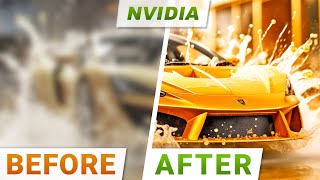
A narrated YouTube explainer (LARRUZ, Oct 29, 2023) describing NVIDIA research on neural-network-based texture compression for games and virtual worlds. The speaker contrasts photographic-quality textures (which are data-heavy) with a new neural compression method that preserves high detail (including MIP levels) while drastically reducing storage. Key reported results: decompression in ~1 millisecond, training/compression per texture under a minute, and up to ~45× less storage for similar visual quality; improvements are strong but not perfect at very low bitrates.
Questions this video answers
October 29, 2023
Approximately 1 millisecond
Less than a minute per texture
About 45× less data
Yes—different versions (MIP levels) of the same image are compressed together
Chapters
This paper can simulate really sophisticated virtual material models. Here, billions and billions of numbers describe the reflectance properties of these materials. But material properties are not the only thing that is important in a virtual world. Textures are important too. And with textures, I have good news and bad news for you. Good news, they look fantastic. So much so that you can take a photograph from the real world and add it to your video games. And bad news, they take a ton of data. Gigabytes and gigabytes of data. That is often too much for real time applications and handheld devices. And sometimes it is too much even for big honking machines and video games. But still, why? Well, you see, in a video game or virtual world, when we get closer to an object, we need to see more detail. Imagine going closer to an open book and suddenly a blurry mess emerges. What instead should happen is that we should be able to even read that book. So what does that require? Storing more detail means. Yes, you guessed it right, fellow scholars. That means storing even more data. So what is the solution? Well, if too much data is the problem, of course the solution is compression. Compression means making things smaller, more compact. We are in luck because these shiny neural networks are excellent at compression. We just saw how well they have done this job with the material models here. They are also excellent at compressing simulation data. So scientists at Nvidia said, let's do exactly that here too. And now hold on to your papers, fellow scholars. And look, this is the previous technique and this is the new one. For approximately the same amount of data storage, this can provide so much better quality. Wow, that is excellent. But wait, is it excellent enough for real time applications? I mean, how many seconds does it take to then decompress this and use it in our games? Dear fellow scholars, this is where I fell off the chair when reading this paper. It is not seconds, a thousand times less, just approximately one millisecond. That is all it takes to decompress all this information. And you are going to love this one. Do you see this flickering? This is the process of compression by the neural network. It means that it is at work. Now. The flickering arises as the technique is trying a lot of different but similar ways to compress it down. Ok, so is this good? Is it doing better over time or worse? Well look here. Here you see the signal to noise ratio. This is the quality of the reconstruction. The. The higher the better. And oh my, I love this. Over time, this is increasing steadily. And don't forget the decibel scale is logarithmic, which means a lot of things. But among those lot of things, it means that even a small numerical difference means a big difference in quality. So how long does this take? Days? Hours? Oh wait, we are done. The whole process took less than a minute per texture. That is excellent. So with that, if we have this beautiful inkwell in a video game with the previous technique, when going closer to it, we saw this and now we see this and all this in real time. That is incredible. Because of the papers, next level games and virtual worlds are coming. But wait. One more final question. This looks good, but what would be the proper real solution? How much information do we lose during this compression? And the answer is almost nothing. Wow. Note that this technique is specifically designed for storing textures. And thus it also includes compressing different versions of the same image together that we call MIP levels. And some more magic. And here is the bombshell result. The previous technique could do this and the new technique can do this. Whoa. That book is readable even if we magnify it a great deal. And my goodness, look at that. It looks nearly the same as the true solution and takes about 45 times less data. And do not worry for a second, a bunch of other techniques are also tested against in the paper. Now not even this one is perfect for very low bit rates when we are really short on storage and memory. Hmm, not so good. Still better than previous techniques, but not ideal. But that is an incredible jump in quality in just one paper. Loving it. What a time to be alive. We are sponsored by weights and biases, experiment tracking, model evaluation and production monitoring for your deep learning products and LLM apps. It is the the best. Everyone is using it. Try it out now at WNB Me Papers or click the link in the description below.